


















Custom candy bags look simple on a shelf. Behind them sits one of the most demanding specification problems in food packaging. Chocolate blooms when it gets warm. Gummies stick together inside a film that runs too hot. Hard candy goes tacky in a bag that lets moisture in.
And a candy program almost never ships in one format: the same launch usually needs a pouch, a flow-wrapped piece, a carton for gifting and a display for the checkout.
This guide walks through the decisions a confectionery brand has to make before asking for quotes: which bag or pouch suits which product, what the film has to protect against, how to keep seals clean, how to plan seasonal packs, and when a carton or rigid box is the better buy. If you already know you want help with the whole program, start with Armour Rose’s custom candy packaging options.
Quick Answer: Which Candy Bag or Pouch Should You Choose?
Choose a resealable stand-up pouch for gummies and multi-serve candy, a flat-bottom pouch for premium shelf presence, a pillow bag for high-volume lines and inner packs, and flow wrap for single pieces. Choose a folding carton, sleeve or rigid box when the product is a gift, an assortment or premium chocolate.
Why Candy Is Hard to Package
Confectionery is chemically more demanding than most dry snacks, and each type of candy attacks the package differently.
Chocolate. Cocoa butter reacts to oxygen and light and slowly goes rancid. Heat is the bigger day-to-day enemy: when chocolate warms and cools, fat moves to the surface and leaves a dull gray or white film called fat bloom.
Research on filled chocolate bars published in Food Science & Nutrition found that quality held best at cool storage temperatures and declined at room temperature, mainly in meltdown and off-flavors. A package cannot fix a warm warehouse, but it can limit oxygen and light exposure and help the product survive distribution.
Gummies. Gummies carry surface moisture and are often coated with oil or starch. If the film or the sealing jaws run too warm, pieces can stick together into a single mass, which the industry calls blocking. Moisture also has to be controlled in both directions: gummies should not dry out or pick up moisture.
Hard candy. Hard candy pulls moisture from the air. In a bag with a weak moisture barrier it turns tacky and pieces fuse together, especially in humid regions or summer distribution.
Mixed assortments. Assortments and seasonal mixes combine chocolate, gummies and hard candy in one pack, so the film has to meet the strictest need in the mix.
Sugar dust and fat at the seal. Fine sugar powder, sanding sugar, cocoa fat and oil reach the seal area during filling. Once they sit between two film layers, the seal can look perfect and still leak.
None of this shows up when you compare quotes on price. It shows up weeks later as a returned pallet, which is why the specification has to start with the product, not the bag.
Candy Bag and Pouch Formats Compared
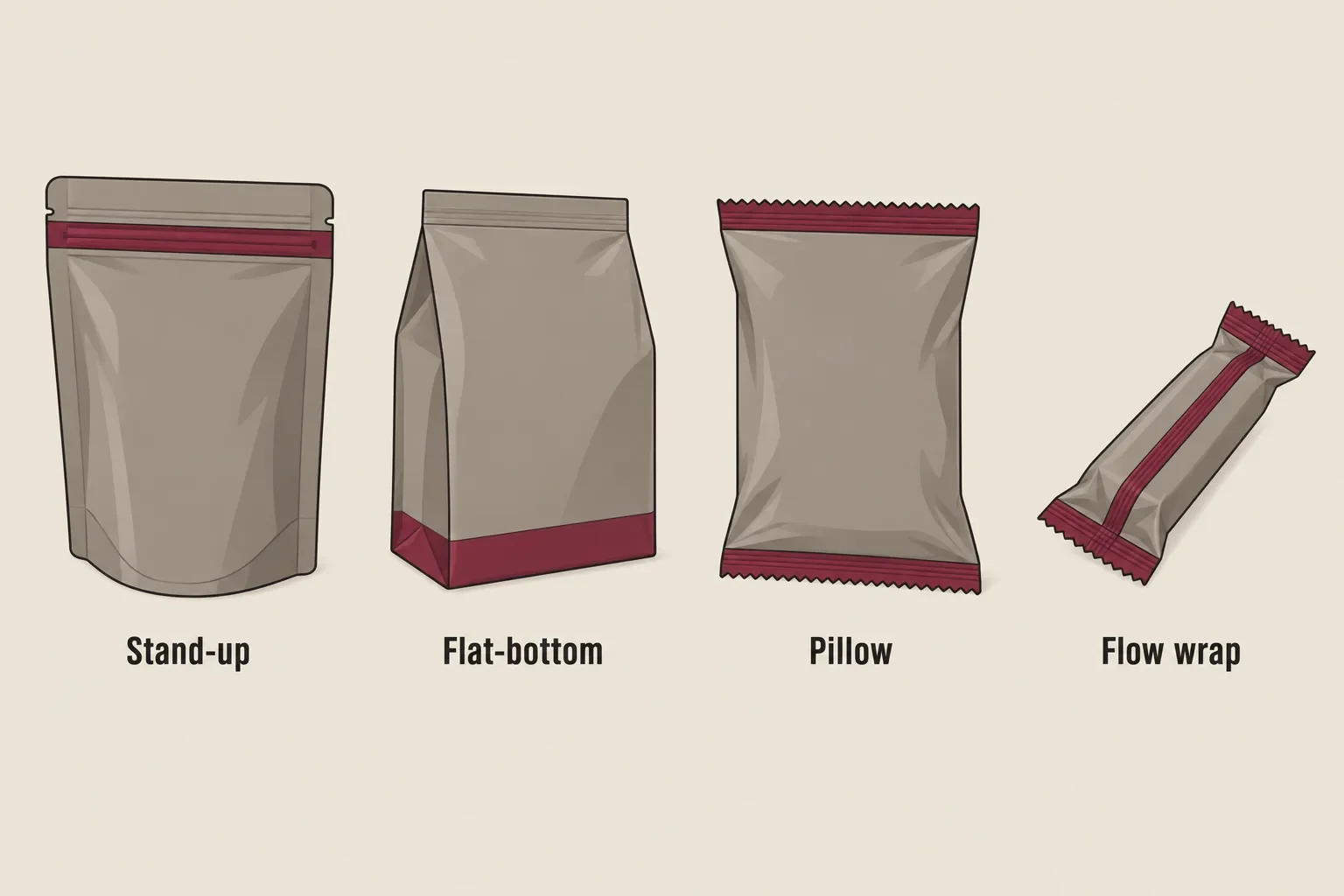
The table below compares the flexible formats most candy programs use. For a full, product-neutral comparison of the two upright formats, see the guide to flat-bottom bags vs stand-up pouches.
| Stand-up pouch | Flat-bottom pouch | Pillow (lay-flat) bag | Flow wrap | |
|---|---|---|---|---|
| How it’s built | Front and back panels with a folded bottom gusset | Box-like flat base with side panels | Flat bag sealed on the edges, usually formed from roll stock | Film wrapped around a single piece with a long seal and two end seals |
| Best candy fit | Gummies, multi-serve candy, sharing bags | Premium confectionery, gift-style bags | High-volume lines, peg bags, inner packs | Individually wrapped pieces, bars, single servings |
| Shelf presence | Stands upright with a wide front panel | Strongest: stands like a box, more print panels | Lies flat; hangs on a peg or sits in a tray | Sold in multipacks, cartons or displays |
| Resealing | Zipper is common | Zipper or slider available | Usually single use | Single use |
| Filling | Easy to hand fill; works on many semi-automatic fillers | Easy to hand fill; wide opening | Vertical form-fill-seal lines | Horizontal flow wrappers |
| Main cost drivers | Usually the most economical upright format | More material and converting steps | Lowest material use, needs a packaging line | Film only, but needs a wrapper |
Armour Rose sources stand-up pouches, flat-bottom pouches, pillow pouches and flow wrap film, so the recommendation can follow the product and the retailer rather than one production line.
Matching the format to the product
- Gummies and soft candy: a resealable stand-up pouch is the usual choice. Customers snack from it over several days, and the zipper protects the product between servings.
- Premium chocolate pieces and truffles: a flat-bottom pouch or a carton. The squared shape and extra panels support a higher price point.
- High-volume hard candy and mints: pillow bags run fast on vertical lines and suit peg displays and inner packs.
- Single pieces and bars: flow wrap, often packed into a carton or a counter display.
- Seasonal and party bags: stand-up or pillow bags, depending on the pack weight and whether the bag is opened in one go.
Film Barrier by Confection Type

Most candy bags are laminates: two or more film layers bonded together. The outer layer carries the print, middle layers provide the barrier, and the inner layer seals. Metallized and foil structures solve different halves of the confectionery problem, so the product should choose the film, not the catalog.
| Confection | Main threat | What the film needs | Typical structure direction |
|---|---|---|---|
| Chocolate and chocolate-coated | Oxygen, light, heat | Strong oxygen barrier and light blocking | Metallized or foil laminate |
| Gummies and jellies | Moisture loss or gain, blocking | Moisture control in both directions; a sealant that tolerates tacky surfaces | High-barrier laminate chosen for moisture |
| Hard candy and mints | Moisture pickup | Tight moisture barrier | High moisture-barrier film |
| Mixed assortments | All of the above | Meet the strictest requirement in the mix | Usually metallized or foil |
| Short shelf-life or fresh confection | Handling and presentation | Clarity and basic protection | Clear films, sometimes with a window |
Three points brands often miss:
- Windows cost protection. A clear window lets shoppers see the candy but reduces light protection, which matters for chocolate. Keep windows for products that tolerate light, or limit their size.
- Barrier is measured, not described. Ask suppliers for barrier data, not just “high barrier”. The key measure for oxygen is oxygen transmission rate (OTR), explained in Armour Rose’s guide to oxygen transmission rate packaging.
- Shelf life is a system. Film, seals, closures, storage temperature and distribution time all work together. Specify from your shelf-life target and your distribution route, not from a house film.
Seal Integrity: Sugar Dust, Cocoa Fat and Tacky Surfaces
Barrier gets most of the attention, but the seal causes most of the failures. Sugar dust and cocoa fat reach the seal area during filling and create narrow channel leaks: tiny paths through the seal that look sealed and then let oxygen and moisture in over weeks.
What controls seal integrity:
- Sealant choice. The inner layer of the film has to seal through a contaminated area, not a clean one. Some sealants tolerate sugar dust and fat far better than others.
- Jaw temperature, pressure and dwell time. A film that seals well at low speed can smear or leak at production speed, because dwell time shrinks as the line runs faster.
- Product handling. Dust control at the filler, product temperature and how pieces drop into the bag all affect what ends up in the seal area.
What to send for machine fit
Two films with the same barrier claim can behave completely differently on a wrapper or form-fill-seal line. Before a plant quotes, share:
- Web width, to match the forming shoulder.
- Core diameter and unwind direction, to match the unwind mandrel.
- Repeat or cut-off length, so print stays in register and the tail of the roll is not scrapped.
- Sealing temperature range your jaws can hold at line speed.
- Line speed, and whether filling happens at your plant or at a co-manufacturer with its own requirements.
If you have already seen seals fail, Armour Rose’s guide to pouch seal failure causes walks through the usual causes and fixes.
Closures and Features That Matter for Candy
Features that protect the candy
- Press-to-close zipper. Essential for gummies and multi-serve bags opened over several days. Armour Rose’s resealable zipper pouches page covers closure options.
- Tear notch. Lets customers open the bag cleanly above the zipper instead of tearing the pouch.
- Seal width and placement. Wider, well-placed seals give more margin when sugar dust is present.
Features that help the sale
- Hang hole. Candy sells heavily on pegs and clip strips. A hang hole needs enough film strength for the pack weight, or it tears on the shelf.
- Window. Shows the product and works well for colorful gummies and hard candy. Use with care on chocolate.
- Finishes. Matte, soft-touch and spot gloss shape the brand. They do not change protection.
Decide on the features that protect the product first, then add presentation features within the budget left.
Single Pieces and Bars: Flow Wrap and Roll Stock
Individually wrapped pieces, mini bars and single servings usually run on a horizontal flow wrapper: a machine that wraps film around each piece and seals it. The film arrives as roll stock, printed film on a roll. Flow wrap keeps each piece fresh, supports portion control and lets brands pack mixed assortments in a carton or display.
What matters for candy pieces:
- Seal type. Heat seal is standard; cold seal (a pressure-activated coating) is common for chocolate because it avoids heating the product.
- Print registration. On small pieces, a small drift in registration is very visible. Repeat length has to match the cut-off.
- Machine fit. The same web width, core and sealing data apply as for pouches.
For bars specifically, including fin seals, cold seal and wrapper layout, see Armour Rose’s protein bar packaging page, which covers bar formats in depth. Roll stock for automated candy lines is covered on the roll stock film page.
When to Choose a Carton, Sleeve or Rigid Box Instead
A bag is not always the right package. Choose a paperboard or rigid format when presentation or protection matters more than the lowest unit cost.
Choose a folding carton when:
- You sell multipacks of wrapped pieces or bars.
- The product is a gift or a seasonal box that needs premium print.
- You need a carton that runs on an automatic cartoner, which needs consistent dimensions.
Armour Rose sources folding cartons, including cartons built for auto-cartoning lines. For board choice, the guide to SBS vs CUK vs CRB paperboard compares print quality, strength and price.
Choose a carton sleeve or wrap when:
- You want to add branding or seasonal graphics to an existing pack without reprinting the whole structure.
- You run promotional or limited flavors on a shared base pack.
See carton sleeves and wraps for options.
Choose a rigid or mailer box when:
- You sell premium chocolate gift boxes and seasonal assortments.
- You ship delicate confections online and need a right-sized box that protects them in transit.
Armour Rose’s rigid and mailer boxes page covers these formats.
Many brands use a mix: a pouch for everyday gummies, flow wrap for single pieces, a folding carton for gift packs and a rigid box for premium chocolate. That works well when the whole range is specified together.
Seasonal and Club-Store Candy Packs
Confectionery lives on four big seasons, and each one multiplies the number of packaging specifications without multiplying volume. A brand with a few year-round items can end up managing many more active specs once holiday variants, club packs and limited flavors are counted.
How to keep seasonal packs under control:
- Share one structural die and one film specification. Only the printed graphic changes, so tooling costs stay off the second run and approvals come down to artwork.
- Plan backwards from the retailer’s ship date. Plate and press scheduling for a fourth-quarter program is a summer conversation, and fall artwork decisions move earlier than most brands expect.
- Use digital print for small seasonal runs. It needs no plates, which suits many variants at lower volumes. The guide to digital printing vs rotogravure packaging explains the trade-off.
- Ask whether a make and hold program is available for your product. Producing to an annual quantity and releasing stock against demand smooths the minimums that make seasonal candy painful to buy.
Club-store packs. Club stores have their own expectations for case packs, pallets, labeling and displays. Armour Rose’s guide to Costco packaging requirements for suppliers shows how detailed those can get. Confirm the current vendor guide with your buyer before artwork is final.
Displays, Shelf-Ready Trays and Case Math
Candy is an impulse category, so the pack often has to work at the checkout or on a promotional display rather than on a standard shelf.
- Counter and PDQ displays. For single pieces and small packs at the till. See PDQ and counter displays.
- Floor and pallet displays. For larger promotions and seasonal events.
- Shelf-ready trays. Cases that open into a tray for faster stocking and a tidy shelf. See shelf-ready packaging and trays.
Decide the case count early. Case count drives the shipper size, the pallet pattern and freight cost. Deciding it after the carton die is cut is how brands end up shipping air.
The most common mismatch is a display or tray that does not fit the case the pouches ship in, because the film supplier and the corrugated supplier never spoke. Reconcile case, shipper and display counts before anything goes to plate.
Labels and Panel Space for Candy Packs
Candy packs carry a lot of required information on a small surface: the product name, net quantity, ingredients and allergens, nutrition information where it applies, and the name and address of the brand or distributor. Brands selling in both Canada and the US also have to plan for each market’s rules, including bilingual labeling in Canada.
What that means for the pack:
- Plan panels before artwork. A pillow bag or small flow-wrapped piece has very little flat space. Required text often moves to the back panel, a carton or an outer case.
- Keep text off seals and gussets. Small text printed across a seal, a zipper track or a gusset fold becomes hard to read.
- Use labels for flexibility. Stock or semi-custom pouches with a printed label can bridge small runs, test flavors and seasonal variants before you commit to fully printed film. Armour Rose’s guide to shrink sleeves vs pressure-sensitive labels compares the main label options.
This is packaging guidance, not regulatory advice. Confirm label content for each market with your regulatory adviser.
Sustainable Candy Packaging: What Can Be Specified
Sustainable candy packaging is a frequent request, and the honest answer depends on the format.
- Flexible film. The realistic option today is film containing a percentage of post-consumer recycled (PCR) content, where the structure and barrier requirement allow it. High-barrier needs, such as chocolate, limit what is possible.
- Paperboard and corrugated. The options are stronger: recycled content and FSC-certified board are available for folding cartons, sleeves and shipping cases.
- Claims. Any claim printed on the pack has to match the actual structure and be something you can document for a buyer or retailer.
If your range uses both pouches and cartons, moving more of the presentation into a recycled or certified board carton can be the most practical step, while keeping the barrier film where the product needs it.
Minimum Orders, Lead Times and Cost: What Drives Each
Every brand wants three numbers before ordering. All three depend on the specification, so it helps to know what moves them.
What drives the minimum order
- Print method. Digital print carries lower minimums and no plate cost, which suits many SKUs and seasonal variants. Conventional print costs more to set up and rewards volume.
- Number of designs. Each flavor, size and seasonal variant counts as a design.
- Format mix. Film, paperboard and corrugated each run on their own schedules and minimums. Stacked minimums across several suppliers are how brands overbuy.
What drives the lead time
- Artwork preparation and proof approval for every format.
- Plates or cylinders, if the print method needs them.
- Material sourcing for the specific film and board.
- Production scheduling, printing, laminating and converting.
- Carton and display production on their own schedules.
- Quality checks.
- Freight, customs brokerage and delivery.
Sequencing the whole program backwards from your production date, so every format arrives together, matters more than any single lead time. For a stage-by-stage breakdown, read the guide to how long custom packaging takes.
What drives the unit cost
- Film structure and barrier level.
- Pouch size, closures, windows and finishes.
- Print method, number of colors and number of designs.
- Order quantity, freight and duties.
Compare quotes on the delivered cost per sellable pack. A cheaper film that blocks gummies or blooms chocolate costs far more in returns.
A Candy Brand's Pre-Order Spec Checklist
Product
- Confection types: chocolate, gummies, hard candy, assortments
- Coatings: sugar, sanding, oil, starch
- Pack weights and number of SKUs, including seasonal variants
- Shelf-life target and distribution route (including summer and cross-border shipping)
Format
- Stand-up, flat-bottom, pillow, flow wrap, or a mix
- Cartons, sleeves or rigid boxes for gifting and multipacks
- Dimensions confirmed by a fill test with the actual product
Protection
- Barrier needs per confection type (oxygen, light, moisture)
- Sealant suited to sugar dust, fat or tacky surfaces
- Window: yes or no, and size
Line and filling
- Equipment type (hand fill, vertical, horizontal flow wrapper, cartoner) or co-manufacturer
- Web width, core diameter, unwind direction, repeat length
- Sealing temperature range and line speed
Retail
- Channels: grocery, convenience, club, online
- Displays, shelf-ready trays, clip strips or pegs
- Case count, shipper size and pallet pattern agreed
Planning
- Seasonal calendar and retailer ship dates
- Print method preference and artwork status
- Sustainability requirements and claim wording
- Delivery locations (plant, co-manufacturer, warehouse)
How Armour Rose Helps Candy Brands
Armour Rose is a custom packaging partner that manages sourcing and production through a vetted manufacturing network across Canada and the United States, so the recommendation follows the product and the retailer rather than what one press happens to run.
- Every confectionery format from one point of contact. Stand-up, flat-bottom and pillow pouches, resealable zipper pouches, roll stock and flow wrap film, folding cartons (including auto-cartoning ready cartons), carton sleeves and wraps, rigid and mailer boxes, corrugated shipping boxes, PDQ, counter, floor and pallet displays, shelf-ready trays and labels.
- One coordinated program. Formats consolidated with one point of contact, and case, shipper and display counts reconciled before anything goes to plate.
- Specifications built around your line. Web width, core diameter, repeat length and sealing window written into the specification before a plant quotes.
- A vetted manufacturing network. Armour Rose can qualify an alternate manufacturer for a format, with your final approval as a checkpoint, so a booked press does not have to stop the job.
- Safety stock on select products. For certain products, with some manufacturing partners, stock can be held and released against demand.
- Cross-border supply. Logistics and customs brokerage across Canada and the United States.
The A-R-G Process (Ask First, Resolve Second, Grow Third) runs in three steps: a packaging review of what you buy today and where it breaks, specification and sourcing through vetted manufacturers with options rather than a single number, and production and delivery managed through to your door. Explore Armour Rose’s custom candy packaging options.
Related readingProtein Bar WrappersRead the guide →
Frequently asked questions
What is the best packaging for gummies?
For most gummy brands, a resealable stand-up pouch with a film chosen for moisture control is the best starting point. The sealant has to tolerate a slightly tacky, sugary surface, and the line must not run so warm that pieces block together.
What packaging does chocolate need?
Chocolate needs protection from oxygen, light and heat, so it usually calls for a metallized or foil structure with strong light blocking. Packaging cannot replace cool storage, so plan distribution conditions as well as the film.
Why does chocolate turn white in the package?
That is usually fat bloom: fat moving to the surface after the chocolate warms and cools. It is mainly a storage and temperature issue. A good film limits oxygen and light, but cool, stable storage is what prevents bloom.
Why are my gummies sticking together in the bag?
That is called blocking. Common causes are surface moisture, film or sealing jaws running too warm, or a film that lets moisture move in or out. Review the film, the sealant and the line temperature together.
Can I use the same bag for chocolate and gummies?
Often not. Chocolate and gummies need close to opposite things from a film, so one house film rarely suits both. Assortments need a film that meets the strictest requirement in the mix.
What is the difference between a stand-up pouch and a pillow bag for candy?
A stand-up pouch has a bottom gusset so it stands on the shelf and usually reseals. A pillow bag lies flat, runs fast on vertical packaging lines and suits pegs, inner packs and bags opened in one go.
Do candy bags need a zipper?
Multi-serve gummy and candy bags usually benefit from one, because customers eat from them over several days. Single-serve bags and inner packs inside a carton usually do not.
When should I use a carton instead of a bag?
Use a folding carton for multipacks, gifting and seasonal boxes, and a rigid box for premium chocolate gift sets. Many brands combine a flow-wrapped piece with a carton for presentation.
How far ahead should we plan Halloween and holiday candy packaging?
Earlier than most brands expect. Plate and press scheduling for a fourth-quarter program is usually a summer conversation. Plan backwards from the retailer’s ship date and share one die and film specification across variants so approvals come down to artwork.
Are there sustainable options for candy packaging?
On flexible film, the realistic option is usually film with some post-consumer recycled content where the barrier allows it. Paperboard and corrugated offer stronger options, including recycled content and FSC-certified board. Only print claims you can document.
Can you supply film that runs on our existing flow wrapper?
Film can be specified for an existing wrapper if the specification includes web width, core diameter, unwind direction, repeat length and the sealing temperature range your jaws hold at line speed. Share those numbers, or your co-manufacturer’s, before quoting.
Get Your Candy Packaging Specified as One Program
Send your confection types, pack weights, filling equipment or co-manufacturer details, retail channels and seasonal calendar. Armour Rose will specify bags, pouches, cartons and displays as one program. Start with custom candy packaging or contact Armour Rose to share your current packaging.