


















SBS, CUK, and CRB are three common paperboard grades used for folding cartons. They differ in fibre source, surface, and typical performance, but grade alone does not determine how a carton will perform. Caliper, board construction, carton design, coatings, print requirements, product weight, and the co-packer’s equipment all matter.
This guide compares the three grades and explains what to confirm before you choose a board or compare supplier quotes.
SBS vs CUK vs CRB: Quick Comparison
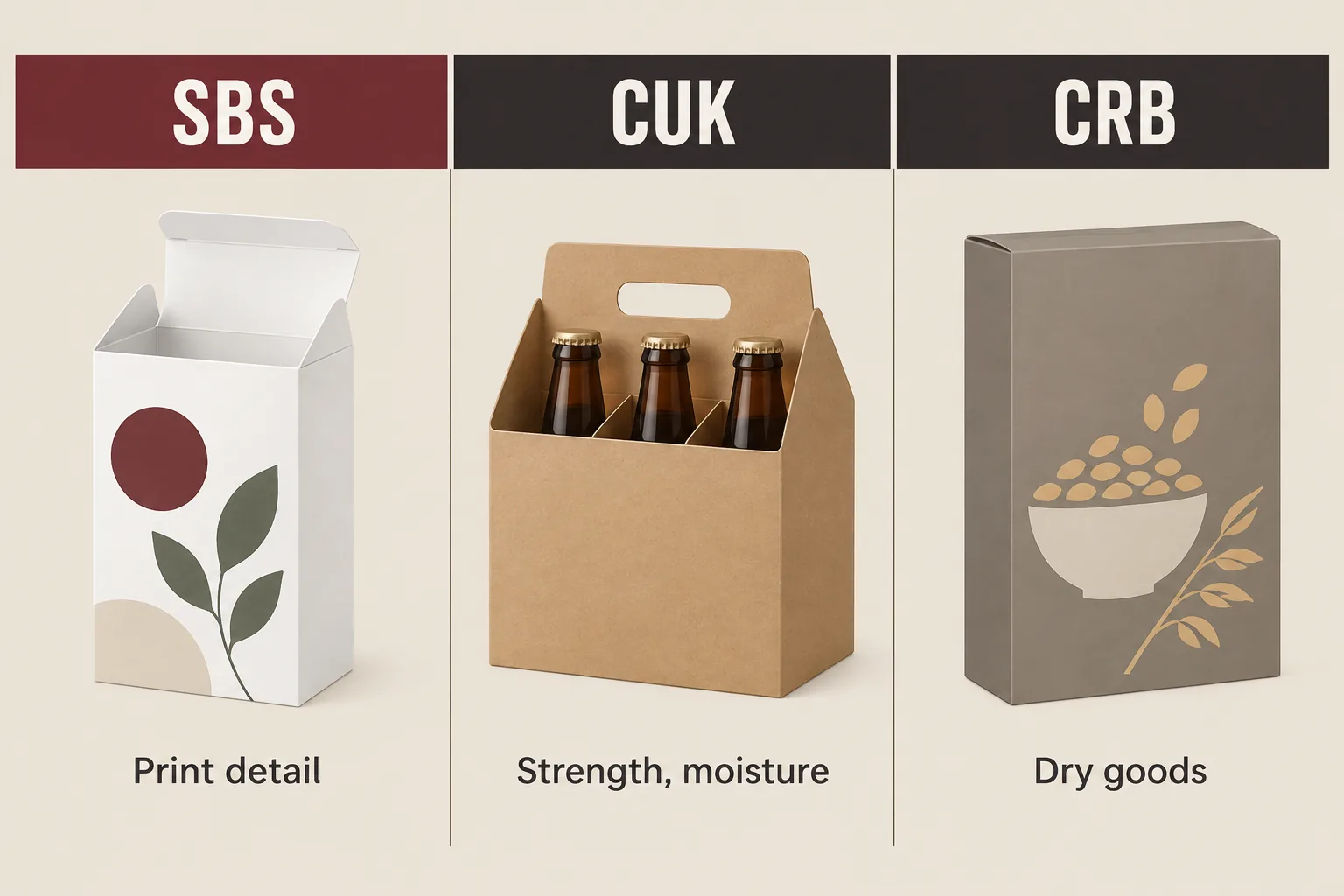
SBS (solid bleached sulfate) is made from bleached virgin fibre and is white through the sheet. It is often chosen for a bright print surface and detailed graphics. If food will touch the board, confirm the specific board, coating, intended food, and use conditions with the supplier; the grade name alone does not establish food-contact suitability.
CUK (coated unbleached kraft) is made with unbleached virgin kraft fibre and is often selected where tear strength or moisture resistance is important, including some beverage carriers. Its appearance and performance depend on the specific board construction, coating, and caliper. Some versions have a white printing surface over a brown kraft base.
CRB (coated recycled board) is made primarily with recovered fibre and commonly has a coated printing surface over a recycled core. It may suit dry, lighter products protected by an inner bag or pouch. Compare the actual quote and required performance; CRB is not automatically the lowest-cost option for every order.
Start with product weight, contact conditions, moisture exposure, print needs, and cartoning equipment. Then compare complete specifications and quotes; there is no universal grade winner.
Paperboard basics: fibre, plies and coating
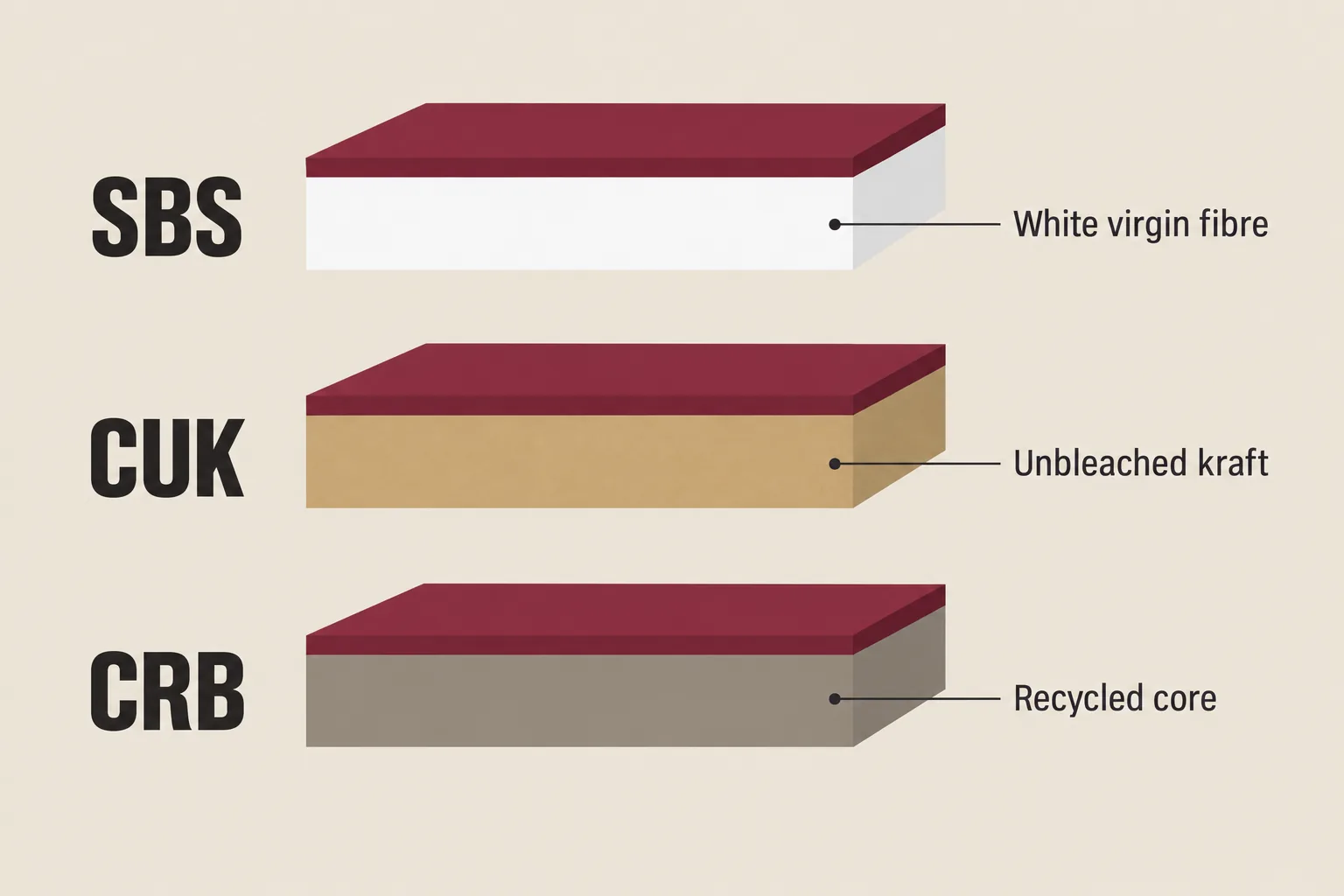
Folding-carton paperboard is a dense sheet that is cut, scored, printed, and folded into a carton. Its fibre furnish and layer structure vary by grade and mill. Corrugated board is a different material: it includes a fluted layer between liners and is commonly used for shipping cases, trays, and displays.
Fibre source and surface coating are two important differences between these grades. Caliper, construction, and carton design also affect performance.
Fibre source. SBS and CUK use virgin fibre; CRB uses recovered fibre. Fibre source influences board properties, but strength and stiffness also depend on the mill’s furnish, board construction, caliper, and converting. Do not use fibre type alone to predict how a finished carton will perform.
Coating. A clay coating can create a smoother printing surface. The number of coated sides and the coating type vary by board; confirm the construction with the supplier.
For food-contact decisions, ask whether food touches the board directly or is separated by a wrapper, liner, or other barrier. “Primary” and “secondary” describe packaging roles and do not, by themselves, confirm whether a material contacts food.
SBS paperboard: the premium print board
SBS uses bleached virgin fibre, so the sheet is white through its thickness. Recycled boards commonly have a different-coloured core or back, but appearance varies by grade and mill.
What that buys you:
- A bright, neutral print surface that can support detailed graphics and light colours; confirm the appearance with a production-representative proof.
- A smooth surface that may suit fine graphics and finishes such as foil, embossing, or spot gloss, subject to the selected board and converter’s process.
- A virgin-fibre option to discuss when food contact is being considered. Confirm the specific board and coating for the intended use; virgin fibre alone is not a compliance determination.
- A white inside surface may be available when the board is coated on both sides; confirm the requested finish with the supplier.
SBS is often priced above CRB, but actual pricing depends on board specification, quantity, market, and supplier. Compare the extra cost with the print, structural, and contact requirements it is meant to address.
Where SBS earns its cost
- Bar cartons where print quality or a specialty finish is central to the design.
- Supplement or personal-care cartons with detailed graphics or finishes, if the selected board meets the product requirements.
- Applications being considered for direct food contact, after the supplier confirms suitability for the specific use.
- Chilled or frozen distribution when the converter confirms the board and coating are suitable for the expected moisture exposure.
CUK paperboard: the strength grade
CUK is made from unbleached kraft fibre and is commonly selected for applications that need strength or moisture resistance. Actual tear, stiffness, and wet-strength performance varies by board grade, caliper, coating, carton design, and test conditions. Compare supplier specifications and test the carton in its intended environment.
Some brands use the natural brown surface as part of the design. White-top CUK can provide a light printing surface over a kraft base, but compare colour proofs with the proposed SBS option before deciding.
Where CUK earns its cost
- Some canned or bottled multipack carriers, where the selected construction is designed for the load and handling conditions.
- Cartons with heavier contents or repeated handling, after load and stacking requirements are checked.
- Distribution involving humidity or condensation, when the supplier verifies the selected board and coating for those conditions.
- Brands that want a visible kraft appearance.
CRB paperboard: the cost-efficient recycled grade
CRB is made primarily from recovered fibre and commonly has a coated printing surface over a recycled-fibre core. It is often considered for dry-goods cartons, but cost and suitability depend on the exact board, construction, print needs, quantity, and product conditions.
CRB may require a different caliper or carton design to meet a particular stiffness or load requirement. Do not assume the same caliper will perform equally across grades; compare the board data and the finished carton, then include any material or converting changes in the cost comparison.
Recycled content can be reported when the supplier can substantiate the specific content claim. Whether CRB is suitable depends on the carton’s performance and any food-contact requirements, not simply on whether the product is dry.
Where CRB earns its cost
- Dry, lighter goods protected by an inner bag or pouch, when the carton meets the required performance.
- Cereal, cracker, cookie, or granola cartons with an inner pack; see Armour Rose’s granola and cereal packaging options.
- Higher-volume runs where a quoted CRB specification meets performance requirements and offers a cost advantage.
- Cartons separated from the food by a suitable inner package, subject to any applicable requirements.
SBS vs CUK vs CRB: side by side
| Factor | SBS | CUK | CRB |
|---|---|---|---|
| Fibre source | Bleached virgin fibre | Unbleached virgin kraft fibre | Primarily recovered fibre |
| Appearance | White through the sheet | Kraft appearance; some grades have a white print surface | Coated print surface; core and back appearance vary |
| Strength and tear resistance | Check data for the specific grade and caliper | Often selected where strength matters; check grade data | Check data for the specific grade and caliper |
| Stiffness | Depends on board, caliper, and carton design | Depends on board, caliper, and carton design | Depends on board, caliper, and carton design |
| Moisture exposure | Confirm coating and performance for use conditions | Often considered for moisture-exposed packs; verify the grade | Confirm coating and performance for use conditions |
| Print surface | Bright white surface | Natural kraft or a white print surface | Coated print surface; verify appearance with a proof |
| Food contact | Confirm suitability for exact board and use | Confirm suitability for exact board and use | Confirm suitability; a barrier may be required |
| Typical relative cost | Often priced at a premium; confirm by quote | Varies by specification and supplier | Often considered as a lower-cost option; confirm by quote |
| Potential applications | Detailed graphics or finishes | Some beverage carriers or packs with strength needs | Some dry-goods cartons protected by an inner pack |
Potential mismatches include selecting a board without checking the product load or moisture exposure, and paying for print or finishing that the customer will not see. Confirm the actual carton design, shipping conditions, and use before making either choice.
Caliper, basis weight, and reading a board spec
Caliper is board thickness. In North America, it may be quoted in points: one point is 0.001 inch, so 18-point board is 0.018 inch thick. Other suppliers may quote thickness in microns. Confirm the unit on every quote.
Basis weight (also called grammage) is the mass of a given area of board. It may be shown in pounds per 1,000 square feet in North America or grams per square metre (g/m²). Caliper and basis weight describe different properties; neither alone tells you how a finished carton will perform.
Thickness is not a direct measure of strength or stiffness. Boards with the same caliper can behave differently because their construction and properties differ. Carton shape, dimensions, load, and stacking also affect how the finished pack performs.
A change in grade at the same caliper is not automatically a like-for-like substitution. Ask the supplier to compare relevant board data and confirm the finished carton through samples or trials before changing the specification.
A written carton specification should identify the board grade and supplier code, caliper, basis weight where relevant, coating, print and finish, carton style and dimensions, grain direction, order quantity, case pack, and pallet configuration. Add the product load and co-packer requirements so suppliers can price comparable options.
What to include in a folding-carton quote request
Send each supplier the same project details so the quotes are easier to compare:
- Product and inner pack: product weight, count, and the sample or dimensions of the item the carton will hold.
- Carton and board: style, internal dimensions, proposed grade or acceptable alternatives, caliper, basis weight if specified, coating, and grain direction.
- Print and finish: artwork requirements, colour count, print process if known, and requested coatings or special effects.
- Production: annual and order quantities by SKU, co-packer or cartoner details, case quantity, and pallet configuration.
- Commercial details: tooling and setup as separate line items where available, lead-time assumptions, delivery location, and any inventory-hold requirements.
Ask suppliers to identify any differences between the proposed specifications.
A low unit price is only comparable when the board, carton dimensions, print, quantities, and delivery scope are comparable.
For carton-style examples, see Armour Rose’s folding carton styles guide.
Print and finishing: how each board holds graphics
A coated print surface can support sharper graphics and more consistent colour than an uncoated surface. SBS and white-top CUK may suit artwork with photography or fine detail, but the result depends on the board, printing process, and converter. Review production-representative proofs before approval.
On a natural kraft surface, colours may appear warmer or less bright than on a white surface. A white underprint can change the result, but its availability and cost depend on the printer and process. Request a proof on the proposed board.
Print process selection depends on run length, SKU count, artwork, finish, and converter capabilities. Ask suppliers to price appropriate process options for the same board specification and quantity rather than assuming one process always fits a given volume.
Finishes such as varnish, foil, embossing, or spot UV need to be checked against the selected board and print process. Include the intended finish in the initial specification so suppliers can assess compatibility and cost.
Moisture, grease, and barrier coatings
Paperboard can lose stiffness when exposed to moisture, but the degree depends on the board, coating, carton design, and exposure. Describe likely humidity, condensation, grease, and temperature conditions when requesting a specification.
Grease from products such as popcorn, chips, or nut-based bars can stain or weaken an unprotected carton. Consider the inner package and any required barrier when assessing the finished pack.
Possible approaches include, depending on the exposure and supplier’s recommendation:
- Internal sizing, which may reduce liquid absorption in the board.
- Aqueous coatings, which may address some moisture or scuffing requirements.
- Extrusion coatings, which may be considered for specific liquid or grease resistance requirements.
- Laminated films, when the application requires a more substantial barrier.
Coatings and laminations can affect how a carton is handled by recycling systems. Do not assume a coating is recyclable or disruptive based on its name alone; confirm the finished package and local acceptance before making an environmental claim.
Food Contact: Check the Specific Board and Barrier
For food-contact decisions, establish whether food touches the board directly or is separated by a wrapper, liner, or barrier. The answer depends on the full material construction and intended conditions of use.
Do not assume that all recycled-fibre boards are unsuitable for food contact or that all virgin-fibre boards are automatically suitable. The supplier should confirm the specific board and components for the intended food and market; a liner or functional barrier may be needed for some applications.
In the United States, FDA requirements may apply to food-contact substances used in packaging. In Canada, consult Health Canada’s packaging materials guidance and confirm any applicable requirements for the product and sales market.
Ask which food-contact documents are available from the selected manufacturing partner for the specific board, coatings, food, and intended use. Do not treat a general grade description as a compliance statement. The FDA’s food-contact overview explains how packaging components can fall within food-contact rules.
Runnability: how board grade affects your cartoning line
Carton-line issues can arise from the interaction between board, carton design, and equipment. Confirm the proposed specification with the co-packer before committing to production.
Scoring and creasing. Score depth and crease design need to suit the board and carton layout. An unsuitable crease can cause poor folding or coating cracks. Ask the converter to confirm the score design for the selected grade and caliper.
Grain direction. Board behaves differently along and across the grain, which can affect folding and stiffness. The correct orientation depends on carton geometry, score lines, and load. Have the converter confirm grain direction on the dieline and check a sample.
Glue adhesion. Adhesion can vary with board surface, coating, varnish, and adhesive. Confirm the glue area and adhesive requirements with the converter or co-packer.
Automatic cartoning. Cartoner performance can depend on blank dimensions, caliper consistency, feeding, static, and line settings. Confirm the board and blank with the co-packer’s equipment rather than assuming results transfer between lines.
If a co-packer runs the product, confirm equipment limits before artwork and tooling are approved. That can help catch specification issues earlier, though the co-packer should confirm any trial, timing, or cost requirements.
Cost: unit price versus total cost
CRB is often positioned as a lower-cost option, with SBS often at a premium, but actual prices vary by specification, volume, supplier, and market. CUK’s relative price also depends on the quote. Compare equivalent finished-carton requirements.
The board price is only one part of the cost comparison. Other costs to consider include:
- Damage and rework. A carton failure can affect the product, labor, and replacement costs as well as the packaging.
- Line downtime. Feeding or glue issues can add labor and delay production; the impact depends on the line and run.
- Freight. Finished-case dimensions, pallet pattern, shipment weight, and freight terms can affect delivered cost.
- Minimum order quantities. A cheaper board with a high minimum can leave you holding inventory you will not use before the artwork changes.
- Obsolescence. Overbuying to reach a price break becomes a write-off the moment a claim, a nutrition panel, or a regulation changes.
A board with a higher unit price may still be economical if it meets the required performance with less material or reduces other project costs. Compare the full cost of the specified carton, including tooling, production, freight, waste, and inventory.
Sustainability and recyclability by grade
All three grades are fibre-based, but the finished carton’s acceptance depends on its coatings, laminations, other components, and the recycling programs available where it is sold. Check local guidance before describing a carton as recyclable.
CRB may support a recycled-content claim when the supplier documents the percentage and basis for that claim. Use forestry certification claims only when the relevant certification covers the specific material and supply chain. Coatings and laminations may affect local recycling acceptance. Canada’s Competition Bureau guidance on environmental claims explains why environmental claims need proper substantiation.
Lightweighting may reduce material use and shipping weight, but any caliper change should be validated against carton strength, product protection, and line performance.
Keep on-pack environmental claims specific and supported by current supplier documentation. Avoid broad claims such as “eco-friendly” unless they are appropriately qualified and substantiated.
Choosing by product category
Protein, breakfast, and nut bars. Multi-count cartons can carry prominent brand graphics. Compare board and coating options against product weight, any grease exposure, print needs, and the co-packer’s equipment. See Armour Rose’s protein and nutrition bar packaging.
Chips and popcorn. When an inner film bag protects the product, a carton may serve as an outer pack. Confirm the carton’s load, print, grease exposure, and cost requirements. See snack packaging options.
Cookies and brownies. If an inner pack separates the food from the carton, compare CRB with other grades based on carton strength, print needs, and quote, not on volume alone.
Granola and cereal. A sealed inner bag may separate dry product from the carton. Compare the board against the filled carton’s weight, case pack, and handling requirements.
Craft beverage multipacks. Load, handle design, and possible condensation make strength and moisture exposure important specification questions. CUK is one option to price, but confirm the specific board and carton design for the load.
Frozen and refrigerated products. Ask suppliers to evaluate expected condensation and temperature exposure alongside board grade and coating. Test the finished carton under representative conditions.
Retail-ready and display packaging. A program may pair folding cartons with corrugated trays, shelf-ready cases, or displays. Confirm how the retail pack and outer display fit together; Armour Rose also offers corrugated shipping boxes.
Five specification mistakes that cost money
1. Copying a competitor’s board spec without checking whether product weight, carton design, and distribution conditions match your own. 2. Choosing a grade before confirming equipment limits with the co-packer or cartoner operator. 3. Leaving grain direction unspecified when the carton design makes it important to folding or stiffness. 4. Paying for graphics or finishes the customer will not see without checking whether they serve another packaging or operational need. 5. Skipping a production trial when the supplier or co-packer recommends one. A print proof checks appearance; a line trial can help assess folding, gluing, and feeding on the actual equipment.
How to prepare a folding carton board specification
The sequence that avoids rework:
1. Define the product. Record weight, fill, count per carton, and relevant grease or moisture exposure. 2. Map the journey. Note storage, transit, retail conditions, and any chilled or frozen handling. 3. Confirm the equipment. Ask the co-packer about carton style, supported dimensions and calipers, line settings, and glue requirements. 4. Set print requirements. Identify artwork, colour, print process, and finishes before finalizing the board. 5. Compare board grades and calipers against the product, use, and equipment requirements; ask suppliers to explain their recommendations. 6. Validate the proposed carton. Review structural samples and print proofs; arrange a line trial if the co-packer or supplier says it is needed. 7. Document the agreed specification. Include board grade and code, caliper, basis weight where relevant, coating, dimensions, print and finish, grain direction, case pack, and pallet configuration.
Armour Rose’s custom folding carton service describes a process that considers the product, co-packer requirements, board, caliper, grain direction, print, and finish before quoting through manufacturing partners. Armour Rose’s sourcing and brokering service explains its broader supplier-coordination model.
Some food and beverage brands use cartons alongside printed film, pouches, corrugated trays, or displays. Armour Rose can source across packaging categories; confirm the scope, supplier documentation, and delivery milestones for each project in the proposal.
Armour Rose identifies February through April as a slower period for its business. Supplier lead times and plant capacity vary, so confirm current availability before planning a trial or specification change.
Frequently asked questions
Do SBS, CUK, and CRB cover every folding-carton board option?
Which paperboard is strongest?
Can recycled paperboard touch food directly?
What does the pt in 18pt board mean?
Is SBS always the better-looking carton?
Is CUK the same as corrugated cardboard?
Can I switch grades without retooling my cartoner?
Are all three grades recyclable?
Get the right board specified for your product
To compare SBS, CUK, or CRB for a real carton, gather the product weight, carton dimensions, co-packer requirements, quantity by SKU, print needs, and delivery location. Armour Rose’s discovery process can review these details and discuss specification options and pricing. Contact us to discuss a folding-carton project.