












Flexible films and pouches designed for freshness, durability, and shelf appeal.

Custom boxes and sleeves built for protection, display, and a premium presentation.

High-quality labels and shrink sleeves that elevate your product and ensure compliance.

Displays and trays designed to capture attention and boost conversions.

Food-safe containers and takeout bags built for freshness, durability, and on-the-go convenience.

Corrugated boxes are the workhorse of the packaging world and your number-one choice for safely delivering products to your customers.

Packaging designed to keep coffee fresh, protected, and shelf-ready.
Flexible packaging solutions that preserve aroma, freshness, and quality.
Durable, eye-catching packaging built for snack brands of every size.
Protective packaging that helps maintain crunch, freshness, and shelf appeal.
Custom packaging made to keep popcorn fresh, crisp, and ready to stand out.
Reliable packaging that protects texture, freshness, and product presentation.
Packaging solutions designed to protect baked goods and enhance presentation.
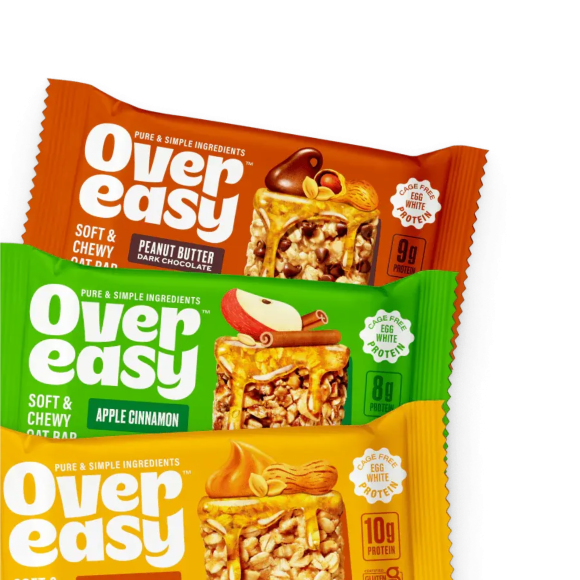
High-performance packaging for bars that need freshness, durability, and impact.
Vibrant packaging designed to protect and showcase confectionery products.
Secure, professional packaging built for supplements and wellness products.
Freshness-focused packaging for dried fruits, nuts, and healthy snacks.
Durable packaging designed to preserve crunch, freshness, and quality.
Protective packaging made for freshness, shelf life, and convenient storage.
Reliable packaging designed for pet food, treats, and specialty products.
Practical packaging solutions for prepared meals, kits, and convenience foods.
Functional packaging built for restaurants, takeout, delivery, and foodservice.
Premium packaging designed to protect products and strengthen brand presentation.

Specialized packaging solutions focused on protection, presentation, and compliance.
Confectionery is chemically demanding in ways most dry snacks are not. Cocoa butter picks up oxygen and light and turns rancid, then blooms into a grey film the moment the pack sees a warm truck. Gummies carry enough surface moisture to block into a single mass if the film runs too warm through the sealing jaws. Hard candy pulls moisture out of the air and goes tacky inside a pack with a weak moisture barrier. None of that shows up in a quote comparison. It shows up eight weeks later in a returned pallet, which is why we start with the product rather than the price.
Most growing candy brands end up buying film from a converter, cartons from a printer and displays from a corrugated house. Each holds its own artwork version, its own lead time and its own minimum. The brand becomes the project manager for a supply chain it never wanted to run.
Printed films and pouches, folding carton retail boxes, corrugated shipping cartons, PDQ and counter displays, and labels. Those categories make up the working majority of what we move for food and beverage brands, which means a candy program is a normal order for us rather than a special project.
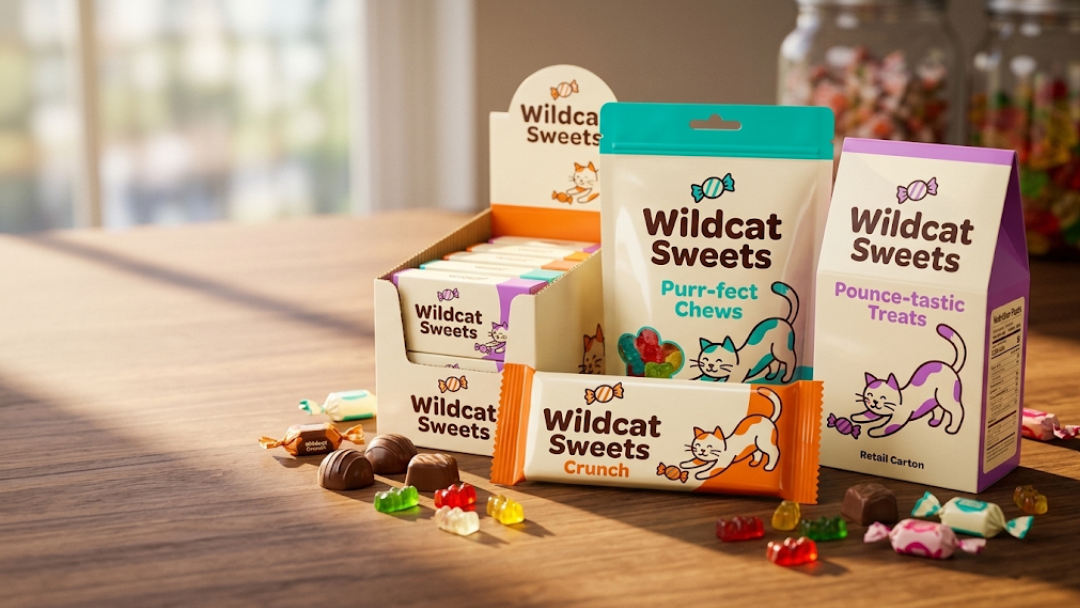
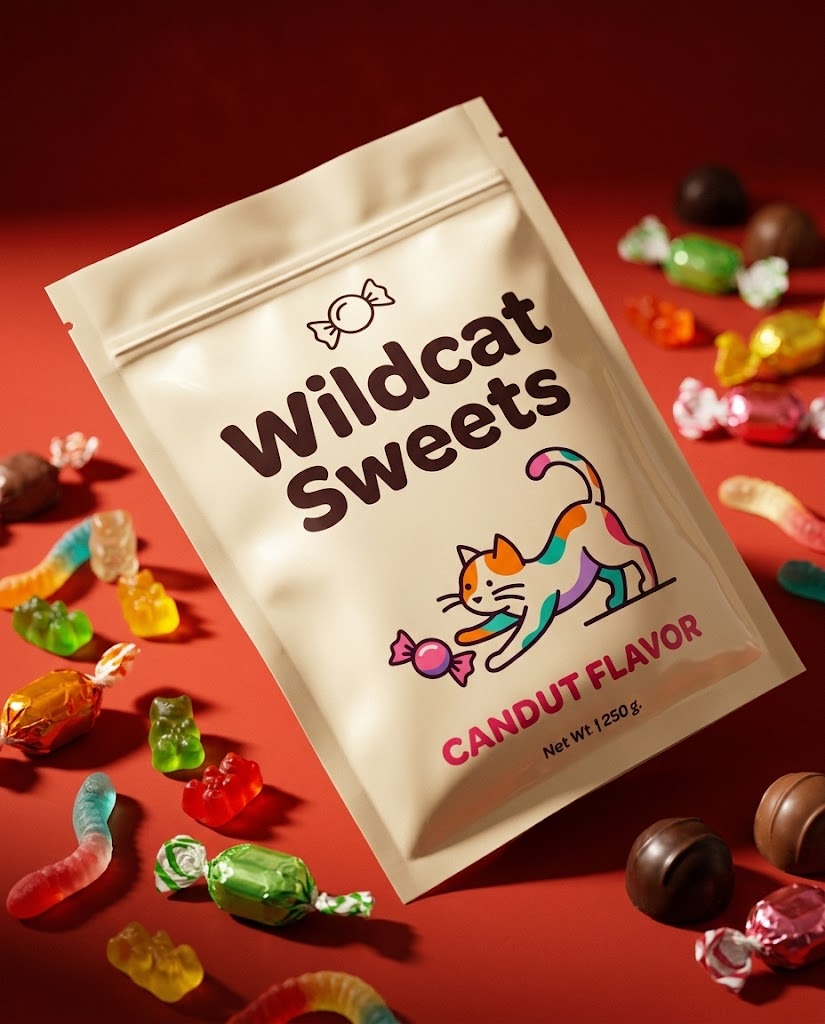
A custom candy packaging program spans single pieces, bars, bags and multipacks, and each one lands on different equipment. These are the formats a confectionery program usually draws on.
For gummies, candies and multipacks needing strong barrier protection, convenient handling and high-impact shelf presentation.
For premium confectionery requiring stable shelf presentation, dependable seals and multiple printable panels for branding.
For high-volume candy lines requiring efficient filling, reliable seals and lightweight flexible packaging.
For automated confectionery lines requiring film wound and slit to match your wrapper, seal profile and production speed.
For bars and individually wrapped pieces requiring dependable seals, smooth machine performance and quality printed film.
For gummies and multipacks needing convenient resealing, suitable barrier protection and dependable performance around pack weight.
For multipacks, gifting and seasonal confectionery requiring premium printed presentation and efficient retail packing.
For shipping candy and confectionery safely with dependable protection, stacking strength and efficient distribution handling.
For adding branding and product information to confectionery packs while supporting seasonal and promotional variations.
For automated confectionery lines requiring consistent carton dimensions, reliable feeding and efficient high-speed production.
For single pieces and smaller packs needing retailer-ready counter displays with strong visibility at the point of sale.
For larger confectionery promotions requiring durable branded displays, strong in-store visibility and store-ready placement.
For confectionery products needing faster stocking, organized shelf presentation and protection through distribution.
Two films can carry the same barrier claim and behave completely differently on a wrapper. Web width has to match the forming shoulder. Core diameter has to match the unwind mandrel. Repeat length has to match the cut-off, or every third pack drifts out of register and you scrap the tail of the roll. Sealing temperature has to sit inside the window your jaws can hold at line speed, because a film that seals beautifully at low speed will smear at production speed. We ask what equipment the run happens on, whether that is your plant or a co-manufacturer you already work with, and we write those numbers into the specification before a plant quotes it. That single question removes most of the reasons a first run fails.
Four decisions do most of the work on a confectionery pack. Get them right and the rest is artwork and scheduling. Get one wrong and it surfaces in a warm warehouse three months later.
Chocolate needs oxygen and light control to protect cocoa butter. Hard candy needs a tight moisture barrier in the other direction. Metallized and foil structures solve different halves of that problem, so the product decides, not the catalogue.
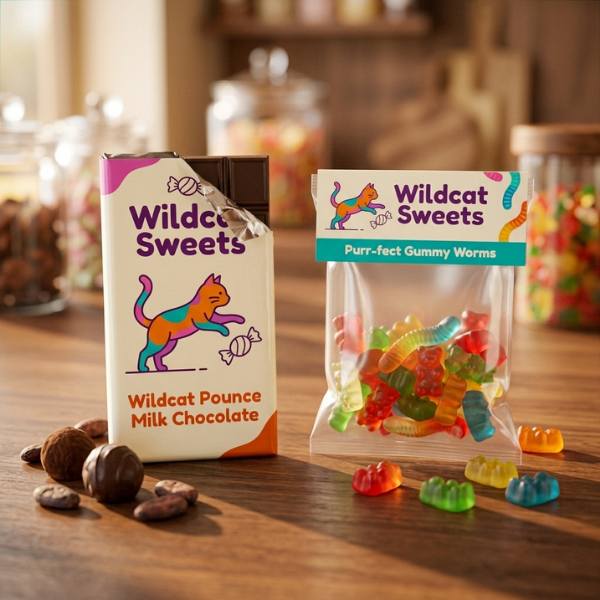
Sugar dust and cocoa fat contaminate a seal area and create channel leaks that pass a visual check and fail a shelf-life test. Film choice and jaw configuration have to account for what your product throws off during filling.
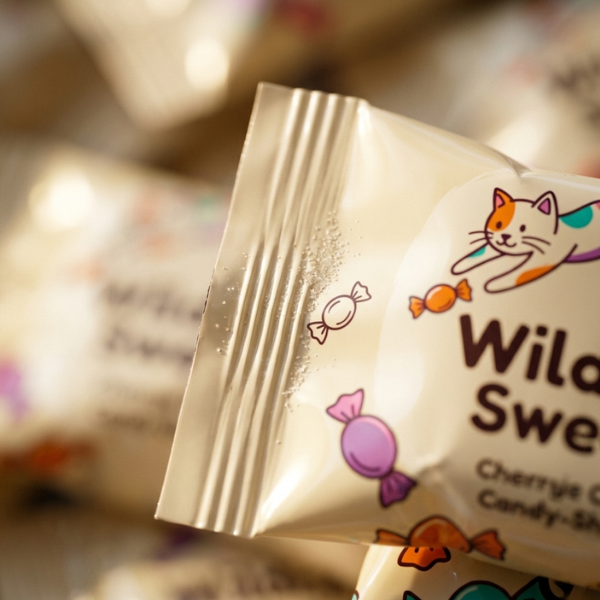
Candy is an impulse category, so the pack often has to work at the till rather than on a planogram. That changes the display format, the case count and sometimes the pack size itself.
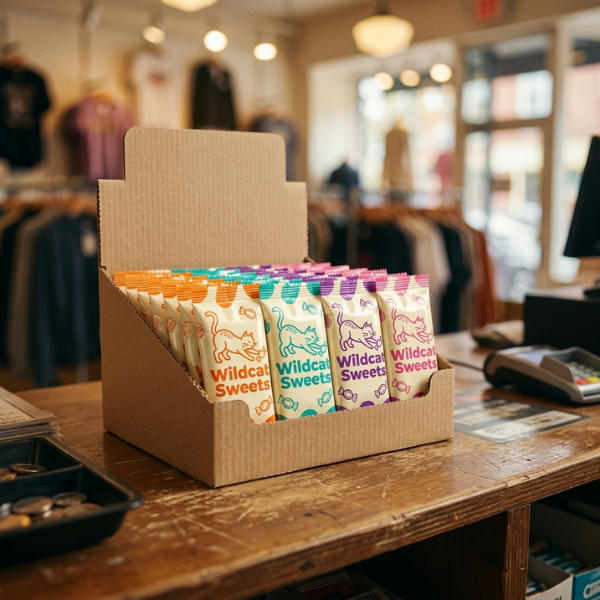
Case count drives shipper size, pallet pattern and freight cost. Deciding it after the carton die is cut is how brands end up shipping air across the border.
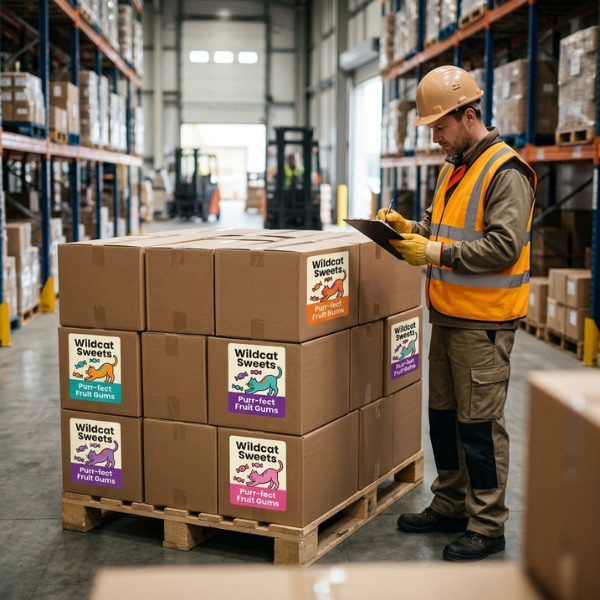
Our starting point for custom candy packaging is a review of what you buy today and where it breaks, not a product list. That review is usually where the cost sits.
We map current formats, purchase frequency, order quantities, delivery points and equipment or co-packer requirements, then flag the gaps in supply and specification.
We build the specification around your line and your retailer, then quote it through qualified plants and bring back pricing with options rather than a single take-it-or-leave-it number.
Once you approve, we manage the run, coordinate logistics and delivery including customs brokerage across the border, and can hold inventory against a release schedule.
We are a sourcing and brokerage partner for custom candy packaging and every format around it. We buy from our manufacturing partners and sell to you, which means our job is getting the specification and the vendor right rather than filling our own press.
We understand the business and the packaging requirement before proposing anything, so the solution covers where you are heading, not only this order.
Film, cartons, corrugated and displays consolidated instead of split across suppliers who each see one slice of your program.
Vendors are vetted before your job reaches them, and we hold more than one qualified option in the formats we supply most.
Produce to an annual quantity and release against demand, which smooths the minimums that make seasonal confection painful to buy.
Confectionery lives or dies on four seasons, and each one multiplies your SKU count without multiplying your volume. A brand with three year-round items can carry fifteen active packaging specifications once holiday variants, club packs and limited flavours are counted. The trap is treating each variant as a new project. Built properly, seasonal work shares one structural die and one film specification, and only the printed graphic changes. That keeps tooling costs off the second run and shortens the approval cycle to artwork alone. It also means the ordering decision moves earlier than most brands expect, because plate and press scheduling for a fourth-quarter program is a summer conversation. If your slowest quarter is the one you use to plan, we can build the calendar backwards from the retailer’s ship date.
Reliability that teams can measure.
As a small but growing brand, we struggled to find a packaging supplier who would take us seriously. AR not only welcomed us — they partnered with us. Their work with other startups showed in the quality of our packaging, and Daron went above and beyond, including helping our co-manufacturer optimize their equipment so our pouches came out perfect. We couldn’t ask for a more supportive, solution-focused partner.
ARG is the packaging partner we always needed. They cut through confusion, move fast, and operate like part of our internal team. Their expertise has streamlined our product development, and their above-and-beyond support — like Daron personally delivering samples to our co-manufacturer — is unmatched. We trust them completely.
Armour Rose Group believed in us when other suppliers didn’t. They treated us with the professionalism of a much larger brand and played a real role in helping us scale. Their team is collaborative, reliable, and always willing to solve problems together. Daron’s proactive support and genuine investment in our success stand out above anything we’ve experienced in packaging. Highly recommended.
From day one, the team has been a trusted partner. They provided clear guidance, cost-effective solutions under tight timelines, and the flexibility to scale with a startup. Communication is fast, pricing is transparent, and deliveries are consistently on time and high quality. Support is always there when needed, which makes a real difference. The entire experience makes you feel safe and in good hands— we absolutely recommend Armour Rose Group.
We source printed films and pouches, folding carton retail boxes, corrugated shipping cartons, PDQ and counter displays, in-store trays and labels. For a confectionery brand that usually means a combination rather than one item, for example flow wrap film for the individual piece, a flexible pouch or film format for the multipack, a folding carton for gifting and a counter display for checkout placement. Because we are not tied to one product line, the recommendation is based on what the product and the retailer need rather than what a single plant happens to make.
No. Armour Rose is a sourcing and brokerage partner. We purchase from our manufacturing partners and sell to our customers, which is a deliberate model rather than a limitation. A converter that owns one plant can only ever offer you the formats and the capacity that plant runs, and if that press is booked, your schedule waits. We hold qualified partners across flexible film, paperboard, corrugated and displays, so we can specify the right process for the job and move a run if capacity tightens.
They need close to opposite things, which is why one house film rarely suits both. Chocolate is vulnerable to oxygen and light because cocoa butter oxidises and blooms, so it usually calls for a metallized or foil structure with strong light blocking. Gummies are moisture-rich and prone to blocking, so the priority is controlling moisture transfer in both directions and choosing a sealant that tolerates a sugary, slightly tacky surface at the seal area. We specify from the product’s shelf-life target and distribution conditions, then confirm the structure with the plant before it goes into production.
Yes, and that is the first thing we ask about. We need the web width, core diameter, unwind direction, repeat or cut-off length and the sealing temperature range your jaws can hold at line speed. If the run happens at a co-manufacturer rather than your own facility, we work from their equipment requirements instead. Those numbers go into the specification before any plant quotes, which is the difference between film that performs in a lab and film that performs on your line at production speed.
We are straightforward about what is genuinely available. On flexible film the realistic option today is material containing a percentage of post-consumer recycled content, and we can specify that where the structure and the barrier requirement allow it. On the paperboard side the options are stronger, including recycled content and FSC-certified board for folding cartons, sleeves and corrugated. We would rather tell you what can be substantiated than repeat claims that a buyer or a retailer will ask us to document later.
Both depend on the format, the print process and the plant, so any number quoted before we see your program would be a guess. Digital print carries lower minimums and no plate cost, which suits multiple SKUs and seasonal variants. Conventional print costs more to set up and rewards volume. Paperboard and corrugated run on different schedules again. What we can commit to is sequencing the whole program backwards from your production date so the formats arrive together, and telling you early where a minimum does not fit your volume so a make-and-hold program can absorb it instead.
Send us what you buy today and what your line runs. We will come back with a specification, qualified plant options and pricing across every format you need. Start with a packaging review.