



















A chip bag and a coffee bag can look similar on the shelf but protect very different products. One useful specification is oxygen transmission rate (OTR), which measures how quickly oxygen passes through a packaging material under stated test conditions. OTR can inform material selection, but it cannot predict shelf life by itself: product formulation, package size, seals, oxygen at filling, storage, and distribution also matter.
This guide explains what OTR measures, what information to compare on a data sheet, how to work toward a product-specific target, and why a good flat-film result may not guarantee performance in a finished package.
What Oxygen Transmission Rate Means in Plain Terms
Oxygen transmission rate measures how much oxygen passes through a packaging material over a set area in a set time. Common units include cc/100 in²/24 h and cc/m²/24 h; some reports also normalize the result by oxygen pressure difference (for example, per atm). For area-only units, 1 cc/100 in²/24 h is about 15.5 cc/m²/24 h. Convert only after confirming the pressure basis, test temperature, relative humidity, and method match.
Keep three points in mind when comparing OTR values.
Lower is better. A smaller OTR number means less oxygen gets through, so a higher barrier.
Every number is tied to test conditions. An OTR figure without a stated temperature and relative humidity is not usable. The same material measures very differently in cool, dry air than in warm, humid air.
“High barrier” is a relative claim, not a universal threshold. There is no single cutoff that applies across every material, method, and application. Compare measured values under aligned conditions.
OTR is a material or package transmission measurement, not a shelf-life guarantee.
Use it alongside the product’s quality limits, target date code, package design, and distribution conditions.
Material names alone do not establish a reliable barrier ranking. Polymer type, layer design, thickness, coating quality, humidity, temperature, and conversion all affect the measured result. Foil and metallized structures can provide strong oxygen protection when intact, while EVOH and coated structures perform differently depending on their construction and test conditions. Compare measured data for the specific structure.
Film OTR Versus Finished Package OTR
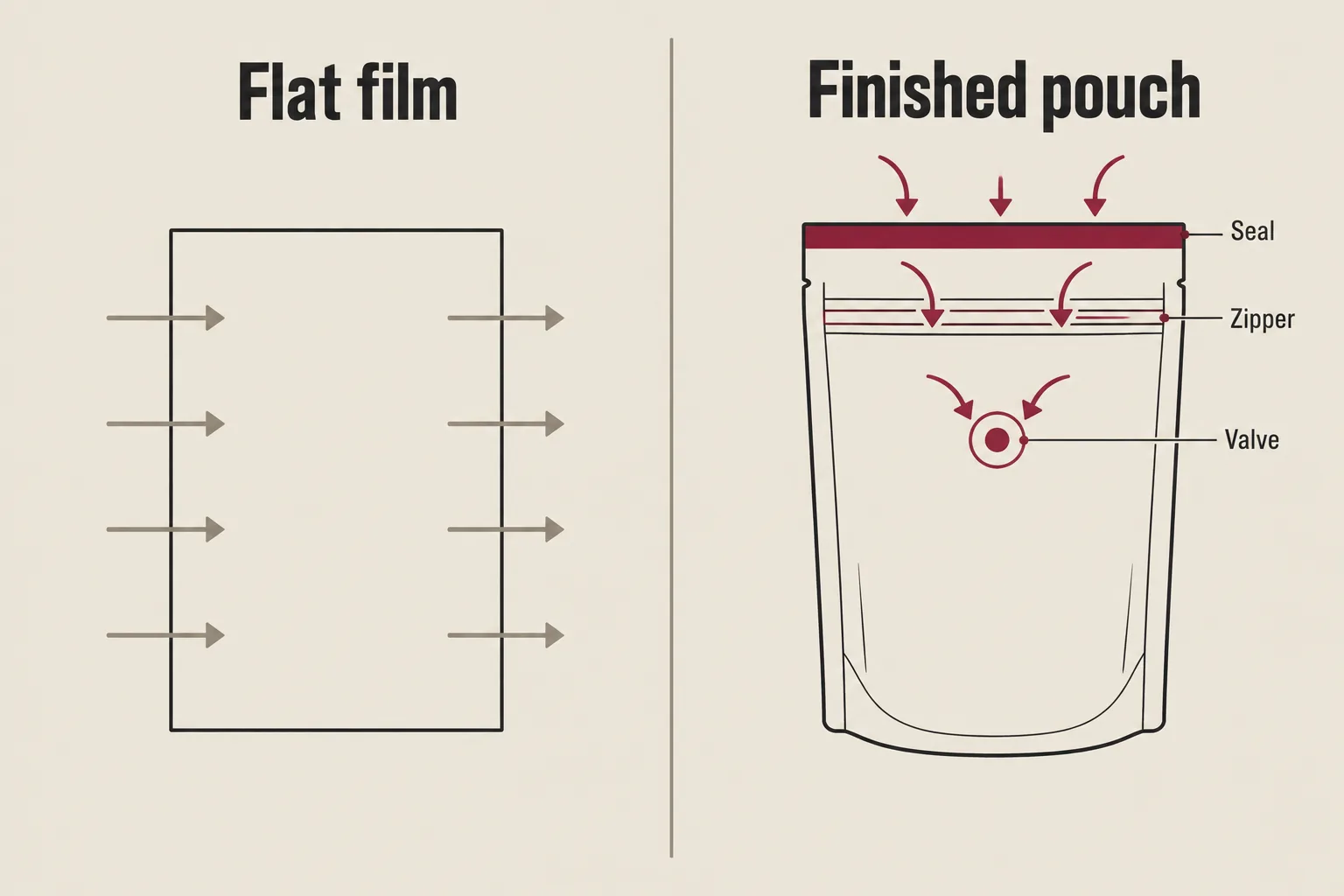
Lab values are measured on flat film. What you fill is a pouch, bag, or wrapper with seals, folds, gussets, a zipper, maybe a one-way valve, and a laser score. Each of those is a feature the flat sheet never had.
A finished-package OTR test reports oxygen transmission for the package under a defined method and conditions; it is not interchangeable with a flat-film result. Forming, seals, closures, package area, and handling can change package performance. When those details matter to the product or customer requirement, ask whether the data describe flat film or the complete package and consider package-level testing. ASTM F1307 describes a method for measuring OTR through dry packages. Review ASTM F1307 for its scope and limitations.
Why Oxygen Is the Enemy of Snacks, Bars and Beverages
Fat oxidation. Fried chips, roasted nuts, nut bars and buttered popcorn carry high fat loads. Oxygen drives the reactions behind rancid, cardboard-like off-flavors. Consumers rarely call it rancidity. They say the product tastes stale and stop buying it.
Color and nutrient loss. Depending on the ingredient and formulation, oxygen exposure may contribute to changes in color, aroma or sensitive nutrients during storage. Confirm the relevant quality limits for the product.
Aroma loss. Coffee, tea, spice blends and dried fruit can lose desirable aroma during storage. The extent and cause depend on the product and package, so use sensory or other product-specific checks when aroma matters.
Beverage quality. Oxygen exposure can affect flavor, aroma and color in some beverages. The relevant sensitivity depends on the formulation, processing, dissolved and headspace oxygen, package format and storage conditions, so validate the specific product rather than treating all beverages alike.
If packaging contributes to a shelf-life problem, the business effects can include shorter date codes, product complaints, returns or limits on distribution. These outcomes depend on the product and supply chain; OTR is one input to investigating them, not proof that packaging caused them.
How OTR Gets Tested and What the Report Should Show
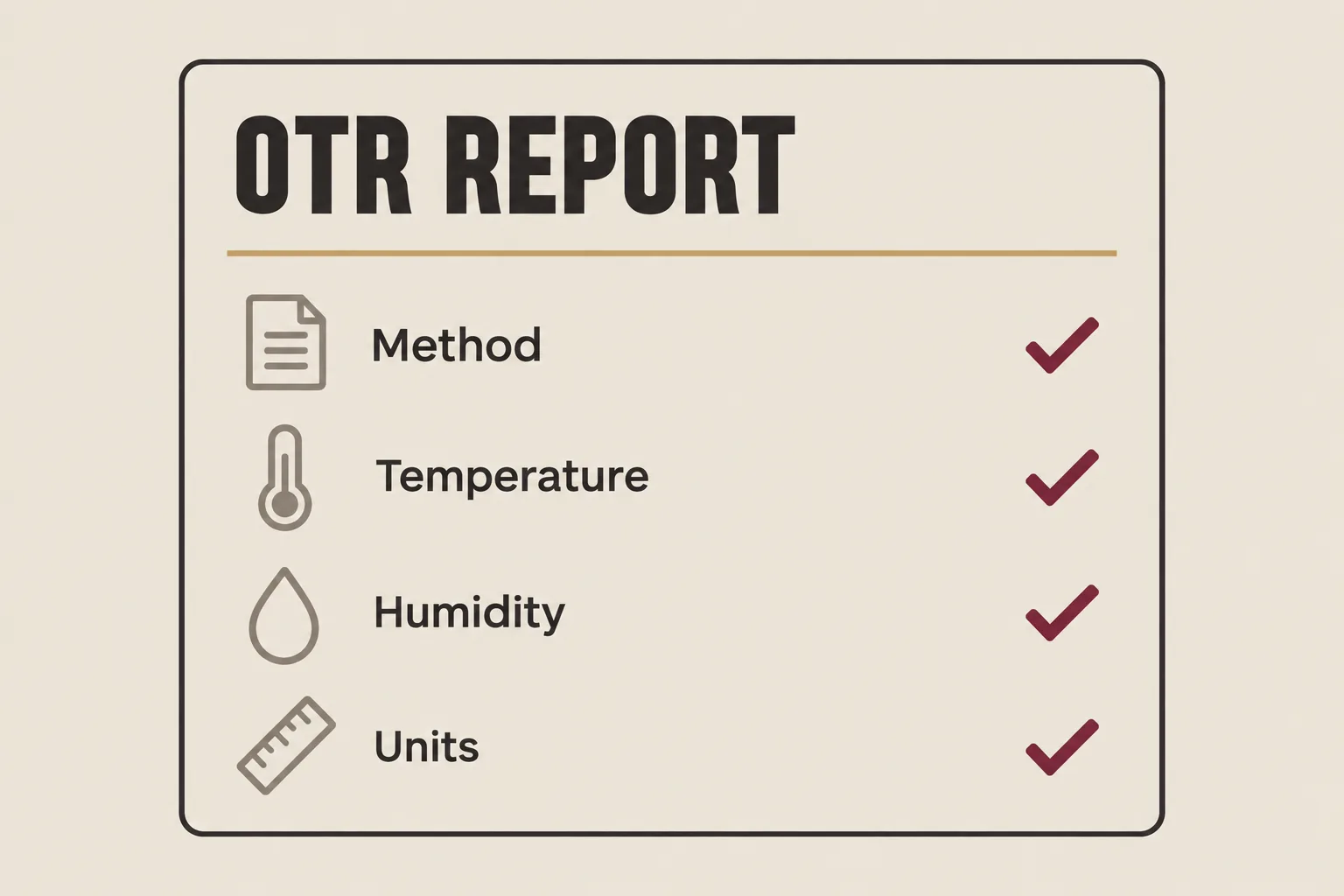
OTR test methods measure oxygen transmission through a specimen under specified conditions. The method and sample type matter when comparing supplier data: ASTM D3985 covers film and sheet specimens; ASTM F1927 addresses testing at controlled relative humidity. A report should identify the test method, specimen, temperature, humidity, units, and any pressure basis. See ASTM D3985 and ASTM F1927 for method scopes.
Temperature and relative humidity can affect results, particularly for some barrier materials. Compare values only when their units, method, and test conditions are sufficiently aligned. Lab conditions do not recreate every distribution environment; use product and supply-chain knowledge to decide whether additional testing is needed.
When requesting quotes, ask each supplier for the available technical data and the conditions used to generate it. Armour Rose’s packaging review can help customers review current packaging needs and coordinate sourcing across product lines; the specific test reports and documentation available depend on the selected manufacturing partner and structure.
A complete barrier specification includes:
- the full structure, layer by layer, with thickness
- oxygen transmission rate with its test temperature and humidity
- moisture vapor transmission rate (MVTR), a separate measure of water-vapor movement through a material
- seal specification and seal strength expectations
- the shelf life the structure is intended to deliver
- the filling equipment and line conditions the material has to run on
Matching an OTR Target to Your Product and Shelf Life Goal
Start with the required shelf life and map the time the product may spend in storage, transit, distribution, and retail. Use that timeline, product sensitivity, and storage conditions to define what the packaging must help protect. Then evaluate candidate structures and validate the finished pack; a data sheet alone cannot set a shelf-life claim.
Use these product and supply-chain factors to frame a target for evaluation:
- Product composition and sensitivity. Fat and oxygen-sensitive ingredients can affect oxidation risk, but formulation and processing matter; do not set an OTR solely from fat content.
- Moisture sensitivity. Determine whether the product must resist moisture gain or loss. Water activity describes the product, while MVTR describes moisture transmission through packaging; keep the concepts distinct.
- Light sensitivity. If light affects quality, consider opacity or a separate light barrier in addition to oxygen protection.
- Distribution conditions. Account for storage duration, temperature, humidity, and handling across the intended route.
As a starting hypothesis, many dry baked snacks are less oxygen-sensitive than products rich in oils or unsaturated fats, but category labels do not determine a specification. Recipe, processing, target shelf life, headspace, package size, and distribution can change the requirement. Armour Rose works with food categories including jerky and meat snacks; the appropriate structure still depends on the product and validation needs.
Package geometry matters too. Headspace volume sets how much oxygen is present at the moment of sealing. Fill weight changes the ratio of product to surface area. Case pack and pallet configuration affect how much flexing and abrasion the pouch takes in transit. Two brands can buy identical film and get different shelf life results from fill and format decisions alone.
Product Risk Check: What to Investigate Before Setting OTR
Use this as a discovery checklist, not as a ready-made OTR specification. Similar products can need different structures because formulas, processing, pack sizes and supply chains vary.
| Product example | Quality change to investigate | Packaging questions to ask |
|---|---|---|
| Chips, popcorn and crackers | Rancidity, loss of crispness or flavor | Is oxygen, moisture, light or physical damage the main risk? What happens at seals and folds? |
| Nuts, nutrition bars and granola | Oxidation, aroma or texture change | What fats and ingredients are present? What is the target date code and distribution time? |
| Coffee and tea | Loss of aroma or flavor; oxygen already in the pack | Is gas flushing or a valve used? Does the pack need aroma retention or light protection? |
| Juice and specialty beverages | Flavor, color or formula-specific changes | What filling process, headspace, and package format are used? What storage conditions are expected? |
After answering these questions, compare candidate structures using matched test methods and conditions, then validate the complete package for the intended product and route to market.
Plan trials early enough to collect the evidence needed before a launch or seasonal production increase. Real-time studies take the length of the period being evaluated; accelerated tests can help screen options but do not automatically replace real-time validation.
The Materials and Structures That Control Oxygen
Foil laminates. Foil can provide a very strong oxygen and light barrier when the laminate remains intact. Flexing, creasing, pinholes, seals, and conversion quality still matter; confirm performance on the intended structure and package.
Metallized films. A deposited metal layer can improve barrier compared with an otherwise similar uncoated film. Actual performance varies by substrate, metal coverage, and conversion. Flexing or damage may affect the layer, so evaluate the converted package and distribution stresses.
EVOH layers. Ethylene vinyl alcohol is used as an oxygen-barrier layer in some multilayer structures. Humidity can affect its barrier performance, so the surrounding layers and the test conditions matter. Specify oxygen and moisture protection based on product needs.
Transparent barrier coatings. These coatings can reduce oxygen transmission while preserving visibility, but the result depends on coating chemistry, substrate, and processing. Compare the specific structure’s measured performance rather than assuming a fixed position relative to foil.
Printed films. In many flexible packs, printing, barrier layers, and sealant are combined in a converted structure. A change to film, coating, ink, adhesive, or lamination can affect performance or compliance; review the specification and requalify when the change could affect the package.
Barrier Versus Recyclability: The Real Trade-off
Single-material structures, often called mono-material, can simplify material sorting compared with some mixed-material laminates, but recyclability depends on the package design and the collection and processing systems in the market. Barrier performance also varies; evaluate a candidate structure against the product’s protection needs rather than assuming it will pass or fail.
Some newer coatings and film designs aim to combine barrier with improved recyclability, but performance is structure- and application-specific. Compare test data and validate the product in its actual package and distribution conditions before changing materials or making an environmental claim.
Recyclability claims depend on the package and the markets where it is sold. Confirm the applicable guidance and substantiation before printing a claim.
Where Barrier Fails Even When the Film Spec Is Right
A shelf-life issue can arise from the material, the finished-package design, filling, seals, storage, or product factors. Investigate the package system before concluding that the film OTR alone caused the problem.
Seals. A contaminated seal is the leading way oxygen gets in. Product dust, oil, or seasoning in the seal area prevents a full bond, and the channel that results defeats an excellent film.
Flex cracking and pinholes. Handling and distribution can stress a film, including at folds and gussets. Whether that creates a meaningful oxygen path depends on the material, structure, and damage; inspect and test the converted package where relevant.
Features. Zippers, spouts, laser scoring, and one-way valves each add function, and each adds a potential oxygen path. Every one needs its own barrier consideration.
Machine settings. Seal temperature, dwell time, and pressure can affect seal quality on a co-packer’s line. A film’s performance on one line does not establish performance on another; confirm the production settings and package integrity for the intended process.
Storage and distribution. Temperature and humidity can vary during warehousing and transit. Consider likely conditions when choosing test conditions and evaluating package performance; lab results do not automatically represent every field condition.
Co-packer and equipment requirements belong in the packaging conversation from the first meeting, not at the purchase order stage. A structure that cannot run well on your line is not a solution, whatever its data sheet says.
OTR and the Rest of the Pack: Cartons, Trays and Displays
In most food packs, oxygen protection is designed primarily into the package component that directly encloses the product, such as a film, pouch, or wrapper. A carton or corrugated component should not be assumed to provide the required oxygen barrier unless its performance has been specified and validated for that use.
Secondary packaging can still protect product quality by limiting light exposure, abrasion, puncture, and handling damage, depending on its design. It does not replace an appropriate primary-package specification.
Do not assume an outer carton compensates for an inner package that lacks the needed protection. Evaluate the complete package system and identify which component provides each function.
Reviewing primary and secondary packaging together can help identify fit, protection, and display issues, for example, abrasion near a seal or a fold that stresses a barrier panel. Armour Rose’s stated model is to understand packaging needs first and coordinate sourcing across product lines through manufacturing partners. Confirm responsibilities, specifications, and quality controls for each item in the proposed program.
Nitrogen Flush and Modified Atmosphere: A Partner to OTR, Not a Substitute
Nitrogen flushing can reduce oxygen in the package at filling, while OTR describes oxygen transmission through a material under test conditions. These are different measures, and neither alone establishes how quickly oxygen will enter a finished pack in distribution.
Nitrogen flushing can reduce oxygen present at filling, while the package barrier affects oxygen ingress over time. Neither measure alone proves that a package will meet a shelf-life target; confirm residual oxygen, seals, structure, and product performance through appropriate testing.
For products that use gas flushing, discuss how residual oxygen will be measured on the production line and how the target will be verified for the product and package. Line settings, fill, headspace, and product handling can affect the result.
Oxygen absorbers may be considered for suitable products and pack formats, but they require application-specific assessment and do not remove the need to evaluate barrier, seals, headspace, and food-contact suitability.
How to Specify OTR With a Packaging Partner
Discovery first. Review the current structure and supply arrangement, product characteristics, target shelf life, co-packer and equipment constraints, order frequency, volumes and delivery points. This matches the Ask First step of Armour Rose’s A-R-G Process.
Gap analysis. Check for both under-protection and unnecessary complexity or cost. A different structure may be worth evaluating, but only product-specific data and validation can show whether it meets the required performance.
Options and estimates. Compare suitable specification alternatives and the trade-offs that matter, such as measured barrier, appearance, line requirements, availability and quoted cost. Confirm claims and performance with the relevant suppliers before ordering.
Total cost thinking. Consider unit cost alongside potential waste, returns, freight, handling and distribution requirements. Treat any financial benefit as a hypothesis to evaluate against the customer’s actual costs and sales opportunities.
A long-term view. Consider expected volume changes and whether the packaging specification can remain practical as demand grows. Armour Rose describes a single-source model with manufacturing relationships across packaging categories; confirm the available options, lead times, and quality responsibilities for each program.
Five Costly OTR Mistakes Brands Make
- Selecting a structure before defining the need. A foil, metallized, or coated structure should be evaluated against the product’s required protection and validated shelf life; do not assume another option will perform adequately without testing.
- Comparing numbers run under different conditions. OTR figures measured using different methods, temperatures, humidity, or pressure bases may not be directly comparable.
- Optimizing for oxygen and ignoring moisture. MVTR and OTR belong in the same conversation, particularly with humidity-sensitive barrier layers.
- Setting barrier from the warehouse date. The clock includes transit, the distributor’s network, and time on shelf.
- Changing a structure without review. A film or laminate change may affect barrier, sealing, print, or food-contact suitability. Assess the change and revalidate where the risk or customer specification requires it.
Frequently Asked Questions
Related readingPouch Seal Failure Causes: Diagnose, Fix, PreventRead the guide →Frequently asked questions
What is a good oxygen transmission rate (OTR) for food packaging?
What is the difference between OTR and MVTR?
Why can two OTR reports for the same film show different values?
Does a thicker film always mean better oxygen barrier?
How do I know what OTR my product needs?
Can recyclable or mono-material pouches hit high barrier?
Does printing or ink affect oxygen barrier?
How long does a shelf life study take before I can commit to a spec?
Next Step: Get Your Current Structure Reviewed
If you are reviewing a current structure, gather the product details, shelf-life target, packaging specification, co-packer or equipment requirements, volumes, and delivery locations. Armour Rose’s process begins by reviewing packaging needs before discussing sourcing options. Armour Rose serves customers across Canada and the United States.
Discuss your packaging requirements with Armour Rose or review its custom packaging solutions. Share the relevant specifications for printed films, pouches, cartons, or displays so the options can be considered together.