



















A protein bar wrapper looks simple: a printed film, sealed along the back and at both ends. In practice it is one of the most demanding jobs in snack packaging. The film has to run on a high-speed wrapper without wrinkling, seal through crumbs and chocolate, keep moisture and oxygen away from the bar, survive shipping in a caddy, and still look sharp on a crowded shelf.
This guide walks through the decisions a bar brand has to make about its wrapper (the film structure, the seal type, the barrier and the print) and how the wrapper, the display carton and the shipper work together as one system. If you already know you want help with the full program, start with Armour Rose’s protein bar packaging options.
Quick Answer: What Is the Best Wrapper for a Protein Bar?
Most protein bars are best packed in a printed flow wrap film, sealed with a fin seal along the back and crimp seals at each end. Choose a metallized or high-barrier film for long shelf life, cold seal for chocolate-coated or heat-sensitive bars, and plan the display carton and shipper at the same time.
Why Bars Are Hard to Wrap
Bars combine several packaging problems in one small product.
Fat bloom and melt. Chocolate and compound coatings react badly to heat and to temperature swings. Fat migrates to the surface and leaves a dull white or gray film, called fat bloom. It is not a safety issue, but it makes the bar look old. A 2021 study in Food Science & Nutrition tested filled chocolate bars at four storage temperatures over 26 weeks and found that bars kept at 6 °C and 12 °C stayed in good condition, while bars kept at 20 °C started to decline after about 10 weeks, mainly in meltdown and off-flavors. A wrapper cannot fix a warm warehouse, but the film and seal type you choose can make heat damage more or less likely during production and storage.
Moisture. Protein bars are sensitive to moisture in both directions. Some pick up moisture from humid air and turn sticky. Many lose moisture or redistribute it over time and harden, which is one of the most common complaints about protein bars. A good moisture barrier slows both.
Oxygen. Nuts, seeds, oils and some protein ingredients oxidize and develop stale or rancid flavors. Oxygen protection depends on the film’s barrier, measured as oxygen transmission rate (OTR), and on clean, continuous seals.
Light. Light speeds up the breakdown of fats and some vitamins. Opaque and metallized films block more light than clear films.
Shape and inclusions. Bars have sharp corners, crunchy pieces, drizzles and crumbs. Sharp edges can puncture weak films, and crumbs or chocolate in the seal area are one of the main causes of leaking seals.
Speed. Bar wrappers run fast. A film that is slightly too stiff, too slippery or too sticky causes wrinkles, misaligned print and jams long before it causes a shelf life problem.
All of this is why the wrapper decision for bars is really four decisions: the format, the seal, the film and the system around the bar (cartons, caddies and shippers). The rest of this guide covers each one.
Flow Wrap Explained for Bars
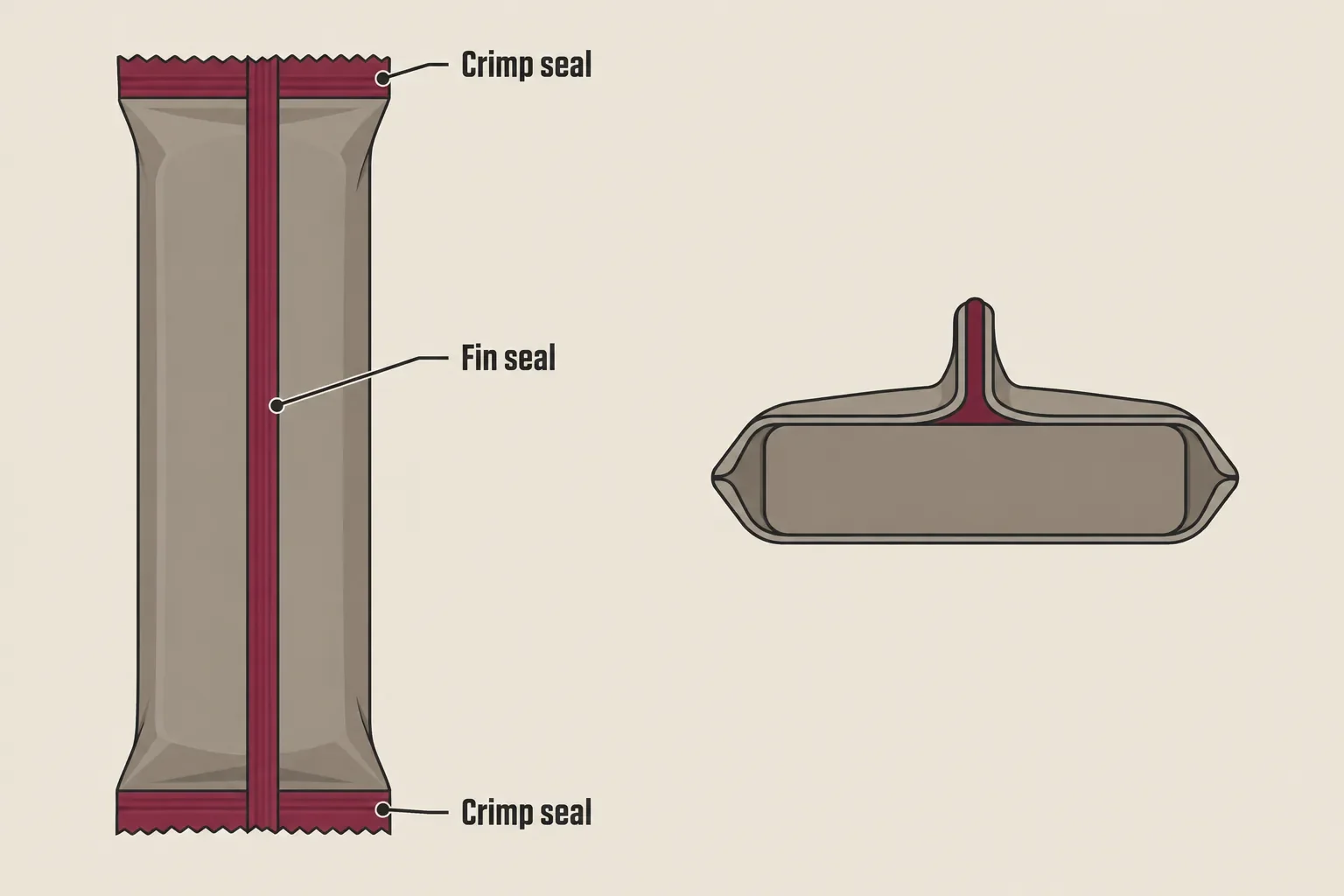
Flow wrap is the packaging process most bar brands use. A roll of printed film is fed into a horizontal wrapper, formed into a tube around each bar, sealed along the length of the pack, then sealed and cut at both ends. It is also called horizontal form-fill-seal (HFFS) or pillow wrapping. Because the wrapper forms the pack from a roll of film, flow wrap is bought as printed roll stock film, not as premade bags.
Fin seal vs lap seal
The long seal that runs along the back of the pack can be made in two ways.
| Fin seal | Lap seal | |
|---|---|---|
| How it’s made | The two edges of the film are pressed together inside to inside, forming a small fin that folds flat against the back | One edge of the film overlaps the other, outside to inside |
| Film requirement | Only the inner sealing layer needs to seal | Both the inner and outer surfaces must seal to each other |
| Strength | Generally stronger and more forgiving | Uses a little less film, but needs a compatible film structure |
| Typical bar use | The default for most protein, granola and snack bars | Less common; used with specific film structures |
End seals
The ends of a flow wrap pack are sealed with crimp jaws that press a pattern into the film. Crimp seals are where most leaks start, because the film folds at the corners and any crumbs or coating trapped in the jaws weaken the seal. If your bars are leaking or losing freshness at the ends, Armour Rose’s guide to pouch seal failure causes covers the usual diagnosis steps, and most of them apply to flow wrap as well.
Cold Seal vs Heat Seal for Bar Wrappers

This is the decision that most often separates chocolate and coated bars from the rest.
Heat seal films have a sealing layer that melts under heated jaws and bonds when it cools. They give strong, reliable seals and work with a wide range of film structures.
Cold seal films are coated with a pressure-sensitive adhesive in a printed pattern, only where the seals will be. The wrapper presses the coated areas together without heat. This protects chocolate and heat-sensitive coatings from melting at the seal and lets the wrapper run at high speed.
| Heat seal | Cold seal | |
|---|---|---|
| How it seals | Heat and pressure melt the sealing layer | Pressure bonds two cold-seal coated areas |
| Best for | Bars without heat-sensitive coatings; bars that need maximum seal strength | Chocolate-coated, enrobed and heat-sensitive bars |
| Line speed | Limited by the time needed to heat and cool the seal | Often higher, because no heating dwell is needed |
| Film choice | Wide | Needs a cold-seal coating and a release surface on the outside so the roll can unwind |
| Storage of film | Flexible | Cold-seal coatings have a limited working life once applied, so plan stock and reorders carefully |
| Seal strength | Usually stronger | Strong enough for most bars when the coating and pressure are right |
A simple rule: if any part of the bar (coating, drizzle or filling) softens near the seal area under heat, ask for a cold-seal flow wrap film option. If the bar is uncoated and runs comfortably with heat, heat seal gives you more film choices.
Film Structures for Bar Wrappers
Most bar wrappers are laminates or coated films: layers bonded together so that each one does a job. The outer layer carries or protects the print, the middle layer provides the barrier, and the inner layer seals.
| Structure type | Barrier level | Look | Typical bar use |
|---|---|---|---|
| Metallized oriented polypropylene (metallized OPP) | High moisture and light barrier; good oxygen barrier | Opaque, shiny inside | Most protein and nutrition bars |
| White or pearlized OPP | Moderate barrier, good light blocking | Bright white, opaque | Granola and cereal bars, budget lines |
| Clear high-barrier films | Good oxygen and moisture barrier, little light protection | Clear | Bars where the product should be visible |
| Paper-based wrappers with a barrier coating | Barrier depends on the coating, usually lower than metallized films | Natural paper look | Brands moving away from plastic; shorter shelf times |
| Mono-material polypropylene structures | Designed for specific recycling streams; barrier varies | Glossy or matte | Brands with recyclability goals |
Three points bar brands often miss:
- Shelf life is a system. The film, the seals, the residual oxygen in the pack, the storage temperature and the time in distribution all work together. Match the barrier to how long your bar actually sits in warehouses and on shelves.
- The weakest point is usually the seal, not the film. A high-barrier film with crumb-contaminated end seals will still let oxygen and moisture in.
- Stiffness matters on the machine. A film that protects the bar perfectly but is too stiff or too slippery will cause wrinkles and misfeeds on a fast wrapper. Always run a trial roll on the actual line.
For a deeper look at how barrier is measured and specified, read Armour Rose’s guide to oxygen transmission rate packaging. For the wider range of film formats, see the overview of types of flexible packaging.
Wrapper Size and Print Layout
The size of a flow wrap is set by the bar, not by a standard chart. The film supplier needs to know how your bar’s dimensions translate to the film roll.
Web width. The width of the film roll has to wrap around the bar’s width and height, plus enough material for the fin seal. Your co-packer or wrapper supplier calculates it from the bar dimensions and the forming box on their machine.
Repeat length. This is the length of film used for one pack, from the start of one wrapper to the next. It is set by the bar length plus the material needed for both end seals and a little space so the bar does not sit in the seal.
Eye marks (registration marks). A small printed block that a sensor on the wrapper reads to cut each pack in the same place. If the eye mark is in the wrong position, the wrong color or too close to other artwork, the wrapper cuts through your design.
Artwork layout. Remember that the fin seal sits on the back and the crimps take up both ends. Keep logos, claims and barcodes clear of those areas. Leave space for the nutrition facts table, ingredient list, allergen statement and other required text, and plan for the regulations in each market you sell in (Canada and the US have different labeling rules).
Barcode placement. Place the barcode on a flat panel, away from the fin seal and the crimps, so it scans cleanly in the store.
Short-run trials and multi-flavor launches are often easier with digital print; see the comparison of digital printing vs rotogravure packaging before you lock the layout. A good test is a printed or plotted mock-up wrapped around a real bar, so you can see exactly where the seals, eye mark and artwork fall before the plates or files are approved.
Recyclable and Paper-Based Bar Wrappers
Many bar brands want a more sustainable wrapper, and recyclable and paper-based options are on the market. The trade-offs are real, though, and the claim on the pack has to match the actual structure.
Mono-material polypropylene wrappers. These keep every layer within the polypropylene family so the wrapper can be accepted in programs that take that material. Barrier comes from coatings or special layers designed to stay within that family. They can work well for bars, but run them on your wrapper and test them with your bar’s shelf life before switching a whole range. The barrier trade-off is explained in the guide to oxygen transmission rate packaging.
Paper-based wrappers. These use paper with a barrier coating and a sealing layer. They give a natural look and can suit some recycling programs, but barrier performance is usually lower than metallized films and they behave differently on high-speed wrappers. Expect to test sealing, tearing and crimp quality carefully.
What to check before you print a sustainability claim:
- Which recycling or composting programs actually accept the structure in the regions where your customers live.
- Whether the barrier meets your shelf life target in real storage conditions.
- Whether the film runs cleanly on your co-packer’s wrapper at your target speed.
- Whether the cold-seal or heat-seal system is compatible with the recyclable structure.
- How the claim must be worded, and whether any certification applies to the exact structure you are buying.
Ask your packaging partner to put a recyclable structure and a conventional barrier structure on the same quote, so you can compare shelf life, cost, machinability and claims side by side.
Ordering Rollstock for a Co-Packer
Most bar brands do not own their wrapper; a co-packer does. That means the film has to be specified for someone else’s machine. Before you order, get these details from your co-packer and send them to your film supplier:
- Web width and repeat length, calculated for your bar on their forming box.
- Core size (the inside diameter of the cardboard tube the film is wound on), which must fit the wrapper’s unwind shaft.
- Maximum roll diameter and weight, so the roll fits the machine and can be handled safely.
- Unwind direction, which shows how the printed side faces as the film comes off the roll. Suppliers use standard unwind diagrams; your co-packer will tell you which one their wrapper needs.
- Splice rules: how many joins per roll the co-packer accepts and how splices must be marked.
- Eye mark specification: size, color, position and the space required around it.
- Seal type (heat or cold) and any sealing temperature, pressure or speed limits.
- Packing and labeling of rolls for delivery and storage.
Ask for a trial roll before a full production run. Many line problems come from small mismatches in width, eye mark position or unwind direction, and they are much cheaper to catch on a trial.
If you are still deciding between formats, Armour Rose’s guide to rollstock vs premade pouches explains when each order route makes sense, and many bar brands use both: rollstock for single bars and premade pouches for bites or multi-serve packs.
Display Cartons, Caddies and Shippers: How Bars Reach the Shelf
A wrapped bar is rarely sold on its own. It usually travels in a display carton or caddy, inside a shipping case, on a pallet. Each layer affects how the bar sells and how well it survives.
| Layer | What it does | What to decide |
|---|---|---|
| Wrapper | Protects the bar and sells it in the hand | Film, seal, print, barcode |
| Display carton or caddy | Holds a set count of bars on the counter or shelf, often with a tear-away front | Count per caddy, board grade, print, tear-away design, shelf footprint |
| Multipack carton | Sells several bars as one unit at grocery or club | Count, carton style, barcode, retailer rules |
| Shipping case | Protects caddies or cartons in transit | Board strength, case count, case labeling |
| Floor or pallet display | Builds a promotional display for club and big-box retail | Retailer specifications, assembly, pallet footprint |
Bars sold at convenience and grocery counters usually need a PDQ or counter display that opens quickly and stands up on its own. Retailers that ask for shelf-ready cases need shelf-ready packaging and trays that move from the case to the shelf in one step. Multipacks usually go into folding cartons, and club store programs often need floor and pallet displays built to the retailer’s specifications.
Club stores have especially detailed requirements for case packs, pallets and displays. Armour Rose’s guide to Costco packaging requirements for suppliers shows how detailed they can get, and online sellers face their own rules, covered in the guide to Amazon packaging requirements for food products.
The practical lesson: design the wrapper, the caddy and the shipper together. A caddy that fits the bar too tightly crushes the wrapper’s crimps. A caddy that is too loose lets bars shift and scuff. A shipping case that is too weak for the stacking height crushes the caddies in the warehouse.
Minimum Orders, Lead Times and Cost: What Drives Each
Every bar brand wants to know the minimum order, the lead time and the unit cost. Honest answers depend on the specification, so it helps to know what moves each number.
What drives the minimum order
- Print method. Digital printing suits short runs and many flavors because it needs no printing plates or cylinders. Rotogravure and flexographic printing need plates or cylinders, so they suit larger runs of fewer designs. Armour Rose’s guide to digital printing vs rotogravure packaging explains the trade-off.
- Number of flavors and designs. Each flavor is usually a separate design. Eight flavors at small quantities each is a very different order from one flavor at a large quantity.
- Film structure. Standard metallized films are easier to source than specialty barrier, cold-seal or recyclable structures.
- How film is sold. Rollstock is often quoted by weight or length of film, so the minimum is tied to what a printing press runs economically.
What drives the lead time
Separate these stages when you compare quotes:
- Artwork preparation, eye mark placement and proof approval.
- Plates or cylinders, if the print method needs them.
- Sourcing the specific film, coating and cold-seal or heat-seal system.
- Printing, laminating and curing.
- Slitting the film into rolls at the right width and core size.
- Quality checks.
- Freight, customs and delivery to your co-packer.
Display cartons and shippers have their own lead times, so plan them in parallel with the film. Reorders of an existing design are usually faster than first orders, because the artwork, plates and structure are already approved. For a full breakdown, read Armour Rose’s guide to how long custom packaging takes.
What drives the unit cost
- Film structure (metallized, high-barrier, cold seal and recyclable structures all change the price).
- Number of printing colors and finishes.
- Print method and order quantity.
- Number of flavors and design changes.
- Display cartons, caddies and shippers.
- Freight and duties for your co-packer’s location.
Compare quotes on the delivered cost per sellable bar in its caddy, not the film price alone. A cheaper film that wrinkles on the wrapper or lets bars harden early costs more in the end.
A Bar Brand's Pre-Order Spec Checklist
Run through this list before you ask for quotes. It turns a vague request into one suppliers can price accurately.
Product
- Bar dimensions (length, width, height) for each format
- Coating, drizzle or enrobing: yes or no
- Heat sensitivity of the coating or filling
- Moisture and oxygen sensitivity (nuts, oils, high-protein formulas)
- Number of flavors and designs
Wrapper
- Flow wrap with fin seal and crimp ends, or another format
- Cold seal or heat seal
- Film structure (metallized OPP, white or pearlized OPP, clear high-barrier, paper-based, recyclable mono-material)
- Shelf life target from production to sale
- Finishes (matte, gloss, spot effects)
Co-packer and machine
- Wrapper make and model
- Web width and repeat length
- Core size, maximum roll diameter and weight
- Unwind direction
- Eye mark specification
- Splice rules
- Target line speed
Artwork and labeling
- Nutrition facts, ingredients and allergen text for each market
- Barcode placement clear of seals
- Artwork status and print method preference
Secondary packaging
- Display carton or caddy count and style
- Multipack carton requirements
- Shipping case count and strength
- Retailer requirements (club store, grocery, convenience, online)
Sustainability
- Recyclable or paper-based structure required
- Claim wording and program acceptance confirmed
How Armour Rose Helps Bar Brands
Armour Rose is a custom packaging partner that manages sourcing and production through a vetted manufacturing network. That matters for bars, because the wrapper only works if the caddy, the shipper and the display work with it. Every project runs on the A-R-G Process: Ask First, Resolve Second, Grow Third.
- One partner for the whole program. Printed flow wrap film, display cartons, multipack cartons, shipping cases and floor displays can be specified and quoted together.
- Film specified for your co-packer. Help translating your co-packer’s wrapper settings into a film specification, including seal type, web width, core and unwind direction.
- Side-by-side options. Conventional and recyclable structures, cold seal and heat seal, on one quote so the trade-offs are visible.
- Logistics. Coordination of production, freight and delivery of film and cartons to your co-packer.
Explore Armour Rose’s protein bar packaging options and its flow wrap film sourcing, or keep reading for answers to common questions.
Related readingTypes of Flexible Packaging: Formats, Materials & UsesRead the guide →
Frequently asked questions
What are protein bar wrappers made of?
Most protein bar wrappers are made from metallized oriented polypropylene (OPP), sometimes laminated with other films. White or pearlized OPP, clear high-barrier films, paper-based wrappers with a barrier coating and recyclable mono-material structures are also used. The right choice depends on the bar’s shelf life, coating and sustainability goals.
What is the difference between flow wrap and a pouch for bars?
Flow wrap is formed, filled and sealed from a roll of film on a horizontal wrapper, with a back seal and two end seals. A pouch arrives premade and is filled and sealed afterwards. Single bars almost always use flow wrap; pouches suit bites, minis and multi-serve packs.
Should I use cold seal or heat seal for my bars?
Use cold seal if the bar has a chocolate or compound coating, a drizzle or a filling that softens near heat. Use heat seal for bars that tolerate heat and need the widest film choice and strongest seals. Your co-packer’s wrapper must support the system you choose.
What is a fin seal?
A fin seal is the long seal on the back of a flow wrap pack, made by pressing the two inner surfaces of the film together. It forms a small fin that folds flat against the pack. It is the most common back seal for bars because only the inner layer needs to seal.
Why do my protein bars go hard in the wrapper?
Protein bars often harden as moisture moves or escapes and as ingredients change over time. A wrapper with a better moisture barrier and well-made seals slows the loss, but formulation and storage conditions play a big part. Review the film’s barrier and your seal quality with your packaging partner.
Can I get recyclable protein bar wrappers?
Yes. Mono-material polypropylene and some paper-based wrappers are designed for specific recycling streams. They usually trade some barrier and machinability for recyclability, so test them on your co-packer’s wrapper and against your shelf life target before switching.
What does my co-packer need from me to order wrapper film?
Usually the bar dimensions, artwork and flavor count. In return, the co-packer gives you the web width, repeat length, core size, unwind direction, eye mark specification, splice rules and seal type their wrapper needs. Your film supplier needs all of those to produce rolls that run.
Why are my bar wrappers leaking at the ends?
Leaking end seals are usually caused by crumbs, coating or oil in the seal area, the wrong jaw temperature or pressure, worn crimp jaws, or a film that is not matched to the sealing system. Armour Rose’s guide to pouch seal failure causes walks through the diagnosis.
How should bars be stored to avoid fat bloom?
Keep bars cool and avoid temperature swings. Research on filled chocolate bars found they kept their quality best at cool storage temperatures and started to decline after about 10 weeks at 20 °C. The wrapper helps, but storage and distribution conditions matter most.
Do I need a display carton for my bars?
Most retail bars are sold from a display carton or caddy, especially at convenience and grocery counters. Club stores and some retailers require shelf-ready cases or floor displays. Plan the display carton at the same time as the wrapper so they fit each other and the shipping case.
How long does it take to get custom printed bar wrappers?
It depends on the print method, whether plates or cylinders are needed, film sourcing, the number of flavors, and freight to your co-packer. Reorders are usually faster than first orders. Ask each supplier which stages their quoted lead time covers.
Get Your Bar Wrapper and Display Program Quoted Together
Send your bar dimensions, coating details, flavor count, co-packer wrapper specifications and retail channels. Armour Rose will quote printed flow wrap film, display cartons and shippers as one program, so you can see the delivered cost of a shelf-ready bar. Start with protein bar packaging or contact Armour Rose to share your current specification.