


















Every chip bag on a grocery shelf is doing several jobs at once. It keeps oxygen and light away from the oil in the chips, it cushions a fragile product through trucks and warehouses, it carries the brand, and it has to run at speed on a packaging line.
When a chip brand gets the bag wrong, the result shows up as stale or rancid product, broken chips, seal failures or a bag that looks half empty on the shelf.
This guide is written for chip and crisp brands specifying their packaging: potato, tortilla, kettle, vegetable and other fried or baked snacks.
It covers the format choice (pillow bag, stand-up pouch or side-gusset bag), bag sizing, nitrogen flushing, barrier films, rollstock versus premade bags, recyclability and the cases and shippers that get the bags to the shelf. If you want help with the full program, start with Armour Rose’s chips and crisps packaging options.
Quick Answer: What Is the Best Packaging for Chips?
For most chip brands, the best bag is a pillow bag formed from printed barrier rollstock on a vertical form-fill-seal line, flushed with nitrogen. It is the most efficient format at volume. Choose a resealable stand-up pouch for premium, multi-serve or kettle-style chips, and a side-gusset bag for larger club and food-service packs.
Why Chips Are Hard to Package
Chips look simple, but they combine almost every packaging challenge a snack can have.
Oil oxidation. Fried chips carry a lot of oil, and that oil reacts with oxygen over time. The result is rancid, cardboard-like flavors that customers notice quickly. Keeping oxygen out of the bag, and removing it before sealing, is the single most important protection job.
Light. Light speeds up oil oxidation. That is one reason most chip bags are opaque and metallized inside rather than clear.
Moisture. Chips are dry and crisp. If moisture gets into the bag through the film or a weak seal, they turn soft and stale. Baked and lower-fat chips can be just as sensitive as fried ones.
Breakage. Chips are fragile. Every drop from the filling head, every turn on a conveyor and every truck journey breaks a few. Bag size, headspace and gas fill all affect how many whole chips reach the customer.
Seasoning and oil on the seal area. Seasoning dust and oil can land in the seal area during filling. Contaminated seals are one of the most common reasons chip bags leak or open on the shelf.
Speed. Chip lines run fast. The film has to feed, form, seal and cut cleanly at line speed, or the line jams and wastes film. Barrier, sealing and film stiffness all have to be specified together, which is why Armour Rose’s guide to types of flexible packaging is a useful primer before you compare chip bag formats.
That is why the bag decision for chips is really four decisions: the format, the film structure, the gas fill and the order route. The rest of this guide covers each one.
Why Do Chip Bags Have So Much Air? Nitrogen Flushing Explained for Brands
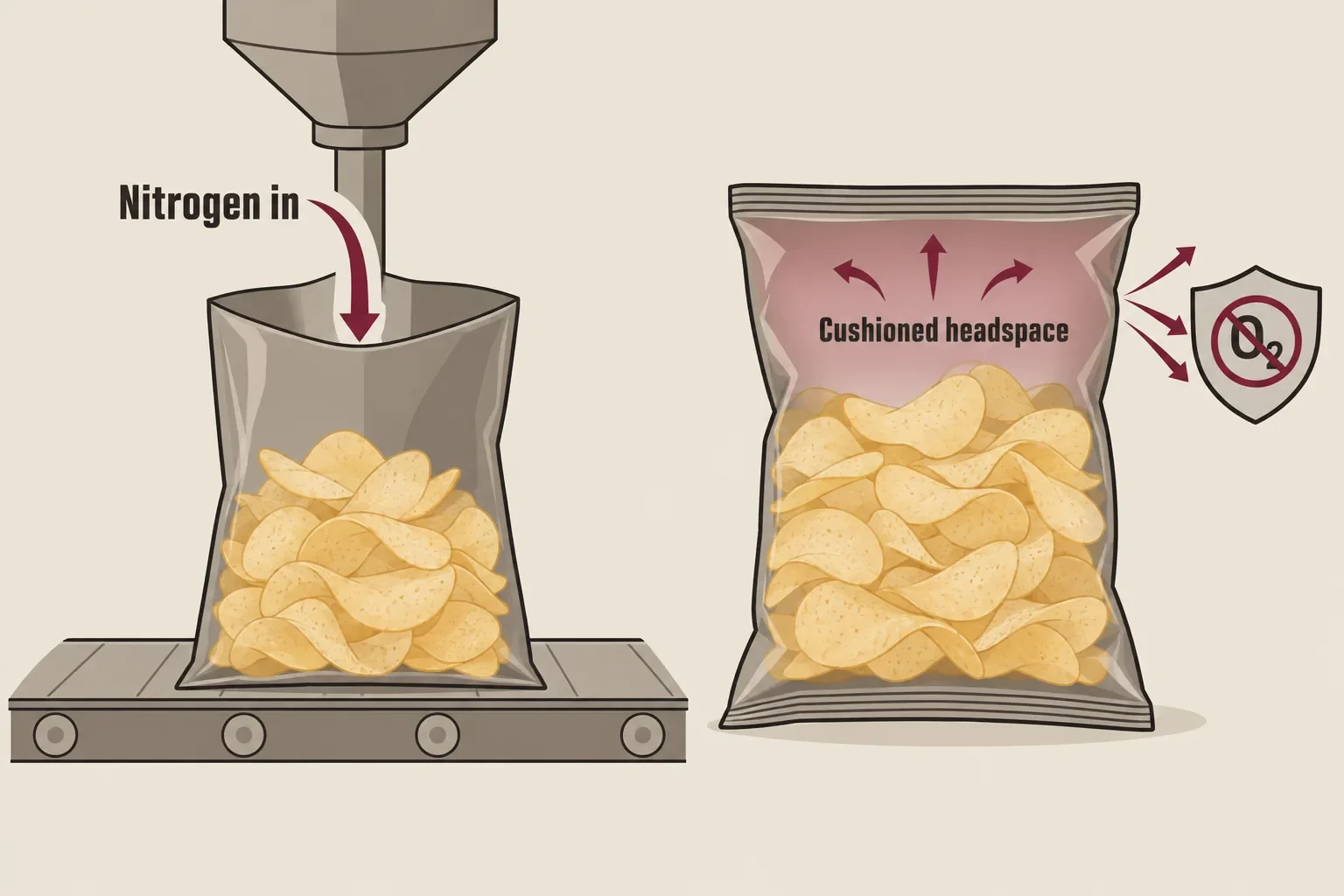
Shoppers often ask why chip bags look so full of air. For a brand, the answer is the basis of your packaging specification.
Nitrogen flushing (also called gas flushing or modified atmosphere packaging) replaces most of the air in the bag with nitrogen just before the bag is sealed. Nitrogen is inert: it does not react with the oil. Removing oxygen this way slows oxidation and helps the chips keep their flavor.
The gas also does a mechanical job. A properly inflated bag acts like a cushion, so the chips are less likely to be crushed when cases are stacked, shipped and handled. A bag with too little gas is easier to crush. A bag with too much can be hard to fit in a case and may stress the seals.
What a brand has to specify:
- Residual oxygen target. How much oxygen can remain in the bag after flushing. Ask your co-packer how they measure it and how often.
- Fill height and headspace. Enough space for gas and cushioning, without a bag that looks under-filled.
- Seal integrity. Flushing only works if the seals hold the gas in. A leaking seal lets oxygen back in within days.
- Film barrier. The film has to keep oxygen out for the whole shelf life, not only at packing.
Slack fill: what the rules say
In the US, the federal rule on misleading containers, 21 CFR 100.100, treats empty space in a package as misleading when it is “nonfunctional slack-fill”.
The rule defines that as empty space in a package filled to less than its capacity for reasons other than a set of listed functions, which include protection of the contents of the package, the requirements of the machines used to fill and close it, and unavoidable product settling during shipping and handling.
In plain terms, headspace that protects the chips or is needed by the packaging line can be justified, while empty space that serves no purpose cannot. The exact application depends on your product, your line and your retailer. Document why your fill level and bag size are what they are, and check current requirements with your regulatory adviser for the US and Canadian markets you sell in.
What Chip Bags Are Made Of
Most chip bags are laminates: two or more thin films bonded together, each doing a different job. A common construction has an outer printed layer, a barrier layer and an inner sealing layer.
| Layer | Typical job | Common materials |
|---|---|---|
| Outer layer | Carries the print, gives gloss or matte finish, resists scuffing | Oriented polypropylene (OPP) or polyester (PET) film |
| Barrier layer | Blocks oxygen, light and moisture | Metallized film (a very thin metal coating), sometimes foil or high-barrier coatings |
| Inner sealant layer | Seals the bag on the packaging line | Heat-sealable polypropylene or polyethylene layers |
Why are chip bags shiny inside? The silver interior is usually the metallized barrier layer. It reflects light and slows the passage of oxygen and moisture, which protects the oil in the chips. It is a functional layer, not decoration.
What changes the barrier you need:
- Fried vs baked. Fried chips with more oil are more sensitive to oxygen.
- Shelf life target. A bag sold within weeks needs less protection than one expected to sit in distribution and on shelves for months.
- Distribution route. Hot or humid supply chains need stronger moisture and oxygen protection.
- Window or clear panels. Clear areas look good but reduce light protection.
For a deeper look at how barrier is measured, read Armour Rose’s guide to oxygen transmission rate packaging.
Pillow Bag vs Stand-Up Pouch vs Side-Gusset Bag for Chips
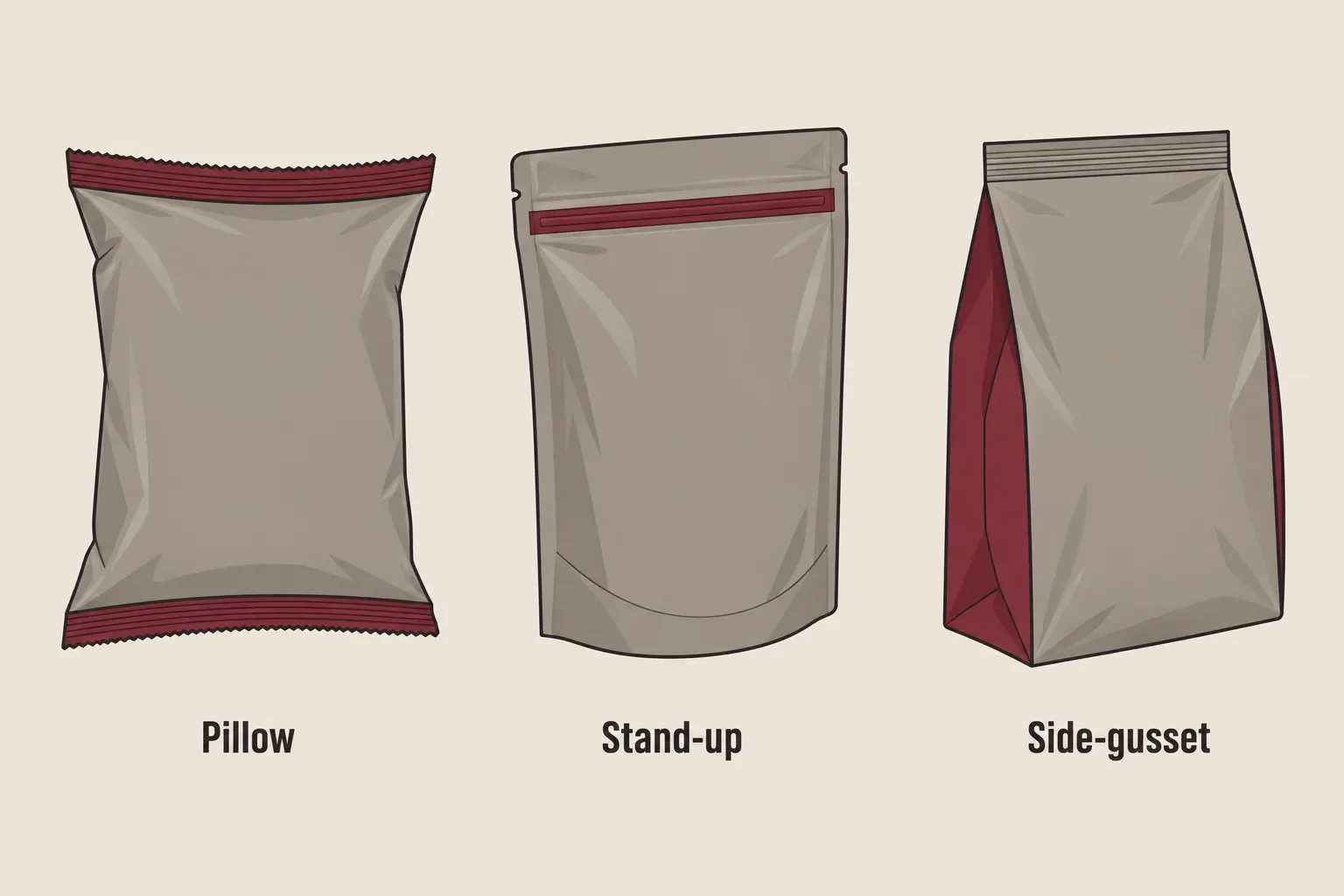
A pillow bag is the classic chip bag: a flat tube of film sealed at the top, bottom and back, with no gusset. It is usually made on a vertical form-fill-seal (VFFS) line, which forms the bag from a roll of film, fills it and seals it in one continuous process. A gusset is a folded panel that expands when the bag is filled.
| Pillow bag | Stand-up pouch | Side-gusset bag | |
|---|---|---|---|
| How it’s made | Formed from rollstock on a VFFS line | Usually supplied premade; some lines form them from rollstock | Formed on VFFS with gusseting tools, or premade |
| Line speed | Fastest, built for high volume | Slower filling and sealing | Moderate |
| Unit cost drivers | Lowest film use and fastest output | More material, premade converting, zipper | More film than pillow, efficient at large sizes |
| Shelf presence | Lies flat or leans; works on shelves, clip strips and pegs | Stands upright with a wide front panel | Stands more squarely when full |
| Resealability | Usually none | Press-to-close zipper is common | Optional |
| Best chip fit | Single-serve, sharing and family bags at volume | Premium, kettle and multi-serve chips, better-for-you lines | Club-store, food-service and large bags |
| Multipacks | Ideal inside cartons or shippers | Less common | Possible |
For most chip brands, the pillow bag on a VFFS line is the right default. It is the most efficient way to package chips at speed, and it is what co-packers are set up for. Armour Rose sources printed roll stock film and premade pillow pouches for this.
When a stand-up pouch is better for chips
- You sell a premium or kettle-style chip where a resealable bag adds value.
- Your chips are eaten over several sittings, such as large sharing bags or better-for-you snacks.
- You want a wider front panel for brand and product storytelling.
- You fill by hand or on a smaller line in short runs.
Stand-up pouches cost more per unit and fill more slowly, so they work best where the price point supports them. See Armour Rose’s stand-up pouches page for options.
Chip Bag Sizes: How Net Weight Maps to Bag Dimensions
Chip bag sizes are usually described by net weight, but the dimensions depend on much more than weight. Thick kettle chips, thin chips, tortilla chips, puffs and vegetable crisps all take up different amounts of space for the same weight.
| Size tier | Typical use | What drives the dimensions |
|---|---|---|
| Single-serve | Lunchboxes, vending, multipacks, food service | Chip shape and breakage tolerance; machine minimum bag size |
| Snack or sharing | Convenience stores, grab-and-go | Fill height, gas headspace, shelf height |
| Family or large | Grocery shelves | Shelf depth and height, case pack, film width on the line |
| Club and party | Club stores, events, food service | Case and pallet requirements, bag strength, handling |
Why your chips may need a different size
- Chip shape and density. Curled kettle chips need more space per gram than flat thin-cut chips.
- Breakage. A bag filled too tightly crushes chips. A bag with more headspace and gas protects them but must still be justified as functional.
- Line limits. Each VFFS line has a range of bag lengths and widths it can form, set by its forming tube and jaws. Your bag has to fit your line, or your co-packer’s.
- Shelf and case. The bag must fit the retailer’s shelf, your shipping case and, for club stores, the pallet pattern.
The only reliable way to set dimensions is a fill trial on the actual line with your actual chips, checking fill height, breakage, gas volume and how the bags pack into a case. If you are choosing between a pillow bag and an upright format at the same weight, the guide to flat-bottom bags vs stand-up pouches explains how capacity and shelf footprint change between upright formats.
Printing and Artwork for Chip Bags
Chip bags are among the most brand-driven packs in the store. Shoppers scan a crowded snack aisle in seconds, so print quality, color consistency and flavor cues matter as much as the structure behind them.
Color and flavor systems. Most chip brands use a consistent brand layout with a color per flavor. Plan the color system before artwork, because every extra spot color can add cost and set-up on rotogravure presses.
Matte, gloss and texture. Matte finishes and soft-touch effects suggest premium or natural positioning. Gloss makes colors pop. Both are achieved through the outer film and coatings, so specify them with the structure, not afterwards.
Windows. A clear window lets shoppers see the chips, but it reduces light protection on a product that is sensitive to light. If you want a window, keep it small and weigh it against your shelf life target.
Regulatory and retailer panel space. The back panel has to carry the nutrition panel, ingredients, allergen statements, net weight, bilingual text for Canada, barcodes and date code area. Lay this out early so it does not crowd the brand front.
Print method. High-volume chip film is usually printed by rotogravure for consistent color over long runs, while digital and flexographic printing can suit short runs, test flavors and seasonal designs.
Proofs and color approval. Ask for printed proofs or press checks on the actual film, because metallized films change how colors read compared with a screen or paper proof.
Rollstock for VFFS Lines vs Premade Bags
There are two ways to buy chip packaging. Rollstock is printed film on a roll that the VFFS line forms into bags. Premade bags arrive already formed; you fill them and seal the top.
| Rollstock | Premade bags | |
|---|---|---|
| Best for | High-volume SKUs on a VFFS line | Small runs, many SKUs, hand or semi-automatic filling |
| Equipment | VFFS line (yours or your co-packer’s) | Simple sealers or premade-bag fillers |
| Unit cost | Lower at volume | Higher per bag |
| Flexibility | Less flexible: tied to line and film width | More flexible for limited editions and launches |
| Formats | Pillow bags, gusseted bags, some stand-up styles with tooling | Pillow, stand-up and gusseted bags |
Most established chip brands buy rollstock. Premade bags are common for launches, test markets, limited flavors and brands filling by hand. For a full comparison, see Armour Rose’s guide to rollstock vs premade pouches.
What to send your co-packer before ordering rollstock
- Film width and repeat length (the printed length of one bag).
- Core size and maximum roll diameter the line accepts.
- Unwind direction (how the print faces as the film comes off the roll).
- Eye mark position (the printed mark the line reads to cut each bag in the right place).
- Splice rules (how many joins per roll are acceptable and how they are marked).
- Sealant layer and sealing range, so jaw temperature and dwell time can be set.
- Gas flush and residual oxygen target.
- Date coding area, kept free of heavy print so the code is readable.
Small mismatches in width, eye mark or unwind direction are a common cause of rejected rolls and lost production time.
Seals: The Weak Point of Most Chip Bags
A chip bag is only as good as its seals. The film can have excellent barrier, but if the back seal or end seals leak, oxygen gets in and the nitrogen gets out.
Common causes of chip bag seal problems include:
- Seasoning dust or oil in the seal area during filling.
- Jaw temperature, pressure or dwell time that does not match the film’s sealant layer.
- Line speed pushed past what the film and jaws can handle.
- Wrinkles or pleats in the seal from poor film tracking.
- Product in the seal, when chips fall late into the seal zone.
Ask for seal strength and leak testing as part of line trials, and build checks into regular production. Armour Rose’s guide to pouch seal failure causes covers diagnosis in more detail.
Are Chip Bags Recyclable?
This is one of the most common questions shoppers ask about chips, and one of the hardest for brands to answer simply.
Traditional chip bags combine different plastics and a metallized layer bonded together. That multi-material construction gives great barrier and runs well at speed, but it is difficult for most recycling systems to separate.
Recyclable options are being developed and used, most often mono-material structures built from a single plastic family, such as polypropylene, with barrier coatings designed to stay within that family. They can work for chips, but brands need to test:
- Barrier performance against the shelf life target.
- Line performance, because heat resistance and stiffness differ from traditional laminates.
- Seal strength at production speed.
- Print and finish, which may look different.
Before printing a recyclability claim:
- Confirm which certification or recognition, if any, the specific structure holds.
- Check whether recycling programs in your customers’ regions accept it, including store drop-off schemes where they exist.
- Make sure the wording matches what the structure and programs actually support.
Ask your packaging partner to quote a recyclable structure and your current structure side by side, so you can compare cost, shelf life and line performance before switching.
Cases, Shippers and Club-Store Packs
The chip bag is only part of the package. Chips also travel in corrugated cases, shelf-ready trays and display shippers, and each retailer may have its own requirements.
- Shipping cases. Must protect bags from crushing and fit the pallet pattern. Case size depends on bag size, bag count and gas fill.
- Shelf-ready packaging. Cases designed to open and go straight onto the shelf. Many grocery retailers ask for them because they save stocking time. See Armour Rose’s shelf-ready packaging and trays.
- Display shippers. Pre-filled displays for promotions and end caps.
- Multipacks. Single-serve bags packed into cartons or overwrapped bundles for lunchbox and variety packs.
- Club stores. Club retailers set detailed rules for case packs, pallets, labels and displays. Armour Rose’s guide to Costco packaging requirements for suppliers shows how detailed they can be.
Specify the bag and the case together. A small change in bag size can change the case, the pallet pattern and the freight cost.
Minimum Orders, Lead Times and Cost: What Drives Each
Chip brands want three numbers before ordering: the minimum order, the lead time and the unit price. Each depends on the specification, so it helps to know what moves them.
What drives the minimum order
- Print method. Rotogravure printing, common for high-volume chip film, needs engraved cylinders and suits long runs of fewer designs. Flexographic and digital printing can suit shorter runs and more designs. Armour Rose’s guide to digital printing vs rotogravure packaging explains the trade-off.
- Number of flavors and sizes. Each flavor and size is usually a separate design.
- Film structure. Standard structures are easier to source in small quantities than custom or recyclable ones.
What drives the lead time
- Artwork and proof approval.
- Cylinders or plates, if the print method needs them.
- Film sourcing for the specified structure.
- Printing, laminating and curing.
- Slitting to roll width, or converting into premade bags.
- Quality checks.
- Freight and delivery to your plant or co-packer.
Reorders of approved designs are usually faster than first orders because cylinders and artwork already exist. For a full breakdown, read Armour Rose’s guide to how long custom packaging takes.
What drives the unit cost
- Film structure and thickness.
- Number of print colors and special finishes.
- Order quantity and number of designs.
- Rollstock vs premade bags.
- Freight and duties.
Compare costs on the delivered cost per sellable bag. A cheaper film that causes line waste, breakage or early staling costs more in the end.
A Chip Brand's Pre-Order Spec Checklist
Use this list before you ask for quotes.
Product
- Chip type (potato, tortilla, kettle, vegetable, baked, puffed)
- Net weights for each size
- Number of flavors and designs
- Oil content and seasoning type
Format
- Pillow bag, stand-up pouch, side-gusset or a mix
- Target dimensions confirmed by fill trials
- Shelf, case and pallet constraints
Protection
- Shelf life target
- Film structure and barrier
- Nitrogen flush and residual oxygen target
- Seal testing method
Line
- Your line or a co-packer’s
- VFFS bag length and width range
- Film width, repeat length, core size, unwind direction, eye mark
- Date code area
Sustainability
- Recyclable structure required or under evaluation
- Claim wording and certification to confirm
Ordering and channels
- Rollstock or premade bags
- Print method and artwork status
- Retail channels (grocery, convenience, club, food service, online)
- Case, tray and display requirements
- Launch date and reorder frequency
How Armour Rose Helps Chip Brands
Armour Rose is a custom packaging partner that manages sourcing and production through a vetted manufacturing network. For chip brands, that means one partner can specify and quote the whole program. Every project runs on the A-R-G Process: Ask First, Resolve Second, Grow Third.
- Film and bags together. Printed rollstock for VFFS lines, premade pillow bags and stand-up pouches for launches and premium lines.
- Cases and displays alongside. Shipping cases, shelf-ready trays and display shippers specified with the bag, so the system fits together.
- Specification support. Help with film structures, barrier, nitrogen flush requirements and co-packer line details before anything is printed.
- Logistics. Coordination of production, freight and delivery to your plant or co-packer.
Explore Armour Rose’s chips and crisps packaging options, or read on for common questions.
Related readingPopcorn Bags and PackagingRead the guide →
Frequently asked questions
What is the best packaging for potato chips?
For most brands, a nitrogen-flushed pillow bag made from printed barrier rollstock on a vertical form-fill-seal line. It is fast and efficient at volume and protects the oil from oxygen and light. Premium and resealable lines often use stand-up pouches.
Why do chip bags have so much air in them?
The gas is usually nitrogen, added to push out oxygen and cushion the chips. It slows staling and reduces breakage. In the US, empty space that protects the contents or is needed by the packaging machine is treated differently from empty space with no function.
What gas is in chip bags?
Most chip bags are flushed with nitrogen, an inert gas that does not react with the oil in the chips. Flushing reduces the oxygen left in the bag before sealing.
What are chip bags made out of?
Most are laminates of several thin films: a printed outer layer such as OPP or PET, a metallized barrier layer that blocks light, oxygen and moisture, and an inner sealant layer that seals on the packaging line.
Why are chip bags silver inside?
The silver interior is a metallized barrier layer. It reflects light and slows the passage of oxygen and moisture, protecting the oil in the chips.
Are chip bags recyclable?
Traditional multi-material chip bags are hard for most recycling systems to process. Mono-material recyclable structures exist and are being adopted, but brands should test barrier and line performance and match any claim to the structure and to local programs.
How do I choose a chip bag size?
Start from net weight, then adjust for chip shape, density, breakage, gas headspace, your line’s bag size range and your shelf and case. Confirm with fill trials on the actual line.
Should I buy rollstock or premade chip bags?
Rollstock suits high-volume SKUs on a VFFS line. Premade bags suit launches, limited flavors, small runs and hand filling. Many brands use both. See the rollstock vs premade pouches guide.
Can chips be packaged in resealable bags?
Yes. Stand-up pouches with press-to-close zippers are common for premium, kettle and multi-serve chips. They cost more per unit and fill more slowly than pillow bags.
Why do my chip bags leak or lose their puff?
Usually a seal problem: seasoning or oil in the seal area, sealing settings that do not match the film, line speed, wrinkles, or product in the seal. Armour Rose’s guide to pouch seal failure causes walks through diagnosis.
What packaging do club stores require for chips?
Club retailers set their own requirements for case packs, pallets, labels and displays. Start with Armour Rose’s overview of Costco packaging requirements for suppliers and confirm the current vendor guide with your buyer.
Get Your Chip Packaging Specified as One Program
Send your net weights, chip types, line type or co-packer details and retail channels. Armour Rose will quote printed film or premade bags, plus cases, shelf-ready trays and displays, as one program. Start with chips and crisps packaging or contact Armour Rose to share your current specification.