


















Popcorn looks like the easiest snack to bag: it is dry, light and forgiving. Then a caramel corn bag shows grease stains two weeks into its shelf life, a batch of kettle corn arrives soft at the store, or raw kernels sold in a cheap bag stop popping well. Popcorn is really three different products, and each one asks something different of the package.
This guide covers what popcorn brands need to decide before quoting bags: how kernels, plain popped corn and coated or kettle corn differ, how to handle grease and moisture, which bag formats suit which products, and when a carton or gift tin is the better buy. If you already want help with the whole program, start with Armour Rose’s custom popcorn packaging options.
Quick Answer: What Is the Best Packaging for Popcorn?
For ready-to-eat popcorn, choose a resealable stand-up pouch or a pillow bag with a grease-resistant inner layer, and manage moisture for kettle corn. Pack raw kernels in an airtight, moisture-protective bag. Use folding cartons, gift tins or rigid boxes for gifting, multipacks and premium retail.
Three Products, Three Packaging Problems
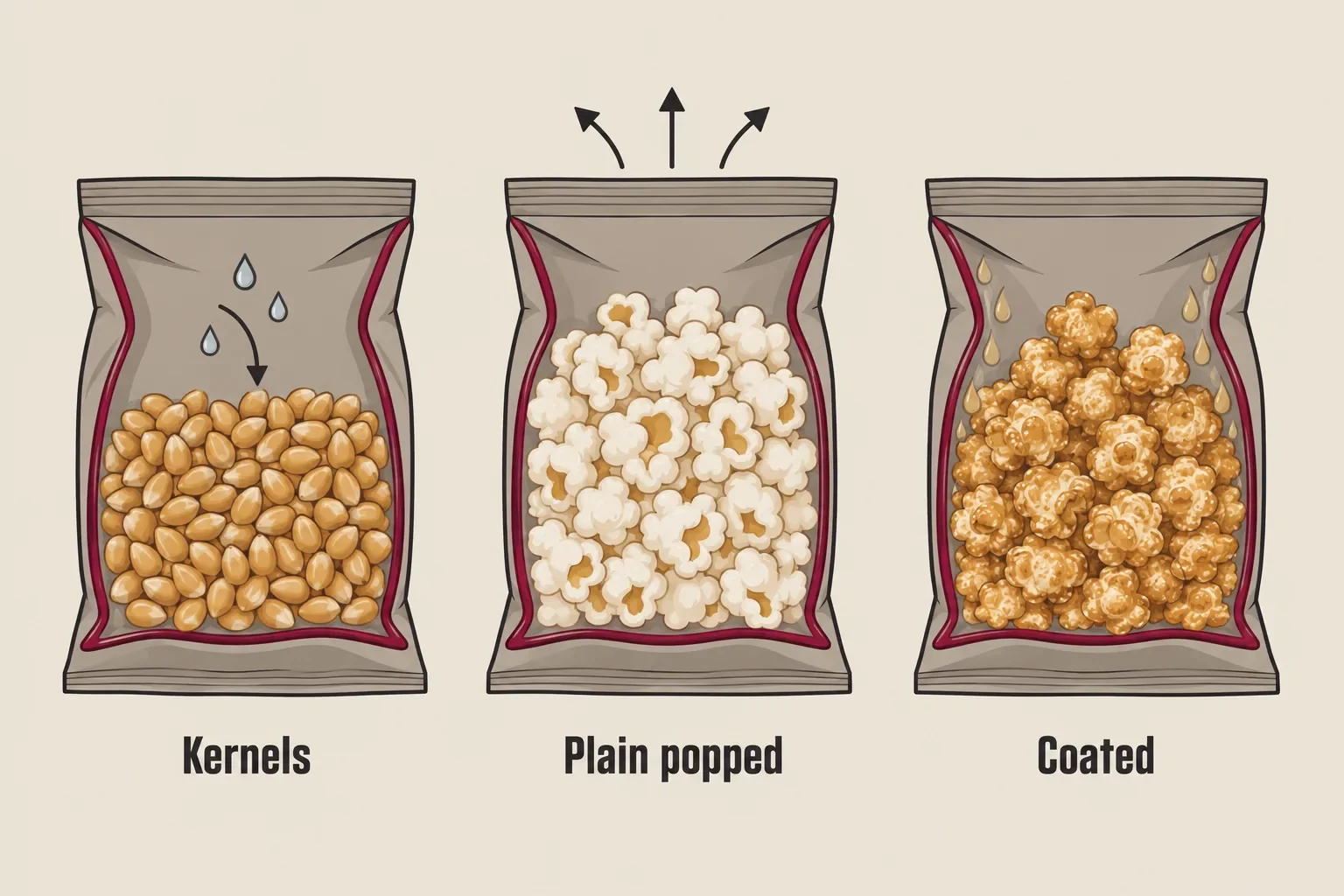
| Raw kernels | Plain popped popcorn | Coated, flavored and kettle corn | |
|---|---|---|---|
| Main threat | Losing or gaining moisture, which hurts popping | Humidity making it stale and chewy; crushing | Grease and sugar staining the bag; residual moisture softening the product |
| What the package must do | Keep moisture stable: airtight and moisture-protective | Keep humidity out and protect a light, bulky product | Resist grease migration and manage moisture without letting humidity in |
| Typical formats | Pillow bags, stand-up pouches, side-gusset bags for bulk | Pillow bags, stand-up pouches, flow-wrapped single serves | Stand-up pouches, flat-bottom pouches, gift tins and boxes |
| Common mistake | Using a popped-corn film spec | Treating it like a chip bag without testing humidity | Using a plain snack film that stains within weeks |
Armour Rose specifies kernel and popped formats separately for exactly this reason. The rest of this guide takes each problem in turn.
Grease: Why Popcorn Bags Stain
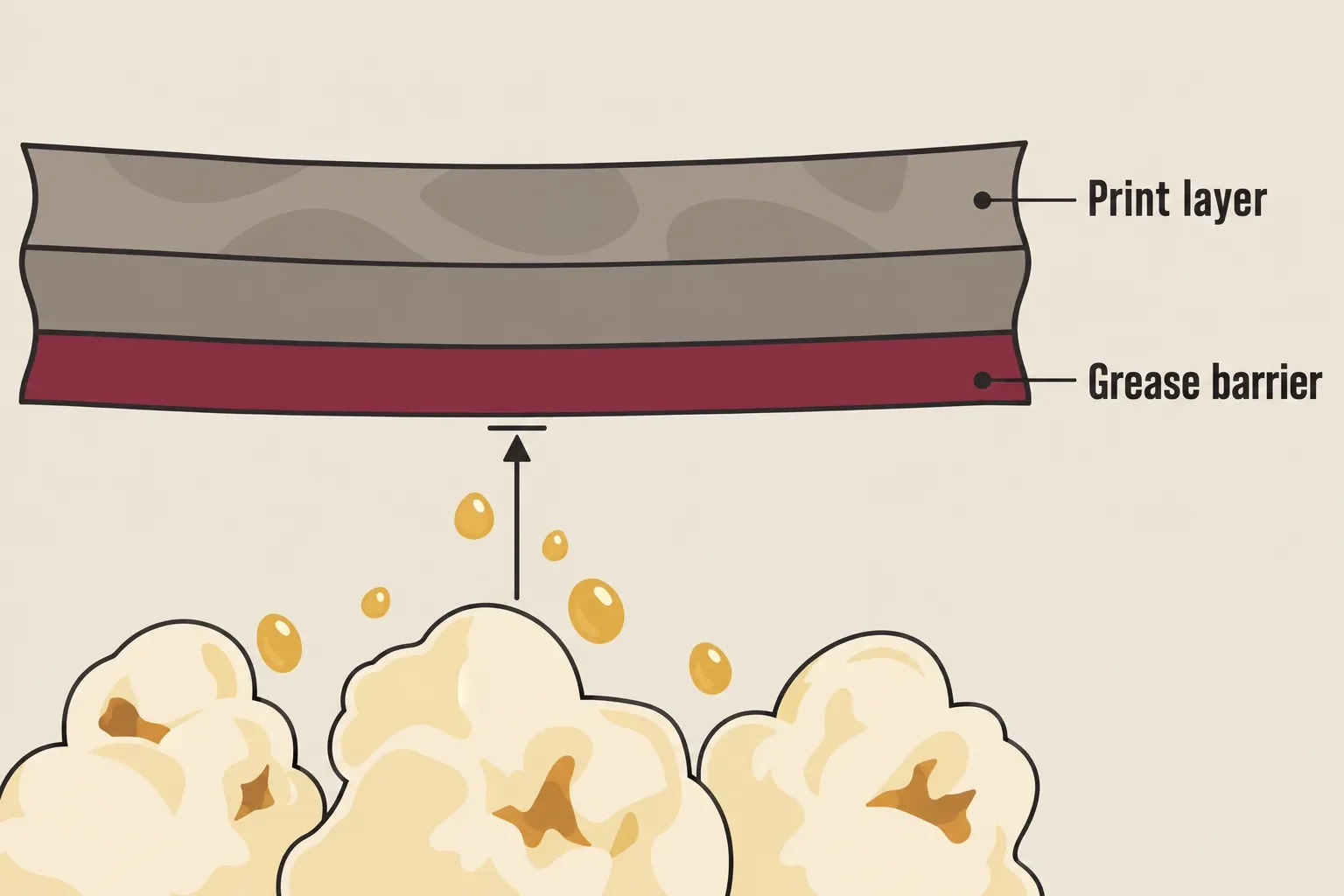
Butter, oil and flavor coatings leave residual fat on popped corn. Over time, that fat migrates into the packaging. If the film’s inner layers do not resist it, grease spreads through the structure and shows up as dark, translucent stains on the print, often a week or two after packing, when the bags are already on a shelf.
Why a chip bag film is not automatically right. Chip bags are built around frying oil on a fairly dry snack. Kettle corn and caramel or cheese-coated popcorn combine fat with sugar and sometimes moisture, which behaves differently. A film that works perfectly on plain popcorn can still stain with a buttery or caramel variety.
What fixes it
- A grease-resistant inner layer in the laminate, specified for your coating rather than a generic snack film.
- Seal quality. Grease and coating dust in the seal area weaken seals. Keep the seal area clean during filling.
- Shelf testing. Grease shows up late. Pack your fattiest flavor, store it in warm conditions, and check the bag over several weeks before you approve the structure.
Paper bags and grease-proofing. Paper popcorn bags and microwave bags have historically relied on chemical grease-proofing. The US Food and Drug Administration announced on February 28, 2024, that grease-proofing substances containing PFAS are no longer being sold for food-contact use in the US market, naming microwave popcorn bags among the typical products they were used on. If you use paper packaging, ask your supplier how grease resistance is achieved today. In Canada, Health Canada oversees the safety of food packaging materials.
For barrier performance against oxygen and moisture, see Armour Rose’s explainer on oxygen transmission rate.
Moisture and Venting: Keeping Kettle Corn Crisp
Popcorn goes stale mainly by absorbing moisture from the air, which turns a crisp product chewy. But freshly popped corn, and kettle corn in particular, can also carry residual moisture and warmth from cooking. Sealed too soon, that moisture has nowhere to go and the product softens in the bag.
Start with the process
- Cool fully before packing. Warm popcorn in a sealed bag creates condensation. Most softening problems start here.
- Pack in a controlled environment. Humid packing rooms add moisture before the bag is even sealed.
- Seal promptly once cool. Leaving cooled popcorn exposed lets it pick up humidity.
Then the package
- High moisture barrier keeps outside humidity away from cooled, dry product. This is the default for most ready-to-eat popcorn.
- Venting or micro-perforation is sometimes specified for kettle corn and freshly packed product to let residual moisture escape. It is a trade-off: vents that release moisture can also let humidity back in, so vent size and count have to be matched to your product, batch size and cooling time, and tested.
- Resealable zippers help customers keep multi-serve bags crisp after opening. Armour Rose’s resealable zipper pouches page covers closure options.
The right answer depends on your product and process. Test your kettle corn in the candidate bag through a realistic distribution cycle before committing.
Raw Kernel Packaging: Holding Moisture In
Raw popcorn kernels pop because water inside the kernel turns to steam. Too little moisture and kernels pop poorly; too much and the popcorn turns out chewy. Iowa State University Extension puts the ideal moisture content of popcorn at 13 to 14.5 percent and recommends storing kernels in airtight containers.
For packaging, that means:
- Airtight, moisture-protective structures that keep kernels from drying out on a warm shelf or absorbing moisture in a humid warehouse.
- Strong seals and puncture resistance. Kernels are hard and dense, and heavy bulk bags are handled roughly.
- No grease barrier needed for plain kernels, which can make the structure simpler than for coated popped corn.
- Clear windows if you want shoppers to see kernel quality, weighed against light and barrier.
Raw kernels and popped corn rarely share the right film, so specify them separately even when they sit in the same range.
Microwave Popcorn Packaging: What It Is and What to Ask
Microwave popcorn uses a specialized package. It is usually a paper bag with a susceptor, a thin metallized layer that absorbs microwave energy and concentrates heat at the base of the bag so the kernels pop. The bag also has to manage oil from the charge inside and vent steam as it pops.
That makes microwave packaging a specialist category:
- It is a food-contact package that is heated, so materials and coatings must be suitable for that use.
- Grease resistance has changed since the FDA’s 2024 announcement on PFAS grease-proofing substances, so confirm how current structures achieve it.
- It usually runs on dedicated filling and folding equipment, often at a co-packer.
If you are developing a microwave product, plan the bag with your co-packer and a specialist converter from the start. The outer packaging around microwave bags, such as printed cartons, overwraps, shippers and displays, follows the same rules as other popcorn formats.
Bag Formats Compared for Popcorn
| Stand-up pouch | Flat-bottom pouch | Side-gusset bag | Pillow bag | Flow wrap | |
|---|---|---|---|---|---|
| How it’s built | Front and back panels with a folded bottom gusset | Box-like base, side gussets | Gussets on both sides | Flat bag sealed on the edges | Film wrapped around the product and sealed |
| Shelf presence | Stands upright, wide front panel | Strongest; stands like a box | Stands when full | Lies flat or hangs; classic snack look | Single-serve and multipack |
| Resealing | Zipper standard | Zipper available | Fold, tie or zipper | Usually single use | Single use |
| Best popcorn fit | Multi-serve gourmet, coated and kettle corn | Premium and gift ranges, larger retail sizes | Bulk, foodservice and raw kernels | High-volume popped corn, single serves, raw kernels | Individual portions and bars |
| Filling | Hand fill or premade-pouch machines | Hand fill or premade-pouch machines | Hand or VFFS | VFFS from rollstock | Horizontal flow wrapper |
| Cost drivers | Mid; zipper adds cost | Higher; more converting steps | Efficient at large sizes | Lowest material per bag at volume | Efficient at high speed |
VFFS stands for vertical form-fill-seal: a machine that forms bags from printed rollstock, fills them and seals them in one process. It is the standard route for high-volume pillow bags.
Armour Rose sources stand-up pouches, flat-bottom pouches, side-gusset bags, pillow pouches, roll stock film and flow wrap film, so the format can follow the product rather than a single production line.
Bag Size and Volume: Why Popcorn Is Different
Most snacks are sized by weight. Popcorn is so light that the bag is really sized by volume. A modest weight of popped corn can fill a large bag, which affects three things:
- Bag dimensions. Size the bag to the popped volume and headspace, not just the net weight. A fill test with your actual product and flavor is the only reliable way to set dimensions, because coatings change density.
- Crush protection. Large, light bags are easy to crush in a case. Headspace and case design matter.
- Case cube and freight. You ship a lot of air. The number of bags per case, the case dimensions and the pallet pattern drive freight cost more than weight does. Plan corrugated shipping boxes alongside the bag.
Common popcorn size tiers by use:
| Use | Typical format | Notes |
|---|---|---|
| Single serve and lunchbox | Small pillow bag or flow wrap | Often sold in multipacks inside a carton |
| Sharing size | Pillow bag or stand-up pouch | Main grocery and convenience size |
| Family and multi-serve | Stand-up pouch with zipper | Resealing keeps it crisp |
| Club and bulk | Large pillow or side-gusset bag | Check club store case and pallet rules |
| Gift and holiday | Gift tin, rigid box or flat-bottom pouch | Presentation first |
For club store programs, Armour Rose’s guide to Costco packaging requirements for suppliers shows how detailed case and pallet requirements can get.
Cartons, Gift Tins and Gift Boxes
Popcorn is a gifting and seasonal category, and rigid formats do a lot of the selling.
- Folding cartons suit multipacks of single-serve bags, microwave products and retail packs that need a strong printed billboard. Cartons are not a moisture barrier on their own, so the popcorn inside still needs a bag or liner. See Armour Rose’s folding cartons.
- Gift tins are a holiday staple for assorted flavors. They protect against crushing and look premium. Plan an inner liner or bag for freshness and grease resistance, and a shipper that protects the tin in transit.
- Rigid and mailer boxes suit gift sets, flavor assortments and online orders, where presentation and parcel protection both matter. See rigid and mailer boxes.
- Displays. Popcorn is an impulse buy. PDQ and counter displays put small bags and gift packs where shoppers see them.
Seasonal flavors and holiday tins make print minimums a real issue. That is covered below.
Labels, Sleeves and Managing a Flavor Range
Popcorn brands rarely sell one flavor. A typical range has a few core flavors, a rotating set of specials and a holiday line, and each one needs its own artwork. How you decorate the pack decides how expensive that range is to run.
Fully printed bags give the best shelf presence and the lowest unit cost at volume, but every flavor is a separate print design with its own minimum. They suit your core, year-round flavors.
Stock or semi-custom bags with labels let you run many flavors, short batches and test products without a print minimum per flavor. A printed base bag in brand colors with a flavor label is a common middle ground. Armour Rose’s guide to shrink sleeves vs pressure-sensitive labels explains label options and where each works best.
Sleeves on cartons and tins. For multipacks and gift packs, a printed carton sleeve over a stock carton or tin lets one container serve several flavors or seasons.
Plan the panels before the artwork. Whatever the decoration, leave room for:
- The product name and flavor, readable at shelf distance.
- The ingredient list and allergen information, which flavored and coated varieties often make long.
- The nutrition panel and net quantity.
- Best-by or lot coding, placed where your coding equipment can reach it.
Keep required text off problem areas. Gussets, seals, zippers and windows distort or hide small text. Put regulatory information on flat panels.
A practical approach for many brands: print core flavors fully, run specials on labeled stock bags, and move a special to full print once its volume justifies it. Reviewing the range once or twice a year keeps print commitments matched to what actually sells.
Filling Lines and Co-Packers
How you fill the bag decides which formats are practical.
- Hand filling and heat sealing. Common for markets, gourmet shops and early retail. Premade stand-up pouches and flat-bottom pouches work well. Keep coating dust and grease out of the seal area.
- Semi-automatic filling. Weighers or volumetric fillers with premade pouches, as volumes grow. Popcorn is fragile and bulky, so fill gently to avoid breakage.
- VFFS lines with rollstock. The route for high-volume pillow bags. Film has to match the machine’s web width, seal temperatures and speed, and nitrogen flushing may be part of the process.
- Co-packers. Many popcorn brands outsource popping, coating and packing. Your co-packer’s equipment decides the film specification.
What to send your equipment supplier or co-packer before ordering
- Bag format and dimensions, including gusset depth.
- Product type and flavor, since coatings affect grease and seal performance.
- Film structure and sealing layer.
- Zipper or vent requirements.
- Target speed, and whether nitrogen flushing is used.
- How rollstock or pouches should be packed for delivery.
Ask for a sample run on the actual equipment before a full print. For the broader trade-off between printed film and finished pouches, see Armour Rose’s guide to rollstock vs premade pouches. If bags fail at the seal, the guide to pouch seal failure causes covers the usual causes.
Sustainable Popcorn Packaging
Mono-material polyethylene bags. Single-material structures designed for store drop-off recycling are available. Grease-resistant additives can complicate recyclability for coated and buttered varieties, so confirm compatibility for each flavor before printing a claim.
Post-consumer recycled (PCR) content. Recycled content is often more straightforward for plain popcorn that does not carry heavy grease.
Paper bags. Paper looks natural and suits some gourmet and event packaging, but grease resistance and moisture barrier are harder to achieve, and paper bags often need a liner.
Before printing any sustainability claim:
- Confirm which certification or recyclability claim the specific structure supports.
- Check that recycling programs in your customers’ regions accept it.
- Test grease resistance and moisture barrier with your fattiest and most humidity-sensitive flavors.
- Match the wording on the bag exactly to the structure.
Minimum Orders, Lead Times and Cost: What Drives Each
Popcorn brands often run many flavors plus seasonal and holiday SKUs, which makes print minimums the main commercial pressure.
What drives the minimum order
- Print method. Digital printing suits short runs and many flavors; plate-based printing suits long runs of core SKUs. See the guide to digital printing vs rotogravure packaging.
- Number of designs. Each flavor and size is a separate design.
- Format. Rollstock, finished pouches, cartons and gift tins each carry their own minimums.
What drives the lead time
- Artwork and proof approval for each flavor.
- Plates or cylinders, if needed.
- Material sourcing for grease-resistant films, zippers and vents.
- Printing, laminating and converting.
- Equipment trials for new film.
- Freight, customs and delivery.
Holiday tins and gift boxes need planning well ahead of the season. Reorders of approved designs are usually much faster than first orders. For a stage-by-stage breakdown, read the guide to how long custom packaging takes.
Make and hold. Where available for your product, a make-and-hold program can let you print at an efficient quantity and release stock as you need it, so a holiday-only flavor is not funded the same way as a year-round bestseller.
What drives unit cost
- Film structure, especially grease-resistant and high-barrier layers.
- Format and features: zippers, vents, windows, finishes.
- Bag size, since popcorn needs large bags for its weight.
- Print method, colors, number of designs and order quantity.
- Freight, which is driven by case cube for a bulky product.
Compare quotes on the delivered cost per sellable bag, not the film price alone.
When to Choose a Carton or Tin Instead of a Bag
Choose a folding carton when:
- You sell multipacks of single-serve bags or microwave products.
- You need a strong shelf billboard and stackable retail packs.
- The product inside is already protected by its own bag.
Choose a gift tin or rigid box when:
- You sell holiday assortments, corporate gifts or premium gift sets.
- Crush protection and presentation matter more than unit cost.
- Customers reuse the container, which keeps the brand in the home.
Stay with a bag when:
- You sell everyday grocery, convenience or club sizes.
- Light weight and freight cost matter most.
- You need resealing for multi-serve popcorn.
Many popcorn brands use all three: pillow bags or stand-up pouches for core flavors, cartons for multipacks, and gift tins for the holidays. That works best when they are specified and quoted together.
A Popcorn Brand's Pre-Order Spec Checklist
Product
- Raw kernels, plain popped, coated, kettle corn or a mix
- Flavor lineup, with the fattiest and stickiest flavors flagged
- Cooling and packing process, including room humidity
Format
- Stand-up, flat-bottom, side-gusset, pillow, flow wrap, carton, tin or a mix
- Bag dimensions set by a fill test with each flavor
- Shelf, display, case and pallet constraints
Protection
- Grease-resistant inner layer for coated flavors
- Moisture barrier target, and whether venting is needed
- Airtight, moisture-protective structure for raw kernels
- Shelf test plan in warm and humid conditions
Features
- Zipper, tear notch, window, hang hole
Filling
- Hand fill, semi-automatic, VFFS or co-packer
- Equipment details shared with the supplier
- Sample run planned before full print
Sustainability
- Claim and certification for each structure
- Recyclability checked for coated varieties
Ordering
- Print method and artwork status for each flavor
- Seasonal and holiday timing
- Make-and-hold needs and delivery locations
How Armour Rose Helps Popcorn Brands
Armour Rose is a custom packaging partner that manages sourcing and production through a vetted manufacturing network, so the recommendation follows your product, your flavors and your line. Every project runs on the A-R-G Process: Ask First, Resolve Second, Grow Third.
- Product review. A look at your current bags and flavor lineup to find where grease resistance or moisture management does not match what the product needs.
- Kernel and popped formats specified separately. Different structures for raw kernels, plain popped corn and coated varieties.
- Grease-resistant films and venting. Grease-resistant structures for coated flavors and venting specified for moisture release where it is needed.
- Equipment matching. Film and pouches specified to your filling equipment, coordinated directly with your co-manufacturer.
- One program, every format. Stand-up, flat-bottom, side-gusset and pillow bags, rollstock, flow wrap, folding cartons, sleeves, gift tins, rigid and mailer boxes, corrugated shippers, labels and displays.
- Safety stock on select products. For certain products, with some manufacturing partners, stock can be held and released as you need it, so seasonal flavors tie up less cash.
- Cross-border supply. Coordination of production, customs and delivery across Canada and the United States.
Explore Armour Rose’s custom popcorn packaging options, or read on for common questions.
Related readingChip BagsRead the guide →
Frequently asked questions
What kind of bag is best for popcorn?
For ready-to-eat popcorn, a stand-up pouch or pillow bag with a moisture barrier is the usual choice, with a grease-resistant inner layer for coated and buttered flavors. Raw kernels need an airtight, moisture-protective bag.
Why does my popcorn bag get grease stains?
Fat from butter, oil or coatings migrates through film layers that do not resist it and shows through the print. A grease-resistant inner layer specified for your actual coating prevents it. Test your fattiest flavor before approving a film.
Why does my kettle corn go soft in the bag?
Usually because it was packed before it fully cooled, or in a humid room, so moisture is trapped in the bag. Cool fully, pack in a controlled environment, and match the barrier and any venting to your product.
Do popcorn bags need vents?
Not always. Most ready-to-eat popcorn does best with a strong moisture barrier once fully cooled. Venting or micro-perforation is sometimes specified for kettle corn or freshly packed product, but it can let humidity in, so it has to be tested.
How should raw popcorn kernels be packaged?
In an airtight, moisture-protective bag. Kernels pop best within a narrow moisture range, which Iowa State University Extension puts at 13 to 14.5 percent, so the package has to stop them drying out or absorbing moisture.
Do popcorn bags expire?
The popcorn has a shelf life, and the bag decides how long it stays crisp. A good moisture and grease barrier, clean seals and a reseal feature extend the period during which the product tastes fresh. Set best-by dates through shelf testing.
What packaging is used for microwave popcorn?
Microwave popcorn uses a specialized paper bag with a susceptor that concentrates heat. It is a specialist format usually developed with a co-packer and converter. The FDA announced in 2024 that PFAS-based grease-proofing agents are no longer sold for US food packaging.
How do I package popcorn for sale at markets and events?
Many brands start with premade stand-up pouches or pillow bags, hand filled and heat sealed, with labels for each flavor. As you move into retail, add a grease-resistant structure for coated flavors, consistent bag sizes and printed packaging.
Can I get custom printed popcorn bags in small quantities?
Digital printing suits shorter runs and many flavors. Labels on stock bags are another option for very small batches. Where available for your product, make-and-hold programs can help when you want the unit price of a larger run without taking all the stock at once.
Are popcorn bags recyclable?
Some are. Mono-material polyethylene bags can suit store drop-off recycling, but grease-resistant additives can complicate recycling for coated varieties. Confirm compatibility for each flavor before printing a claim.
Should I use a tin or a bag for holiday popcorn?
Tins and rigid gift boxes win on presentation, crush protection and reuse, but cost and weigh more. Bags are lighter and cheaper to ship. Many brands use tins for holiday assortments and bags for everyday flavors.
Can raw kernels and popped popcorn use the same bag?
They can share a format, such as a pillow bag or stand-up pouch, but rarely the same film. Kernels need moisture held in at a stable level, while popped and coated popcorn need humidity kept out and, for coated flavors, grease resistance. Specify each product separately, even when the bags look alike on the shelf.
Get Your Popcorn Packaging Specification Reviewed
Send your product types, your flavor lineup, your current bag specification, your filling method and your sales channels. Armour Rose will review where grease resistance and moisture management fall short and quote bags, cartons, tins and displays as one program. Start with custom popcorn packaging or contact Armour Rose to share your current specification.