

















Tea sachets look simple: a small bag, a tag, a box. But the word “sachet” means two different things in the tea trade, and the decisions behind a sachet program reach well beyond the bag itself. The infusion material, the individual envelope, the outer carton or pouch and the way your bagging line handles the film all decide whether a blend still tastes the way you designed it months after packing.
This guide explains what tea sachets are, how they compare with flat tea bags and loose leaf pouches, and what to specify before you ask for quotes. It is honest about the cases where a loose leaf pouch or a carton of individually wrapped bags is the better buy. If you already want help with the full program, start with Armour Rose’s custom tea packaging options.
Quick Answer: What Is a Tea Sachet, and When Should You Use One?
A tea sachet is either a roomy, often pyramid-shaped infusion bag for whole-leaf tea, or the sealed envelope around a single tea bag. Use pyramid sachets for premium whole-leaf blends, flat bags for everyday and foodservice tea, and resealable pouches for loose leaf sold by weight.
What Is a Tea Sachet?
The tea trade uses “sachet” for two different things, and mixing them up is a common source of confusing quotes.
1. The infusion sachet. This is the bag the tea is brewed in, usually larger than a standard flat tea bag. Pyramid (tetrahedral) sachets are the best-known example. The extra volume lets whole leaves, flowers and larger herbal pieces unfurl as they steep, which is why premium tea brands use them for whole-leaf and visually distinctive blends. Infusion sachets are usually made from a mesh or a filter material and may come with a string and tag.
2. The protective sachet, or envelope. This is the small sealed pouch that wraps a single tea bag, often called an individual envelope or overwrap. When people search for “individually wrapped tea bags”, this is the layer they mean. The envelope keeps aroma in and moisture out once the outer box is opened, and it makes single bags suitable for hotels, offices, foodservice and gift assortments.
Many premium programs use both: a pyramid infusion sachet, sealed inside an individual envelope, packed in a printed folding carton. Each layer has its own specification.
In other food categories, “sachet” means a small flat single-serve pack for powders or liquids. That is a different format. Armour Rose’s guide to stick packs vs sachet packs covers that meaning.
Sachet vs Tea Bag: How the Formats Compare
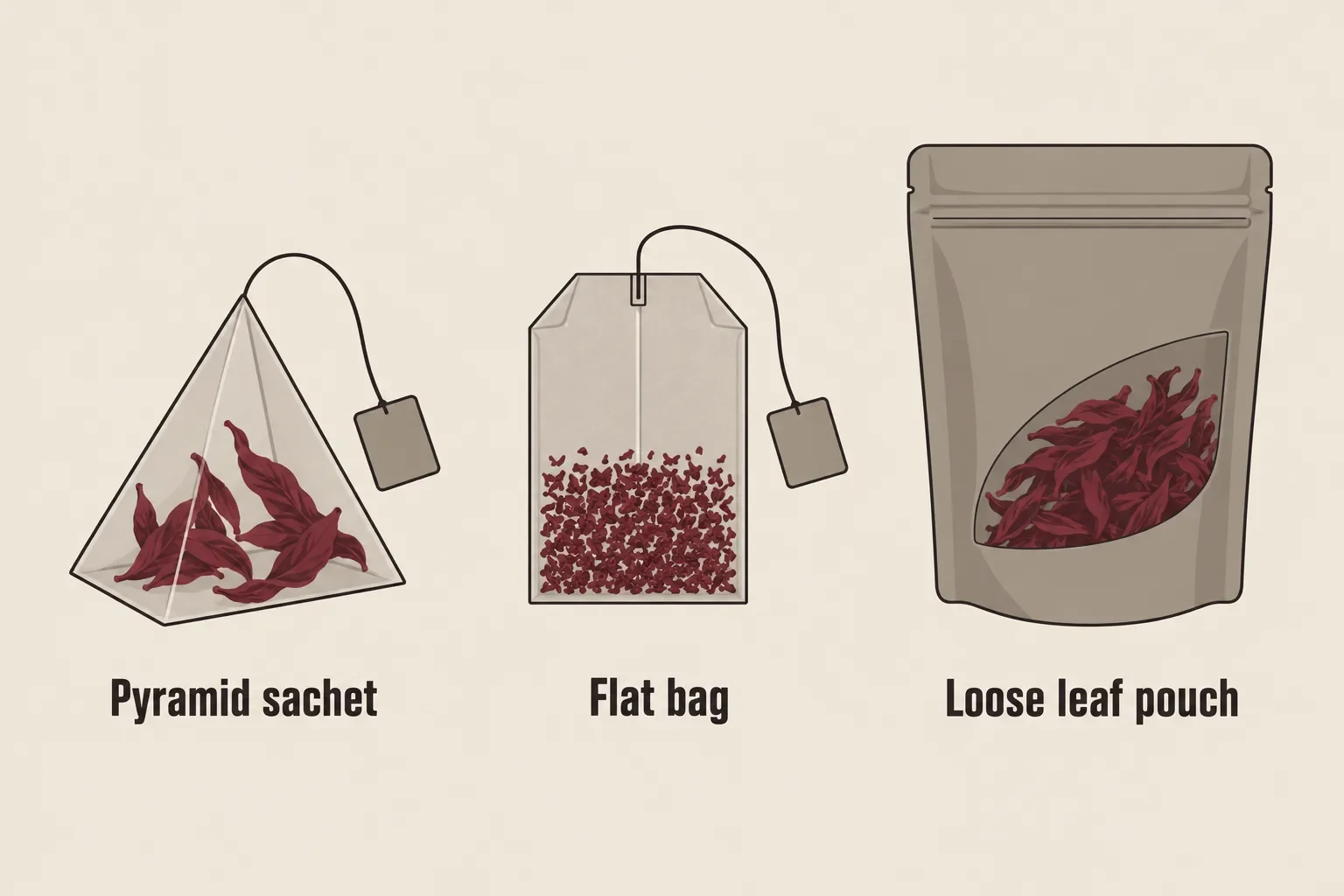
| Pyramid or large sachet | Flat tea bag | Loose leaf in a pouch | |
|---|---|---|---|
| Typical leaf grade | Whole leaf, larger herbal pieces, blends with flowers or fruit | Smaller cut leaf (fannings and broken grades) | Whole leaf and full blends |
| Room to infuse | Generous; leaves can expand | Limited | Full, but the customer needs an infuser |
| Common materials | Plant-based mesh, plastic mesh or filter material | Filter paper (heat-seal or non-heat-seal) | No infusion material; barrier pouch only |
| Shelf presentation | Premium; often shown through a window or in a gift box | Everyday, value or foodservice | Premium and craft; strong storytelling panels |
| Cost drivers | Mesh material, more tea per serve, slower or specialized machines | Lowest material cost per serve; high-speed machines | Pouch structure, zipper and print |
| Machinery | Specialized pyramid bagging machines | Standard tea bag machines (flat, string-and-tag, tagless) | Hand fill or pouch-filling equipment |
| Typical channels | Specialty retail, hotels, gift sets, subscriptions | Grocery, foodservice, offices | Specialty retail, direct-to-consumer, cafés |
Sachets are not automatically “better” than flat bags. They suit whole-leaf blends and a premium price point. Flat bags remain the right choice for many black teas, everyday blends and high-volume foodservice programs, where the leaf grade and cost per serve matter more than visual appeal.
Infusion Materials: Paper, Plant-Based Mesh and Plastic Mesh
The infusion material is usually supplied by your filter media supplier or co-packer, not by your packaging partner, but it shapes every decision around it, from the bagging machine to the sustainability claims on the box.
Filter paper. The traditional material for flat tea bags. It comes in heat-seal grades, which contain a thermoplastic component so the bag can be sealed with heat, and non-heat-seal grades, which are closed by folding, crimping or stitching. Ask your supplier which type your bags use, because it affects both the machine and compostability claims.
Plant-based mesh. Many pyramid sachets use a mesh made from polylactic acid (PLA), a bio-based polymer. It looks like fine fabric, holds its shape for whole leaf, and is often marketed as compostable. Whether it actually composts depends on industrial composting access in your customers’ regions.
Plastic mesh. Some sachets use nylon or polyethylene terephthalate (PET) mesh. These are strong and clear, but they have drawn scrutiny. A 2019 study by researchers at McGill University, published in Environmental Science & Technology (Hernandez et al., 2019, DOI 10.1021/acs.est.9b02540), found that plastic tea bags made of nylon and PET released very large numbers of microplastic and nanoplastic particles into the tea at brewing temperature. The human health effects are not established, but many tea brands now avoid plastic mesh for that reason and because customers ask about it.
Strings, tags and staples. String-and-tag bags add a branding surface. Tagless and staple-free formats reduce materials and suit compostability goals. Your bagging machine decides which options are realistic.
Decide the infusion material first, then specify the protective layers to match it. A compostable bag inside a non-compostable envelope sends a mixed message on the box.
Why Tea Goes Flat: Aroma, Oxygen, Light and Moisture
Tea rarely spoils in an obvious way. It goes flat: the bright, floral or malty character fades and the cup tastes dusty. That is mostly packaging at work, or failing to work.
- Aroma loss. The volatile aromatic compounds that give a blend its character escape through films and seals that do not hold them. A pouch can look perfect on the shelf and still let the aroma out.
- Oxygen. Oxygen degrades flavor compounds over time. Delicate green and white teas are generally the most sensitive. Barrier is measured as oxygen transmission rate; Armour Rose’s explainer on oxygen transmission rate covers how to specify it.
- Light. Light speeds up the loss of color and flavor. Clear windows look attractive but give up some protection.
- Moisture. Tea picks up moisture and odors from the air. Moisture dulls flavor and, in bad cases, leads to mold.
- Odor transfer. Tea readily absorbs smells from its surroundings, from warehouse air to other products in the same case. A good barrier keeps foreign odors out as well as aroma in.
Unlike freshly roasted coffee, tea does not release carbon dioxide after packing, so no degassing valve is needed. That simplifies tea pouches, but it puts all the weight on the barrier film and the seals.
Matching barrier to blend usually looks like this:
| Blend type | Sensitivity | Typical protective structure |
|---|---|---|
| Green and white teas | Highest; lose freshness fastest | Foil laminate or high-barrier structure with full light block |
| Oolong and flavored blends | Medium to high; flavor oils are volatile | High-barrier metallized or foil structures |
| Black teas and robust blends | Lower; more forgiving | Metallized films are often sufficient |
| Herbal and fruit blends | Varies; dried fruit and flowers can be moisture-sensitive | Match to the most sensitive ingredient |
Individual Envelopes and Sachet Film
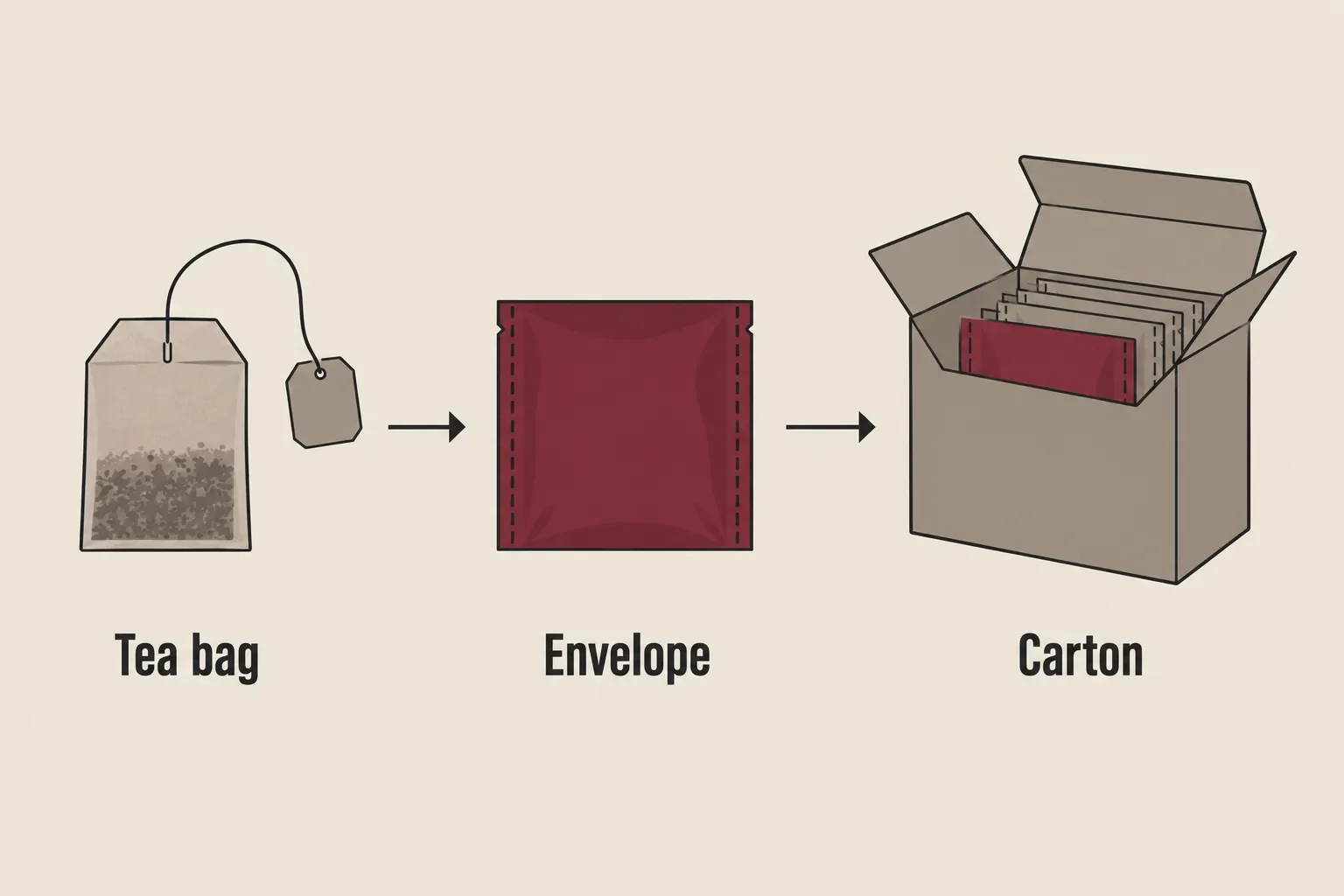
An individual envelope protects each bag after the outer box is opened. Whether you need one depends on how your tea is sold and how long a box sits open.
When individual envelopes make sense
- Hotel, office and foodservice programs where single bags are handed out or displayed loose.
- Gift assortments and sampler boxes with several blends in one carton.
- Delicate or strongly flavored blends that would lose aroma or transfer odor once the box is open.
- Premium pyramid sachets, where the envelope protects both the leaf and the presentation.
When you can skip them
- Everyday black tea in a well-sealed inner bag or a pouch inside the carton, used up quickly.
- Value programs where cost per serve matters more than long open-box freshness.
Envelope materials
| Envelope type | Barrier | Look | Typical use |
|---|---|---|---|
| Foil laminate | Highest; full light block | Metallic inside, printable outside | Green, white and premium blends |
| Metallized film | High at lower cost | Shiny inside | Most retail and foodservice envelopes |
| Paper-look laminate | Barrier comes from the inner film | Natural, matte | Premium and craft positioning |
| Compostable films | Generally lower barrier | Varies | Brands with strong compostability goals |
Seal integrity matters as much as the film. A weak seal on an individual envelope lets air and moisture in before the customer ever opens it, and no outer carton can make up for that. Ask for seal strength checks on sample runs. If you have seen seals fail, Armour Rose’s guide to pouch seal failure causes walks through the usual suspects.
Envelope and sachet film is usually supplied as printed roll stock film that runs on the tea bagging machine. Armour Rose sources sachet film specified to the brand’s bagger.
Outer Packaging: Cartons, Pouches and Gift Boxes
The outer pack does three jobs: it protects the bags or leaves inside, it sells the tea on the shelf, and it carries the required label information. The right format depends on your channel.
| Channel | Common outer format | Why |
|---|---|---|
| Grocery and specialty retail | Printed folding cartons of bags or sachets | Stackable, strong shelf billboard, efficient case packing |
| Premium retail and gifting | Rigid and mailer boxes, cartons with windows, sleeves | Presentation and perceived value |
| Loose leaf retail and direct-to-consumer | Stand-up or flat-bottom pouches with zippers | Resealable, lighter to ship, strong storytelling panels |
| Foodservice and hospitality | Bulk cartons of individually enveloped bags; side-gusset bulk bags | Hygiene and portion control |
| Counter and impulse | Small cartons in PDQ and counter displays | Visibility at checkout and in cafés |
| Seasonal and limited blends | Stock carton plus a printed carton sleeve or label | Lower print commitment per blend |
A note on cartons. Paperboard cartons are not an oxygen or moisture barrier on their own. If bags are not individually enveloped, the tea relies on an inner bag, a sealed liner or an overwrap to stay fresh. Board grade also shapes print quality and stiffness; Armour Rose’s guides to folding carton styles and SBS vs CUK vs CRB paperboard explain the options.
Loose Leaf Tea Packaging: Pouches, Bags and Tins
For tea sold by weight, the choice is between flexible packaging and rigid containers.
| Stand-up pouch | Flat-bottom pouch | Side-gusset bag | Tin or canister | |
|---|---|---|---|---|
| Shelf presence | Stands upright, wide front panel | Stands like a box, five printable panels | Stands when full; often bulk or foodservice | Premium, reusable |
| Resealing | Press-to-close zipper | Zipper or tin tie | Tin tie, fold or zipper | Lid; often with an inner bag |
| Barrier | Comes from the laminate | Comes from the laminate | Comes from the laminate | The tin blocks light, but the lid seal matters |
| Shipping weight | Light | Light | Light and efficient at larger sizes | Heavier and bulkier |
| Best fit | Everyday loose leaf, direct-to-consumer | Premium retail and gift blends | Bulk, wholesale and foodservice | Gift ranges, reuse programs |
Armour Rose sources stand-up pouches, flat-bottom pouches and side-gusset bags for loose leaf, along with zipper reseal options. Tins are a common premium choice in the tea market; if you use them, plan the inner liner and the outer gift box or shipper alongside them.
For loose leaf, the same barrier rules apply as for envelopes: match the structure to your most sensitive blend, keep windows small if you use them, and confirm the zipper still seals well after repeated opening.
Tea Bagging Lines and Co-Packers
Most tea brands either run their own bagging machine or work with a co-packer that does. Either way, the film you order has to run on that machine. Sachet and envelope film is not interchangeable between machines.
What sachet and envelope film must match
- Web width and roll specifications: width, core size, roll diameter and unwind direction.
- Seal temperature range: the film’s sealing layer has to seal within the window the machine runs.
- Infusion material compatibility: the machine settings for filter paper, PLA mesh or plastic mesh affect how the envelope is formed and sealed around it.
- Print registration: eye marks and repeat length so the machine cuts each envelope in the right place.
- Format: pyramid, flat, string-and-tag or tagless.
What to send your equipment supplier or co-packer before ordering
- Machine make, model and format.
- Current film specification, if you have one in writing (many brands do not).
- Bag or sachet dimensions and fill weight per serve.
- Target line speed.
- How film rolls should be packed and labeled for delivery.
Ask for a sample run on the actual machine before committing to a full print. Discovering a seal or registration problem after a full run has been printed costs far more than a trial. For the broader trade-off between printed film and finished pouches, see Armour Rose’s guide to rollstock vs premade pouches.
Sustainable Tea Packaging: What Exists and What to Check
Tea buyers are often sustainability-minded, so tea brands get asked about packaging more than most. The options are real, but each has trade-offs.
Infusion bags. Plant-based mesh and non-heat-seal paper bags are common choices for brands moving away from plastic mesh. Check whether your heat-seal paper contains a plastic component before calling a bag plastic-free.
Compostable envelopes and pouches. Compostable films made from bio-based materials exist for envelopes and loose leaf pouches. They generally offer less barrier than foil, which can shorten shelf life for delicate blends, and they only compost where industrial composting accepts them.
Mono-material polyethylene pouches. Single-material structures designed for store drop-off recycling are a second route. Barrier is typically lower than foil laminates, so test with your most sensitive blend.
Cartons. Paperboard cartons are widely recyclable, which makes the carton the easy part. The question is what is inside it.
Before printing a sustainability claim:
- Confirm which certification, if any, each layer holds, including the bag, the envelope and any string or tag.
- Check that composting or recycling programs in your customers’ regions accept those materials.
- Test barrier and shelf life with your actual blends.
- Make sure the wording on the box matches every layer, not just one of them.
Armour Rose sources compostable structures on request and can put a compostable option and a conventional barrier option on the same quote, so you can compare shelf life, cost and claims side by side.
Minimum Orders, Lead Times and Cost: What Drives Each
Tea brands often run many blends, including seasonal and limited editions, which makes minimum order quantities the biggest commercial headache.
What drives the minimum order
- Print method. Digital printing suits short runs and many designs because it needs no plates or cylinders. Plate-based printing suits large runs of fewer designs. Armour Rose’s guide to digital printing vs rotogravure packaging explains the trade-off.
- Number of blends and designs. Each blend counts as a separate design for envelopes, cartons and pouches.
- Format. Sachet roll stock, finished pouches and printed cartons each carry their own minimums.
What drives the lead time
- Artwork preparation and proof approval for every blend.
- Plates or cylinders, if needed.
- Material sourcing for the specific film, board and features.
- Printing, laminating and converting.
- Machine trials for new sachet film.
- Freight, customs and delivery to your facility or co-packer.
Reorders of approved designs are usually much faster than first orders. For a stage-by-stage breakdown, read Armour Rose’s guide to how long custom packaging takes.
Separating the print run from the cash outlay. Where available for your product, a make-and-hold program can let you print at the quantity that earns an efficient unit price, then release stock as you need it. For a slow-moving seasonal blend, that can matter more than the unit price itself.
What drives unit cost
- Infusion format and material (mesh pyramids cost more than paper flat bags).
- Whether each bag is individually enveloped.
- Film and board structure, finishes and print colors.
- Order quantity, number of designs, freight and duties.
Compare quotes on the delivered cost per sellable box or pouch, not on the cost of a single component.
When to Choose a Loose Leaf Pouch Instead of Sachets
Sachets are not always the right answer.
Choose loose leaf pouches when:
- Your customers are enthusiasts who brew with their own infusers and value full leaf.
- You sell by weight in larger quantities, where bags would add cost and material per serve.
- You want the lowest packaging cost per serve for premium leaf.
- You sell direct-to-consumer and need a light, resealable pack that ships well.
Choose a carton of individually enveloped bags when:
- You sell to hotels, offices or foodservice.
- You offer assortments or samplers with several blends in one box.
- Your blends are delicate and boxes stay open for weeks.
Choose pyramid sachets when:
- You sell whole-leaf or visually distinctive blends at a premium price.
- Convenience matters but customers still expect a loose-leaf experience.
Many tea brands run all three: pyramid sachets for a premium range, flat bags for everyday blends, and loose leaf pouches for enthusiasts. That works well when the whole range is specified and quoted together.
A Tea Brand's Pre-Order Spec Checklist
Product
- Blends and their sensitivity (green, white, oolong, black, herbal, flavored)
- Leaf grade and piece size for each blend
- Serve size and number of serves per box or pouch
Infusion format
- Flat bag, pyramid sachet or loose leaf
- Infusion material (filter paper type, plant-based mesh, plastic mesh)
- String and tag, tagless or staple-free
Protection
- Individual envelope: yes or no, and material
- Outer carton, pouch, gift box or a mix
- Barrier target by blend and shelf life goal
Equipment
- Bagging machine make, model and format, or co-packer details
- Film specification (web width, core, seal temperature, registration)
- Sample run planned before full print
Retail and channel
- Channels: grocery, specialty, direct-to-consumer, foodservice, gifting
- Display needs (counter, PDQ, shelf-ready trays)
- Label content and panel space
Sustainability
- Claims for each layer, with certification where relevant
- Local composting or recycling access for your customers
Ordering
- Print method preference and artwork status for every blend
- Make-and-hold or call-off needs for slow blends
- Delivery location (your facility, co-packer, warehouse)
How Armour Rose Helps Tea Brands
Armour Rose is a custom packaging partner that manages sourcing and production through a vetted manufacturing network, so the recommendation can follow your blends, your bagger and your channels. Every project runs on the A-R-G Process: Ask First, Resolve Second, Grow Third.
- Blend review. A look at your current blends and packaging to flag where the barrier and the shelf life goal do not match.
- Sachet film matched to your bagger. Film specified to your tea bag machine, whether it runs pyramid, flat or string-and-tag formats, coordinated directly with your equipment provider or co-packer.
- One program, every format. Sachet film, stand-up, flat-bottom and side-gusset pouches, zipper pouches, folding cartons, sleeves, rigid and mailer boxes, corrugated shippers, labels and displays on one program.
- Safety stock on select products. For certain products, with some manufacturing partners, stock can be held and released as you need it, so slow seasonal blends tie up less cash.
- Cross-border supply. Coordination of production, customs and delivery across Canada and the United States.
- Sustainable options on request. Compostable and recyclable structures quoted alongside conventional barrier structures.
Explore Armour Rose’s custom tea packaging options, or read on for common questions.
Related readingStand-Up Coffee PouchesRead the guide →
Frequently asked questions
What is the difference between a tea sachet and a tea bag?
A tea sachet usually means a larger infusion bag, often pyramid-shaped, that gives whole leaves room to expand. A standard tea bag is flatter and usually holds smaller cut leaf. “Sachet” can also mean the sealed envelope around a single bag, so check which meaning a supplier is using.
What are tea sachets made of?
Infusion sachets are commonly made from filter paper, plant-based mesh (often PLA) or plastic mesh such as nylon or PET. Protective envelopes are usually foil, metallized film or paper-look laminates. Each material affects barrier, cost and sustainability claims.
Are pyramid tea sachets better than flat tea bags?
They are better for whole-leaf and visually distinctive blends because the leaves have room to open. Flat bags remain the practical choice for smaller cut leaf, everyday blends and high-volume foodservice, where cost per serve matters more.
Do tea bags need to be individually wrapped?
Not always. Individual envelopes make sense for foodservice, hotels, assortments and delicate blends that would lose aroma once the box is open. Everyday blends used quickly from a well-sealed box often do without them.
Why does my tea lose its flavor before the best-by date?
Usually because the barrier was never matched to the blend, or because seals are weak. Aroma escapes through films and seals that do not hold it, and light and oxygen speed up the loss. Green and white teas are usually the most sensitive.
Does tea packaging need a degassing valve like coffee?
No. Tea does not release gas after packing the way freshly roasted coffee does, so a one-way valve is not needed. Focus on barrier film, seal quality and resealing for loose leaf.
Can sachet film be specified for my existing tea bagging machine?
Yes, but it has to match the machine’s web width, roll format, seal temperature range and infusion material. Share your machine details with your packaging partner and equipment supplier, and run a trial before printing a full order.
Are plastic tea bags a problem?
Plastic mesh bags made from nylon or PET have drawn scrutiny since a 2019 study found they released large numbers of microplastic and nanoplastic particles at brewing temperature. Health effects are not established, but many brands now choose paper or plant-based mesh.
What is the most sustainable tea packaging?
There is no single answer. Plastic-free infusion bags, recyclable paperboard cartons and compostable or recyclable pouches can all help, but barrier and local composting or recycling access decide what makes sense. Make sure every layer supports the claim on the box.
How can I manage minimum order quantities for many seasonal blends?
Digital printing lowers minimums for short runs, sleeves or labels on stock cartons reduce per-blend print commitments, and make-and-hold programs, where available for your product, can let you print efficiently and release stock as needed.
Should I sell loose leaf tea in pouches or tins?
Pouches are lighter, cheaper to ship and reseal well with a zipper. Tins are premium and reusable but heavier, and the lid seal and any inner bag decide how well they protect the tea.
Get Your Tea Packaging Specification Reviewed
Send your blend list, your current bag and envelope specification, your bagging equipment details and your retail channels. Armour Rose will review where the barrier falls short and quote sachet film, pouches, cartons and displays as one program. Start with custom tea packaging or contact Armour Rose to share your current specification.