


















Stand-up coffee pouches are the default bag for a lot of specialty roasters, and for good reason: they stand on a shelf, they reseal, they take a degassing valve, and they run on simple filling setups. But “stand-up pouch” is not one specification. The valve, the size, the closure, the film and the way you order all change how well the bag protects your coffee and what it costs you per unit.
This guide walks through the decisions a roaster has to make before asking for quotes, and it is honest about the cases where a flat-bottom or side-gusset bag is the better buy. If you already know you want help with the full program, start with Armour Rose’s custom coffee packaging options.
Quick Answer: When Is a Stand-Up Pouch the Right Bag for Coffee?
A stand-up pouch is the right coffee bag for ground coffee, smaller retail sizes and direct-to-consumer or subscription bags, especially across several SKUs that need a zipper and a one-way valve. For whole bean that has to compete beside national brands, a flat-bottom bag usually earns its cost. Side-gusset bags remain the traditional, film-efficient coffee format.
Why Coffee Is a Hard Product to Package
Coffee is one of the more demanding products to put in a flexible bag, because it attacks the package from inside and outside at the same time.
CO2 off-gassing. Roasting creates gases inside the bean, and a large share of them is carbon dioxide. Research from the Zurich University of Applied Sciences (Smrke et al., Journal of Agricultural and Food Chemistry, 2018) measured how roasted coffee releases these gases over time and found the release depends on the roast degree and roasting speed, and differs between whole beans and ground coffee. In practice, roasters see the same thing: freshly roasted beans keep releasing gas for days, darker roasts tend to release more, and grinding releases much of the gas quickly. If that gas has nowhere to go, a sealed pouch inflates and can split at the seals.
Oxygen. Oxygen drives staling. Once oxygen reaches the coffee, aromatic compounds and oils start to degrade. Keeping oxygen out depends on the film’s barrier (measured as oxygen transmission rate, or OTR), the quality of the seals, and how much air is left in the bag at packing.
Moisture. Roasted coffee picks up moisture from the air, which dulls flavor and speeds up staling. The film’s water vapor barrier matters, especially for ground coffee and humid distribution routes.
Light. UV and visible light speed up oil oxidation. Clear windows look good on a shelf but give up some protection.
Aroma loss. Aroma compounds can escape through weak films and poor seals. A strong barrier keeps the coffee smelling like coffee when the customer opens it.
Whole bean versus ground. Ground coffee has far more surface area. It releases its gas faster, stales faster, and packs more densely than whole beans. A bag that works for whole beans is not automatically right for ground.
All of this is why the bag decision for coffee is really three decisions: the format (stand-up, flat-bottom, side-gusset or pillow), the protection (film, valve, seals), and the order route (premade pouches or rollstock). The rest of this guide covers each one.
Stand-Up vs Flat-Bottom vs Side-Gusset vs Pillow Bags for Coffee
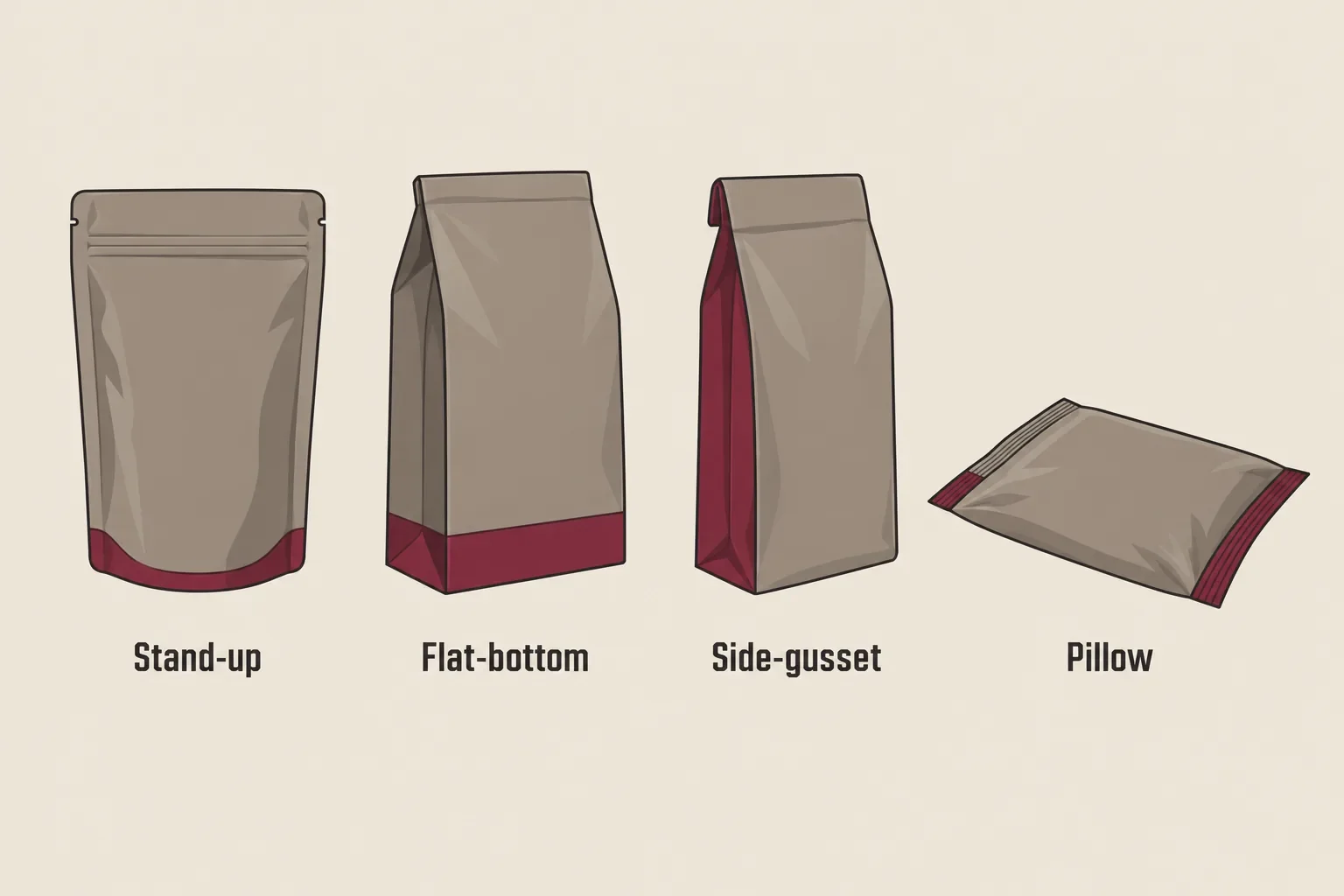
A gusset is a folded panel that expands when the bag is filled. Where the gussets sit is what separates these formats. For a full, product-neutral comparison of the two upright formats, see Armour Rose’s guide to flat-bottom bags vs stand-up pouches. The table below keeps to what matters for coffee.
| Stand-up pouch | Flat-bottom bag | Side-gusset bag | Pillow (lay-flat) bag | |
|---|---|---|---|---|
| How it’s built | Front and back panels with a folded bottom gusset | Box-like flat base with two side gussets | Gussets on both sides, usually a folded or sealed bottom | Flat bag sealed on the edges, no gusset |
| Shelf presence for coffee | Stands upright, wide front panel | Strongest: stands like a box, crisp edges | Stands when full, narrow face; often laid flat or boxed | Lies flat; needs a peg, tray or box |
| Print panels | Front and back | Front, back, two sides and base | Front, back and two narrow sides | Front and back |
| Typical coffee fill weights | Sample sizes to about 2 lb; larger possible | 8 oz to 5 lb | 12 oz to 5 lb and wholesale | Samples, fractional packs, single-serve |
| Main unit cost drivers | Usually the most economical upright format at small and mid runs | More material and more converting steps, so typically higher per unit | Efficient on material at larger sizes | Lowest material use |
| Filling | Easy to hand fill; works on many semi-automatic fillers | Easy to hand fill; wide opening | Often filled on vertical form-fill-seal lines or by hand with a funnel | Usually formed from rollstock on a packaging line |
| Valve placement | Upper front or back panel, above the fill line | Front or back panel | Front panel, upper area | Possible, but uncommon for small packs |
| Best coffee fit | Ground coffee, smaller retail sizes, direct-to-consumer and subscription bags, multi-SKU ranges | Retail whole bean beside national brands, higher price points, gift ranges | The traditional coffee bag: retail, wholesale and food service, 2 lb and 5 lb bags | Samples, frac packs, multipacks inside a carton |
The stand-up pouch earns its place for ground coffee, smaller retail sizes and online or subscription programs, and it gets more cost effective when print runs across several SKUs are combined. For whole bean on a competitive grocery shelf, test a flat-bottom bag against it; for a classic look or larger fills, a side-gusset bag is often the better buy. Armour Rose sources stand-up pouches, flat-bottom pouches and side-gusset bags, so the recommendation can follow your product and channels rather than a single production line.
Do You Need a One-Way Degassing Valve?

A one-way degassing valve is a small fitting heat-sealed or welded into the pouch wall. It opens when the pressure inside the bag rises and lets CO2 out, then closes so outside air cannot get back in.
What the valve does for coffee
- Lets you pack fresh. Without a valve, roasters have to rest coffee for long enough before packing that the bag will not inflate. A valve lets you pack closer to the roast date, which is what most specialty customers want.
- Protects the seals. Trapped gas puts pressure on seams and zippers. Bags that balloon on the shelf look damaged and can fail.
- Keeps air out. A working one-way valve blocks oxygen from flowing back in, so the barrier film can do its job.
When roasters skip the valve
- Small samples and single brews. Sample bags that are opened within days, or that are packed after resting, often go without a valve to save cost.
- Ground coffee packed after degassing. Ground coffee releases much of its gas quickly. Some roasters rest ground coffee briefly before packing and skip the valve, though this trades away some freshness.
- Nitrogen-flushed packs. Some packing lines flush the bag with nitrogen to push out oxygen before sealing. Freshly roasted whole beans in a flushed pack still release CO2, so a valve is usually still needed.
Where the valve goes on a stand-up pouch
The valve belongs on the upper part of the front or back panel, above the fill line, so it stays clear of the beans and can vent freely. Keep it away from the zipper track and the side seals, and leave room for it in the artwork, because it interrupts the printed panel. Your supplier should confirm placement against the pouch dimensions and the fill height of your actual coffee.
Valve vs no valve: the trade-off
| With valve | Without valve | |
|---|---|---|
| Freshness at packing | Pack soon after roasting | Coffee has to rest first, or the bag inflates |
| Unit cost | Higher: the valve and the extra converting step | Lower |
| Shelf appearance | Flat, controlled | Risk of puffed bags if the coffee wasn’t rested long enough |
| Best for | Whole-bean retail and subscription bags | Samples, rested ground coffee, very short shelf times |
For more detail on barrier performance around valves and seals, see Armour Rose’s explainer on oxygen transmission rate.
Coffee Stand-Up Pouch Sizes: A Starting-Point Guide
Size is where roasters most often get caught out. A bag that fits 12 oz of a dense dark roast can be too small for 12 oz of a light roast, and a bag that fits whole beans can leave a lot of empty space when filled with ground coffee.
The dimensions below are typical starting points taken from published coffee pouch size charts (width × height + bottom gusset). Treat them as a way to frame the conversation with your supplier, not as a specification.
| Fill weight | Typical stand-up pouch (mm) | Approx. inches | Common use |
|---|---|---|---|
| 2 oz (about 50 g) sample | 100 × 190 + 60 gusset | 3.9 × 7.5 + 2.4 | Samples, trial packs, gift boxes |
| 8 oz (about 250 g) | 160 × 220 + 70 gusset | 6.3 × 8.7 + 2.8 | Single-origin, café retail |
| 12 oz (340 g) | 180 × 240 + 90 gusset | 7.1 × 9.4 + 3.5 | The most common US retail size |
| 1 lb (454 g) | 180 × 280 + 100 gusset | 7.1 × 11.0 + 3.9 | Grocery and subscription |
| 2 lb (908 g) | 230 × 340 + 120 gusset | 9.1 × 13.4 + 4.7 | Value packs, office coffee |
| 5 lb | 310 × 470 + 125 gusset | 12.2 × 18.5 + 4.9 | Wholesale and food service |
For comparison, the same charts typically list a 12 oz flat-bottom bag at around 125 × 230 mm with an 80 mm gusset (about 4.9 × 9.1 × 3.1 in). The flat-bottom bag is narrower and taller for the same weight, because its base and side gussets hold more volume.
Why your coffee may need a different size
- Roast level. Darker roasts expand more during roasting and are less dense, so the same weight takes more space than a light roast.
- Whole bean vs ground. Ground coffee packs more densely, so a whole-bean bag filled with ground coffee may look under-filled.
- Headspace. You need space above the product for the zipper, the valve and a clean top seal. A bag filled to the top is hard to seal and hard to reseal.
- Shelf and shipping. The bag has to fit your shelf, your display tray and your shipping box. Check all three before locking dimensions.
The only reliable way to confirm a size is a fill test: ask for blank sample stand-up pouches in two or three sizes, fill them with your actual coffee at your actual weight, and check the fill line, the valve position and the seal area.
Closures and Features: What Matters for Freshness and What Is Cosmetic
Features that protect the coffee
- Press-to-close zipper. Lets customers reseal the bag after opening, which slows staling at home and is expected on most retail coffee. Zippers add cost and need space below the top seal.
- Tin tie. A strip of bendable metal or plastic applied to the bag so it can be rolled down and clipped shut. Common on side-gusset and flat-bottom bags and on a kraft-paper look. It closes the bag but does not seal it the way a zipper does.
- Tear notch. A small cut in the side seal that lets customers open the bag cleanly above the zipper. It is low cost and prevents customers from cutting through the zipper.
- Degassing valve. Covered above. For whole-bean coffee, this is the feature that matters most.
Features that are mostly about presentation
- Clear window. Lets shoppers see the beans. It reduces light protection and usually means a clear film in that area, so weigh it against your shelf life goals.
- Hang hole. Useful for peg displays in grocery or café retail. Not needed for shelf-only placement.
- Matte, soft-touch or spot-gloss finishes. These shape the look and feel of the brand. They do not change freshness.
A good rule: decide on the features that protect the coffee first, then add presentation features within the budget left. Armour Rose’s resealable zipper pouches page covers closure options in more detail.
Materials and Barrier Structures for Coffee Pouches
Most coffee pouches are laminates: two or more layers of film bonded together, each layer doing a job. The outer layer carries the print, the middle layer provides the barrier, and the inner layer seals.
| Structure type | Barrier level | Look | Typical coffee use |
|---|---|---|---|
| Foil laminate (aluminum foil layer) | Highest oxygen, moisture and light barrier | Opaque, metallic inside | Long shelf life, export, grocery |
| Metallized film (a thin metal coating on PET or similar) | High barrier at lower cost than foil | Opaque, shiny inside | Most retail specialty coffee |
| High-barrier clear films | Good oxygen barrier, less light protection | Clear | Bags with windows, shorter shelf times |
| Kraft-paper look laminates | Barrier comes from the film inside, not the paper | Natural, craft look | Specialty and café brands |
Three points roasters often miss:
- Kraft paper is not the barrier. A kraft-look coffee bag protects the coffee only because of the barrier film laminated behind the paper. Ask what that inner structure is.
- The weakest point is usually the seal, not the film. A high-barrier film with a poor seal or a badly fitted valve will still let oxygen in.
- Shelf life is a system. Film, seals, valve, headspace, nitrogen flushing and storage conditions all work together. Match the barrier to how long your coffee actually sits in distribution and on the shelf.
For a deeper look at how barrier is measured and specified, read Armour Rose’s guide to oxygen transmission rate packaging.
Recyclable and Compostable Coffee Pouches
Many roasters want a more sustainable bag, and both recyclable and compostable coffee pouches are on the market. The trade-offs are real, though, and the claim printed on the bag has to match the actual structure.
Recyclable mono-material pouches. These use a single family of plastic (most often polyethylene) for every layer, so the bag can be accepted in programs that take that material. Barrier is achieved with special coatings or layers designed to stay within that material family. They can work well for coffee, but barrier performance and heat resistance differ from traditional laminates, so test them with your coffee and your sealing equipment.
Compostable pouches. These use plant-based or certified compostable films and, in some cases, compostable valves and zippers. They generally offer less barrier than foil or metallized laminates, which can mean shorter shelf life. Whether a bag actually gets composted depends on whether local industrial composting programs accept it.
What to check before you print a sustainability claim:
- Which certification, if any, the specific structure holds, and whether the valve and zipper are covered too.
- Whether recycling or composting programs in your customers’ regions accept that material.
- Whether the barrier meets your shelf life target for whole bean and ground coffee.
- Whether the material runs cleanly on your sealing equipment.
Ask your packaging partner to put a sustainable structure and a conventional barrier structure on the same quote, so you can compare shelf life, cost and claims side by side.
Premade Pouches vs Rollstock for a Growing Roaster
There are two ways to buy flexible packaging. Premade pouches arrive already formed, with the zipper and valve in place; you fill them and seal the top. Rollstock is printed film on a roll that a packaging machine forms into bags, fills and seals in one process (a form-fill-seal line).
| Stage | Typical setup | Best order route |
|---|---|---|
| Starting out | Hand filling with a scale and a heat sealer | Premade stand-up pouches |
| Growing | Semi-automatic filler, tabletop or band sealer | Premade pouches, larger runs, fewer designs |
| Scaling | Automatic premade-pouch filling machine | Premade pouches at volume |
| High volume, few SKUs | Vertical form-fill-seal line | Rollstock |
Most roasters stay with premade pouches far longer than they expect, because they handle many SKUs, seasonal designs and small runs. Rollstock makes sense once a few core SKUs run at high volume on dedicated equipment. Some form-fill-seal systems can make stand-up formats with the right tooling, so confirm with your equipment supplier.
For the full comparison, including cost and equipment trade-offs, see Armour Rose’s guide to rollstock vs premade pouches.
Filling Equipment and Co-Packer Compatibility
A common question from roasters is whether stand-up pouches will work with standard filling equipment. They usually can, but only if the pouch is specified for the machine. Before you order, send your filler supplier or co-packer:
- Pouch dimensions including gusset depth and the opening width.
- Fill weight and product type: whole bean or ground, and the roast range.
- Zipper type and position, measured from the top of the bag.
- Valve position, so it clears grippers, nozzles and sealing jaws.
- Film structure and sealing layer, so the sealing temperature, pressure and dwell time can be set.
- Target line speed and whether the line uses nitrogen flushing.
- How the pouches are packed for delivery (stacked, boxed, banded), because automatic machines feed from magazines.
Ask for a sample run on the actual machine before a full order. Many seal failures and jams come from small mismatches in pouch size, zipper position or seal width. If you have seen pouches fail seal tests, Armour Rose’s guide to pouch seal failure causes covers the usual suspects.
Minimum Orders, Lead Times and Cost: What Drives Each
Every roaster wants to know three numbers before ordering: the minimum order, the lead time and the unit price. Honest answers depend on the specification, so it helps to know what moves each number.
What drives the minimum order
- Print method. Digital printing suits short runs and many designs because there are no printing plates or cylinders. Rotogravure and flexographic printing need plates or cylinders, so they suit larger runs of fewer designs. Armour Rose’s guide to digital printing vs rotogravure packaging explains the trade-off.
- Number of designs. Each origin, blend or size counts as a design. Ten designs at a small quantity each is a very different order from one design at a large quantity.
- New structure vs stock structure. Custom film structures and sizes need more setup than a supplier’s standard options.
What drives the lead time
A quoted lead time can cover very different things. Separate these stages when you compare quotes:
- Artwork preparation and proof approval.
- Plates or cylinders, if the print method needs them.
- Material sourcing for the specific film, valve and zipper.
- Production scheduling, printing, laminating and curing.
- Pouch converting (forming, zipper, valve, cutting).
- Quality checks.
- Freight, customs and delivery to your roastery or co-packer.
Reorders of an existing design are usually much faster than a first order, because the artwork, plates and structure are already approved. For a full breakdown of each stage, read Armour Rose’s guide to how long custom packaging takes.
What drives the unit cost
- Pouch size and film structure (foil and specialty films cost more).
- Add-ons: valve, zipper, window, special finishes.
- Print method and number of colors.
- Order quantity and number of designs.
- Freight and duties for your delivery location.
Compare quotes on the delivered cost per filled, sellable bag, not the pouch price alone. A cheaper pouch that causes waste on the line or stales faster on the shelf costs more in the end.
When to Choose a Flat-Bottom or Side-Gusset Bag Instead
The stand-up pouch is the right default for many roasters, but not all of them.
Choose a flat-bottom bag when:
- You are selling into a premium grocery shelf where the bag has to stand like a box and look sharp from every angle.
- You want more print area for origin stories, brew guides or retailer requirements, using the side panels and base.
- You sell larger retail weights (1 lb to 5 lb) and want a stable bag that does not slump as it empties.
- Your price point supports a higher unit cost.
Choose a side-gusset bag when:
- You sell wholesale, office or food-service coffee in 2 lb and 5 lb formats.
- You want the traditional coffee bag: efficient on film, with strong vertical shelf presence and a degassing valve on the front or side panel.
- Packing density in shipping cases matters more than a wide front panel.
- You want a tin tie or a folded top.
Consider a bag inside a carton when:
- You sell gift sets, subscription boxes or multi-origin sampler packs.
- You sell to club stores, where cases, pallets and shelf-ready packaging have their own requirements. Armour Rose’s guide to Costco packaging requirements for suppliers shows how detailed those can get.
Many roasters end up with a mix: stand-up pouches for core retail SKUs, flat-bottom bags for a premium line, and side-gusset bags for wholesale. That is fine, as long as each format is specified for its channel and the program is managed together.
A Roaster's Pre-Order Spec Checklist
Run through this list before you ask for quotes. It turns a vague request into one that suppliers can price accurately.
Product
- Whole bean, ground, or both
- Roast range (light, medium, dark) for each SKU
- Fill weight per bag size
- Number of SKUs and designs
Format
- Stand-up, flat-bottom, side-gusset or a mix
- Target dimensions confirmed by a fill test
- Shelf, display and shipping box constraints
Protection
- Shelf life target from roast to sale
- Film structure (foil, metallized, high-barrier clear, kraft-look)
- Degassing valve: yes or no, and placement
- Nitrogen flushing: yes or no
Features
- Zipper, tin tie or none
- Tear notch
- Window, hang hole, finishes
Sustainability
- Recyclable or compostable structure required
- Certification and claim wording to be confirmed
Filling and ordering
- Hand fill, semi-automatic, automatic or co-packer
- Equipment details shared with the supplier
- Premade pouches or rollstock
- Print method preference and artwork status
- Target launch date and reorder frequency
- Delivery location (roastery, co-packer, warehouse)
How Armour Rose Helps Roasters
Armour Rose is a custom packaging partner that manages sourcing and production through a vetted manufacturing network. That matters for coffee, because the right answer is often a mix of formats rather than one bag. Every project runs on the A-R-G Process: Ask First, Resolve Second, Grow Third.
- One partner for the whole program. Stand-up pouches, flat-bottom bags, side-gusset bags, roll stock for fractional and filter packs, folding cartons, rigid and mailer boxes for subscriptions, pressure-sensitive labels, shipping boxes and counter displays can be specified and quoted together.
- Side-by-side quotes across formats. You can see stand-up, flat-bottom and side-gusset options on one specification sheet, with the trade-offs in cost, shelf presence and filling laid out.
- Specification support. Help with film structures, valves, closures, sizes and co-packer or equipment requirements before anything is printed.
- Logistics. Coordination of production, freight and delivery to your roastery or co-packer.
Explore Armour Rose’s custom coffee packaging options, or keep reading for answers to common questions.
Related readingFlat Bottom Bag vs Stand Up Pouch: How to ChooseRead the guide →
Frequently asked questions
Are stand-up pouches good for coffee?
Yes, especially for ground coffee, smaller retail sizes and direct-to-consumer or subscription bags. For whole bean on a competitive grocery shelf, compare them with flat-bottom and side-gusset bags. They stand on a shelf, take a one-way degassing valve and a resealable zipper, and are easy to fill by hand or on semi-automatic equipment. Protection depends on the film and the seals, so choose a barrier structure that matches your shelf life.
Do stand-up coffee pouches need a valve?
Most whole-bean coffee packed soon after roasting needs a one-way degassing valve, because the beans keep releasing CO2. Without one, the bag can inflate. Sample bags, rested coffee and some ground coffee are sometimes packed without a valve.
What size stand-up pouch do I need for 12 oz of coffee?
Published coffee size charts commonly list a 12 oz stand-up pouch at around 180 × 240 mm with a 90 mm bottom gusset (about 7.1 × 9.4 × 3.5 in). Roast level and grind change the space needed, so confirm with a fill test using your own coffee.
What is the difference between a stand-up pouch and a flat-bottom coffee bag?
A stand-up pouch has a folded bottom gusset and two main panels. A flat-bottom bag has a box-like base and side gussets, so it stands more squarely and offers more print area, usually at a higher unit cost. See the full flat-bottom bag vs stand-up pouch comparison.
What are typical lead times for premade custom stand-up pouches?
Lead times depend on the print method, whether plates or cylinders are needed, the film and valve sourcing, the number of designs, and freight. Reorders are usually faster than first orders. Ask each supplier which stages their quoted lead time covers, from proof approval to delivery.
Are stand-up pouches compatible with standard filling equipment?
They usually are, provided the pouch is specified for the machine. Share the pouch dimensions, zipper and valve positions, film sealing layer and target speed with your equipment supplier or co-packer, and run a sample on the actual line before ordering.
Should I buy premade pouches or rollstock?
Premade pouches suit roasters with many SKUs, small runs or hand and semi-automatic filling. Rollstock suits high-volume SKUs on a form-fill-seal line. Read the rollstock vs premade pouches guide for the full trade-off.
Are recyclable or compostable coffee pouches as protective as foil bags?
Usually not quite. Recyclable mono-material and compostable structures generally offer less barrier than foil laminates, which can shorten shelf life. Test them with your coffee and match the claim on the bag to the certified structure and to local programs.
Can I use the same pouch for whole bean and ground coffee?
You can use the same format, but the size and barrier may need to change. Ground coffee packs more densely and stales faster, so it may fit a smaller bag and benefit from a higher barrier.
How can I tell if my coffee pouches are failing?
Puffed or split bags, zippers that come apart, and stale coffee before the best-by date are the usual signs. Common causes include seal contamination, the wrong sealing settings, a missing or blocked valve, or a film that does not match the shelf life. Armour Rose’s guide to pouch seal failure causes walks through diagnosis.
What packaging do club stores like Costco require for coffee?
Club stores set their own requirements for case packs, pallets, labels and shelf-ready packaging, and they change by retailer and program. Start with Armour Rose’s overview of Costco packaging requirements for suppliers and confirm the current vendor guide with your buyer.
Get Your Coffee Pouches Specified Side by Side
Send your coffee SKUs, fill weights, roast and whole-bean versus ground mix, filling method and target retail channels. Armour Rose will specify stand-up, flat-bottom and side-gusset options side by side in one quote, with labels, cartons, mailer boxes and shipping boxes alongside. Start with custom coffee packaging or contact Armour Rose to share your current specification.