


















A cereal box looks like one package, but it is really two: a printed folding carton made by a paperboard converter, and a sealed barrier liner made by a film converter. The two are usually bought from different suppliers, on different lead times, with different minimums, and they only meet for the first time on your filling line. That is where most granola and cereal packaging problems start.
This guide walks through what a granola or cereal brand has to decide before asking for quotes: carton with liner or pouch, which liner film, how to protect crunch and clusters, how the pack runs on the line, and when a stand-up pouch is the better buy. If you already want help with the whole program, start with Armour Rose’s granola and cereal packaging options.
Quick Answer: Is a Cereal Box or a Pouch Better for Granola?
Choose a folding carton with a sealed barrier liner when you sell cereal or cluster granola into grocery and need a stackable, billboard-style shelf face. Choose a resealable stand-up pouch when you sell premium or multi-serve granola, want a lighter pack, or sell direct to consumer. Many brands use both across their range.
Why Granola and Cereal Are Harder to Package Than They Look
Moisture kills crunch. Crispness is the attribute customers notice first and complain about fastest. Cereals have a measurable moisture point beyond which they stop being acceptably crisp. A University of Wisconsin shelf-life study (Drager, 2014) found critical moisture contents of 5.5% and 6.5% for two ready-to-eat cereals, and used the packaging’s water vapor transmission rate to predict how long each would stay below that point. The lesson for packaging is simple: the liner’s moisture barrier decides how long your crunch lasts.
Oils go rancid. Granola carries oils from nuts, seeds and coconut. Once oxygen and light reach those oils, they oxidize and the product starts to taste stale well inside its stated shelf life. A plain cereal with little fat is far less demanding than a nut-heavy cluster granola.
Clusters break. The clusters are why premium granola commands its price, and they are the first thing lost in transit. A pack with too much headspace lets clusters tumble into fines that settle at the bottom.
Low bulk density. Light product takes up a lot of space for its weight. It falls slowly on a filling line, traps air, and ends up in a bigger pack than the weight suggests, which raises freight cost per unit.
Two suppliers, one package. A carton specified without the liner in front of it is a guess. When the liner is slightly too wide for the carton it wrinkles at the top seal and slows the line. When the carton is sized without knowing the liner gauge, the flaps do not close cleanly.
So the packaging decision for granola and cereal is really four decisions: the format, the barrier, how the product is protected inside the pack, and how the pack ships.
Folding Carton With Liner vs Stand-Up Pouch vs Other Formats
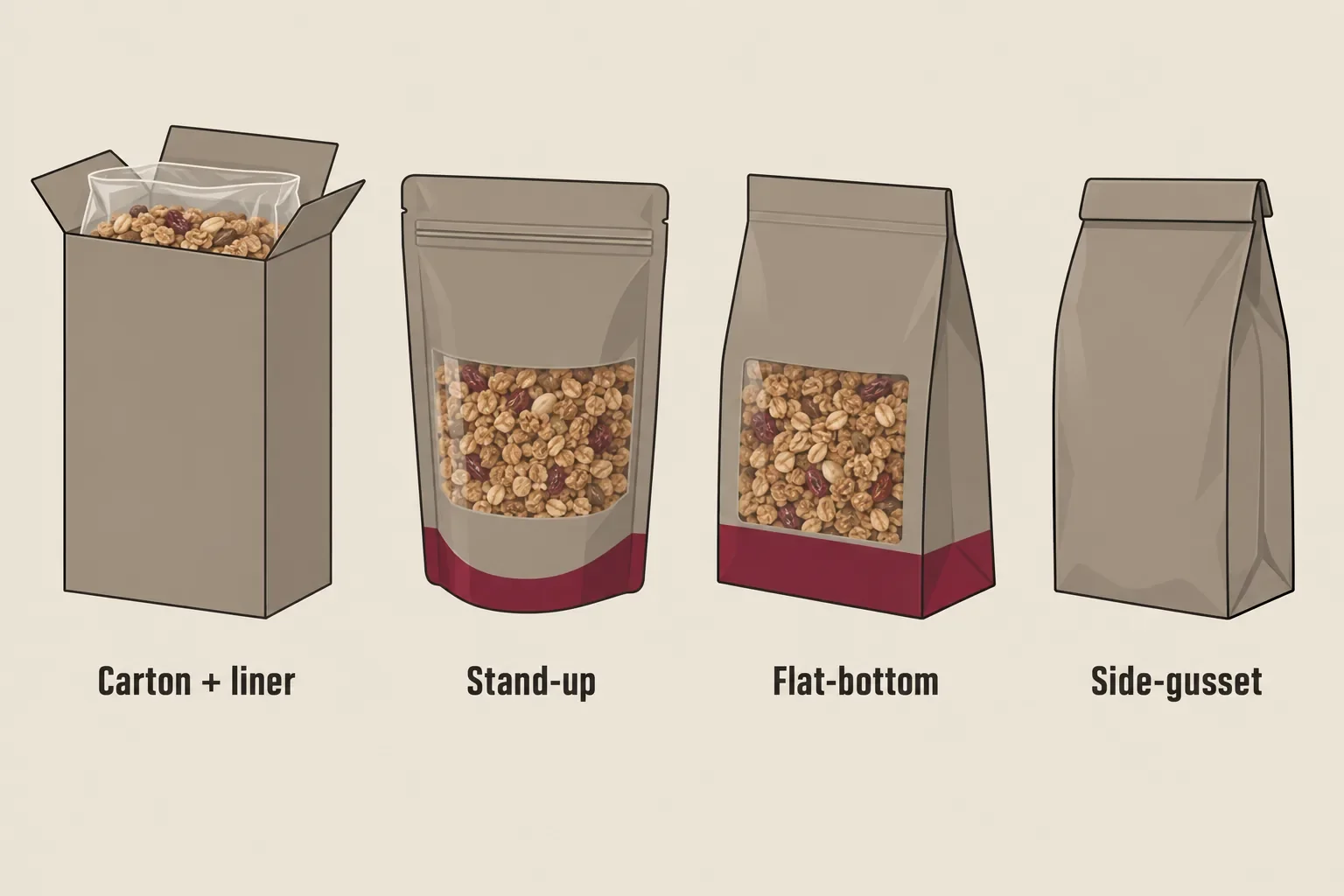
| Folding carton + liner (bag-in-box) | Stand-up pouch | Flat-bottom pouch | Side-gusset bag | Pillow bag | |
|---|---|---|---|---|---|
| How it’s built | Printed paperboard carton with a sealed film liner inside | Flexible pouch with a folded bottom gusset | Flexible pouch with a box-like flat base | Gussets on both sides, folded or sealed bottom | Flat bag sealed on the edges |
| Shelf presence | Classic cereal billboard; stacks and faces forward | Stands upright; strong front panel | Stands like a box; premium look | Stands when full; efficient on shelf | Lies flat; often inside a carton |
| Print area | Large carton panels on every side | Front and back | Front, back, sides and base | Front, back, narrow sides | Front and back |
| Resealing | Liner usually not resealable; carton re-closes | Zipper standard | Zipper available | Fold-and-clip or zipper | Usually single use |
| Typical fit | Cereal and cluster granola in grocery | Premium and multi-serve granola, DTC | Premium granola, higher fill weights | Large cereal and granola fills | Liners, high-volume lines, single-serve |
| Filling | Liner formed on a vertical form-fill-seal line, then cartoned | Premade pouches, hand or machine filled | Premade pouches | Form-fill-seal or premade | Form-fill-seal from rollstock |
| Main trade-off | Two components to coordinate | Less shelf block than a carton | Higher unit cost | Less premium look | Needs a carton or display for retail |
Armour Rose sources every one of these formats, including folding cartons, stand-up pouches, flat-bottom pouches, side-gusset bags and pillow pouches, so the recommendation can follow your product and channel rather than one production process.
How Bag-in-Box Works: Designing the Carton and the Liner Together

In a bag-in-box pack, the liner does the protecting and the carton does the selling. The liner is a sealed film bag that holds the product and carries the moisture and oxygen barrier. The carton gives shelf presence, protects the liner from crushing, and carries the branding and required information.
The two have to be dimensioned together:
- Liner width vs carton width. A liner that is too wide for the carton bunches up and wrinkles at the top seal, which slows the line and can leave weak seals. A liner that is too narrow strains at the corners when filled.
- Liner height and headspace. The liner has to leave enough room above the product for a clean seal, but too much headspace lets clusters move and break.
- Carton depth vs filled liner. The filled liner has a rounded shape. The carton depth has to hold it without bulging panels or flaps that will not close.
- Liner gauge and stiffness. A heavier liner holds its shape better on the line but takes more room in the carton.
- Closure style. Tuck-end and glued-end cartons behave differently on cartoning equipment and for consumers. Armour Rose’s guide to folding carton styles explains the common styles.
The practical rule: decide both components in the same conversation, with filled samples of the actual product, before either the carton die or the liner print is committed. Armour Rose specifies the carton and the liner as one program for this reason.
Choosing the Liner Film: Moisture, Oxygen and Light
Liner and pouch films are usually laminates or coextruded films: layers of plastic combined so each layer does a job.
| What you need | Typical approach | Why it matters for granola and cereal |
|---|---|---|
| Moisture barrier | High-density polyethylene liners, coated or coextruded barrier films, metallized films | Holds crunch through shelf life |
| Oxygen barrier | Barrier coatings or layers, metallized films | Slows rancidity in nut, seed and coconut granola |
| Light protection | Metallized or opaque films; the carton itself blocks light | Protects oils from light damage |
| Aroma retention | Barrier layers that also hold aroma | Keeps the toasted smell when the pack is opened |
| Sealability | A sealant layer matched to the line | Clean, strong seals at production speed |
How far to go depends on the recipe and the shelf life you claim:
- Plain cereal with low fat: moisture barrier is the priority; oxygen barrier matters less.
- Granola with nuts, seeds or coconut: you need moisture barrier and a real oxygen barrier. Light protection matters most in a pouch with a window, because a carton already blocks light.
- Long shelf life or export: higher barrier on both counts, and seal quality becomes critical.
For a deeper look at how barrier is measured, read Armour Rose’s explainer on oxygen transmission rate packaging.
Cereal Box Materials, Board Grades and Print
The carton is made from paperboard, and the grade affects print quality, strength, food contact and recycled content. Rather than repeat the detail here, see Armour Rose’s comparison of SBS vs CUK vs CRB paperboard, which covers the common grades.
What matters specifically for cereal and granola cartons:
- Print. The carton is your billboard. Large panels, strong color and a clear front face matter more than fine detail.
- Strength. The carton protects the liner in the case and on the shelf. It has to resist crushing at the bottom of a stack.
- Windows. A window shows the product, but it means the liner is visible too, and it weakens the panel. Use it only where seeing the product sells it.
- Food contact. The liner is usually the food-contact layer, so the carton board choice is driven more by print, strength and sustainability than by direct contact.
- Sleeves and wraps. Some brands use a printed sleeve over a plain or lightly printed carton for seasonal or multi-SKU programs. Armour Rose sources carton sleeves and wraps for this.
Print method also affects cost and minimums. The guide to digital printing vs rotogravure packaging covers the trade-off for printed films.
What Sets Cereal Box Size and Dimensions
People often search for standard cereal box dimensions, but there is no single standard size that suits every product. The right carton comes from your product and your channel:
- Bulk density. A light puffed cereal and a dense cluster granola at the same fill weight need very different volumes.
- Fill weight. Each size in your range needs its own carton and liner combination.
- Shelf height and depth. Grocery shelves and club fixtures limit how tall and deep the carton can be.
- Case count and pallet pattern. The carton footprint decides how many fit in a shipper and how the shippers sit on a pallet.
- Freight. Light product ships air. A slightly smaller carton that still holds the fill can lower freight cost per unit more than a cheaper board.
The reliable way to size a carton is to fill sample liners with your actual product at your target weight, measure the filled shape, and then design the carton around it. Check the result against your case, pallet and shelf before the die is made.
Protecting Clusters: Headspace, Fill Level and Drop
Cluster integrity is decided on the filling line and in the pack design, not by the film.
- Headspace. Every extra centimeter of empty space above the product gives clusters room to tumble. Keep headspace to what the seal and the closure need.
- Fill level. Inconsistent fills leave some packs loose. Check weigher accuracy and settle time before the seal.
- Drop height. Product falling a long way onto the bottom of the liner breaks clusters. Talk to your line or co-packer about drop height at the fill point.
- Film stiffness. A soft film does not hold its shape on a forming tube at speed, which leads to uneven packs and more headspace.
- Shipping case. A case that lets cartons move or crush adds another round of breakage.
If your brand sells on cluster size, run a shipping test with real filled packs and check what arrives at the bottom of the bag.
Filling Lines, Cartoners and Co-Packers
Most cereal liners are formed from rollstock, printed or plain film on a roll that a vertical form-fill-seal (VFFS) machine forms into a bag, fills and seals. The filled liner then goes into a carton, either by hand or on a cartoning machine.
Light product is harder to run than it looks. It falls slowly and traps air, so the fill cycle takes longer than the weight suggests. Before you order film, the line needs:
- Web width to match the forming shoulder.
- Core diameter and unwind direction to match the machine.
- Repeat length to match the cut-off, so printed graphics stay in register.
- Film stiffness suited to a light product at your target speed.
- Sealant matched to your sealing temperature and dwell time.
For cartons on automated lines, carton dimensions and board stiffness have to feed reliably. Armour Rose sources auto-cartoning ready cartons for automated lines and roll stock film for liners. Where the run happens at a co-manufacturer, the specification is built from their machine requirements before anyone quotes.
If you are deciding between rollstock and premade pouches for a granola line, see the guide to rollstock vs premade pouches.
Stand-Up Pouches for Granola: Features That Matter
When granola goes into a pouch instead of a carton, these features matter most:
- Resealable zipper. Granola is a multi-serve product, so the zipper and the film gauge have to survive repeated opening. Armour Rose’s resealable zipper pouches page covers closure options.
- Tear notch. Lets customers open cleanly above the zipper.
- Window. Shows the clusters but reduces light protection. Use a metallized or opaque structure around it for oily recipes.
- Bottom gusset and footprint. A flat-bottom pouch stands more squarely and gives more print area for premium lines.
- Fill weight range. Pouches are often the way brands add club-size and trial-size packs without new carton tooling.
For the trade-offs between the two upright pouch formats, read flat-bottom bag vs stand-up pouch.
Sustainable Cereal Packaging: Cartons, Liners and Claims
Cereal and granola brands are under pressure to use more sustainable packaging. The carton is the easier part: paperboard is widely collected for recycling, and recycled-content grades are common. The liner is harder, because barrier films are often mixed materials.
Options to discuss:
- Recycled-content or recyclable cartons. Check how the board grade affects print and strength.
- Mono-material liners. Liners made from a single polymer family, usually polyethylene, can be accepted where that material is collected. Check that the barrier still protects crunch and oils for your shelf life.
- Down-gauging. Using less material can reduce impact, but test it against breakage and seal strength first.
- Removing unnecessary windows or layers where they do not help sell or protect the product.
Before you print any claim, confirm what the specific structure supports, whether programs in your customers’ regions accept it, and that the wording matches the structure exactly.
Shippers, Shelf-Ready Trays and Club Displays
Granola and cereal are light and bulky, so the shipping case and display matter as much as the pack.
- Corrugated shippers. Case count and carton orientation decide stacking strength and how much air you ship. Armour Rose sources corrugated shipping boxes alongside the cartons.
- Shelf-ready trays. Trays that go straight onto the shelf speed up stocking. See shelf-ready packaging and trays.
- Club and promotional displays. Club stores and promotions often call for floor or pallet displays that carry larger volumes. See floor and pallet displays, and Armour Rose’s guide to Costco packaging requirements for suppliers.
Plan the carton, the liner, the shipper and any display together, so counts and dimensions line up before any tooling is made.
Minimum Orders, Lead Times and Cost
Bag-in-box packaging has two sets of minimums and two lead times, which is what makes it awkward to buy.
What drives minimums
- Two components. The carton and the liner each have their own run economics.
- Print method. Plates and cylinders suit larger runs of fewer designs; digital suits short runs and many SKUs.
- Number of SKUs and sizes. Each flavor and size can mean another carton design and another liner print.
What drives lead time
- Artwork and proof approval for both carton and liner.
- Carton dies and print plates or cylinders.
- Board and film sourcing.
- Printing, converting and gluing.
- Quality checks.
- Freight, customs and delivery.
Reorders of approved designs are usually much faster than first runs. For a stage-by-stage breakdown, read how long custom packaging takes.
Make-and-hold programs may soften the minimums where available for your product: an efficient annual quantity is produced and then released against your demand. For certain products, with some manufacturing partners, Armour Rose can hold a safety stock position.
Compare quotes on the delivered cost per sellable unit, including freight. On a light product, freight can outweigh the difference between two packaging quotes.
When to Choose a Stand-Up Pouch Instead
Choose a stand-up or flat-bottom pouch when:
- You sell premium or cluster granola where resealing and a premium look matter.
- You sell direct to consumer and want a lighter pack that ships well.
- You want to add trial or club sizes without new carton tooling.
- Your volumes do not yet justify two-component bag-in-box minimums.
Choose a folding carton with liner when:
- You sell cereal or granola into grocery and need the classic stackable shelf block.
- You need large print panels for brand, nutrition and claims.
- You run high volumes on a VFFS liner line with cartoning.
Choose a side-gusset or pillow bag when:
- You sell large fills or bulk, or you need a liner or single-serve format on a high-volume line.
Many granola brands use more than one: cartons for grocery cereal, pouches for premium granola, and flow-wrapped bars alongside. Armour Rose also sources flow wrap film for portioned and bar formats.
Single-Serve Packs, Bars and Club Sizes
Granola brands rarely stay in one format. A cluster granola line adds a bar, then a single-serve pack, then a club-size pouch, and each addition can bring in a process the existing supplier does not run. A flexible film converter does not make cartons, and a carton printer does not make film.
Single-serve and portion packs. Small portions are usually flow-wrapped or packed in small pillow pouches, then sold in a multipack carton or a counter display. The film has to seal cleanly at speed with crumbs and oil near the seal area, so the sealant layer and seal width matter more than on a large bag.
Granola and cereal bars. Bars are usually flow-wrapped in printed film and sold in a display carton. The barrier logic is the same as for loose granola, with oils and moisture, but the format, seal type and machine requirements are different. Armour Rose’s protein and nutrition bar packaging page covers bar formats.
Club and bulk sizes. Large pouches and side-gusset bags carry more weight on their seals and gussets, and club buyers usually specify the case, pallet and display first. Size the pouch so the count works in the club shipper and display, rather than adjusting the display afterwards.
Why plan the range together. When cartons, liners, pouches, bar film and shippers come from separate suppliers, the brand manages several relationships to sell products made from one recipe. Planning the whole range in one review keeps artwork, dimensions and case counts consistent, and it puts the combined spend in one place, which helps when negotiating volume.
A Granola and Cereal Brand's Pre-Order Spec Checklist
Product
- Recipe type: plain cereal, granola, cluster granola
- Nut, seed and coconut oil content
- Bulk density and fill weight per size
- Shelf-life target and crunch requirement at end of shelf life
Format
- Carton with liner, stand-up pouch, flat-bottom pouch, side-gusset or a mix
- Carton and liner dimensioned together from filled samples
- Shelf, case and pallet constraints
Protection
- Moisture barrier set from your crunch target
- Oxygen and light barrier set from oil content
- Headspace, fill level and drop height agreed with the line
Line
- VFFS web width, core, unwind direction and repeat length
- Cartoner requirements, if automated
- Co-manufacturer machine specification, if applicable
Shipping and retail
- Case count, shipper and pallet pattern
- Shelf-ready trays or displays needed
Sustainability and claims
- Carton grade and recycled content
- Liner structure and any recyclability claim
Ordering
- Print method and artwork status for carton and liner
- Launch date, reorder frequency and delivery location
- Interest in a make-and-hold program
How Armour Rose Helps Granola and Cereal Brands
Armour Rose is a custom packaging partner that manages sourcing and production across paperboard and flexible film through a vetted manufacturing network, so it can quote the box and the bag in the same conversation.
- Both sides of bag-in-box. Carton and liner specified, quoted and scheduled together, so they arrive matched.
- The full scope. Printed films and pouches, folding cartons, liner film, corrugated shippers, shelf-ready trays, displays and labels from one program.
- Ask First. The A-R-G Process starts with a packaging review of your current formats, quantities, delivery points and equipment or co-packing requirements.
- Specify and quote. The carton and liner are written as one specification and priced through vetted manufacturers, with the trade-offs stated.
- Produce and deliver. Production, delivery and customs brokerage across Canada and the United States are managed for you, and for certain products, with some manufacturing partners, stock can be held against a release schedule.
Explore Armour Rose’s granola and cereal packaging options, or read on for common questions.
Related readingFolding Carton Styles: Box Types Explained for Food BrandsRead the guide →
Frequently asked questions
What is the best packaging for granola?
For premium and multi-serve granola, a resealable stand-up or flat-bottom pouch with a moisture and oxygen barrier is usually best. For grocery cereal and cluster granola, a folding carton with a sealed barrier liner gives the strongest shelf presence.
What is a cereal box liner made of?
Cereal liners are usually polyethylene-based films, sometimes with barrier coatings, coextruded barrier layers or metallization. The structure depends on how much moisture and oxygen protection the recipe needs.
Why does my granola go soft before its best-by date?
Usually the moisture barrier is not strong enough for the shelf life, or the seals are weak. Cereals have a critical moisture point beyond which they lose crispness, so the liner or pouch has to keep moisture out for the whole shelf life.
What are the standard dimensions of a cereal box?
There is no single standard. Carton size depends on bulk density, fill weight, shelf space, case count and pallet pattern. Fill sample liners with your actual product and size the carton around the filled shape.
What cardboard are cereal boxes made of?
Cereal boxes are made from paperboard grades that balance print quality, strength and recycled content. See the comparison of SBS vs CUK vs CRB paperboard for the differences.
How do I stop granola clusters from breaking?
Keep headspace to what the seal needs, control fill level and drop height on the line, use a film stiff enough to hold its shape, and choose a shipping case that stops packs moving.
Is cereal packaging recyclable?
The carton usually is, because paperboard is widely collected. The liner is harder. Mono-material polyethylene liners can be accepted where that material is collected. Confirm the claim against the specific structure and local programs.
Can I use a stand-up pouch for cereal?
Yes. Pouches work well for premium cereal and granola, direct-to-consumer sales and club sizes. Cartons with liners still suit high-volume grocery cereal and brands that want the classic shelf block.
Do I need different film for granola with nuts?
Usually yes. Nut, seed and coconut oils oxidize when oxygen and light reach them, so nut-heavy granola needs a stronger oxygen barrier and more light protection than plain cereal.
Can the carton and the liner come from one supplier?
They normally come from two different types of converter. Armour Rose sources both and specifies them together, so the carton and liner are dimensioned and scheduled as one program.
Get Your Granola and Cereal Packaging Specified Together
Send your recipes, fill weights, bulk density, shelf-life target, filling line or co-packer details and retail channels. Armour Rose will specify the carton and liner, or the pouch alternative, side by side in one quote, with shippers and displays alongside. Start with granola and cereal packaging or contact Armour Rose to share your current specification.