



















Single-serve stick packs have become one of the most common formats for powdered supplements: protein, electrolytes, collagen, greens, pre-workout and drink mixes. They carry one dose, slip into a pocket or gym bag, and give a brand an easy way to sell trial packs, variety boxes and subscriptions.
But a stick pack is a narrow, thin package holding a product that is often fine, dusty and hungry for moisture, which makes the specification more demanding than it looks.
This guide covers what supplement brands have to decide before ordering stick packs: the film, the size, the fill and seal, the cartons, and the honest cases where a sachet, a multi-serve pouch or a tub is the smarter choice. If you already want help with the full program, start with Armour Rose’s sachets and stick packs options.
Quick Answer: Are Stick Packs Right for Your Supplement?
Stick packs suit supplements sold as single doses: electrolytes, collagen, greens, pre-workout and protein samples, especially for trial packs, variety boxes, travel and subscriptions. Choose a sachet for larger or bulky servings, and a multi-serve pouch or tub when customers buy one flavor in volume and cost per serving matters most.
Why Supplements Suit Stick Packs, and Where They Don't
A stick pack is a long, narrow single-serve package formed from a roll of flexible film, filled with a measured dose and sealed at both ends and along the back.
Where stick packs work well for supplements:
- Exact dosing. One stick is one serving. Customers don’t need a scoop, and the brand controls the dose.
- Trial and sampling. A single stick is the cheapest way to let a new customer try a flavor or product before buying a full tub.
- Variety and bundles. Mixed-flavor boxes, starter kits and subscription boxes are easy to assemble from sticks.
- On-the-go use. Sticks fit in a pocket, gym bag or travel kit, and pour straight into a water bottle.
- Retail and online. Cartons of sticks sit well on a shelf or a counter display and ship well in e-commerce orders.
Where stick packs are a weaker fit:
- Large servings. Big protein servings or meal replacements can be too bulky for a practical stick and often fit a sachet or a pouch better.
- Bulk single-flavor buyers. Customers who buy the same flavor every month often prefer a tub or multi-serve pouch, which usually costs less per serving.
- Very sticky or oily blends. Some formulas flow poorly through narrow forming tubes and dosing systems.
- Very small launches with many flavors. The setup per flavor can make small runs of many SKUs expensive.
For a broader introduction to the format itself, see Armour Rose’s comprehensive guide to stick pack packaging.
Supplement Powders and Stick Packs: The Four Problems to Solve
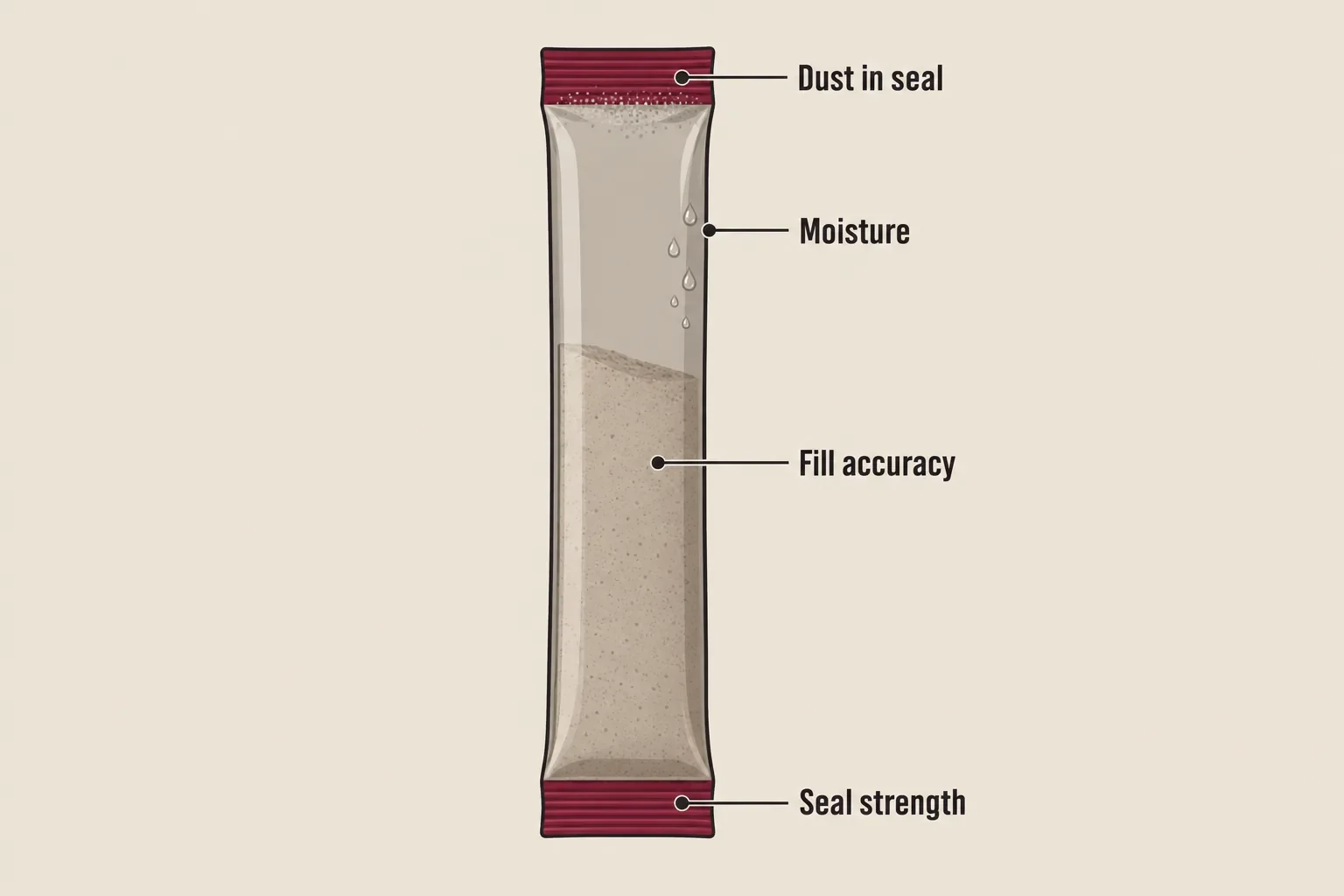
Supplement formulas behave differently from coffee, sugar or spices. Four issues drive most of the specification.
1. Moisture sensitivity
Many supplement ingredients are hygroscopic, meaning they pull moisture out of the air. Electrolyte salts, sugars, some vitamins, collagen and many flavor systems fall in this group.
When a hygroscopic powder picks up moisture, it can clump, cake into a solid stick, change color or dissolve poorly. Every powder has a humidity level above which it starts to absorb moisture quickly, so the film’s water vapor barrier, the seal integrity and the humidity on the filling line all matter.
2. Flowability
A stick pack machine doses powder through a narrow forming tube. Powders that flow freely fill quickly and accurately. Powders that bridge, cling or pack down can cause short fills, overfills and jams. Formula changes, such as a new flavor, sweetener or flow agent, can change how a powder behaves on the line even when the stick specification stays the same.
3. Dust in the seal area
Fine powders create dust as they fall into the stick. If dust lands on the seal area before the end seal is made, it can stop the film layers from bonding fully. That leads to leaks, weak seals and sticks that split in the carton or in a customer’s bag.
Controlling dust is a joint job for the film (the sealing layer), the machine (dosing and anti-dust measures) and the formula. Armour Rose’s guide to pouch seal failure causes explains how contaminated seals are diagnosed.
What these problems mean for your specification
| Problem | What it looks like | Packaging lever | Line or formula lever |
|---|---|---|---|
| Moisture uptake | Clumping, caking, hard sticks, color change | Higher moisture barrier film, opaque structure, strong seals | Humidity control on the filling floor, flow agents in the formula |
| Poor flow | Short fills, overfills, jams | Stick width suited to the dose | Dosing system matched to the powder, formula adjustments |
| Dust in seals | Leaks, split sticks, powder in the carton | Sealing layer that tolerates powder | Anti-dust measures, dosing speed, headspace |
| Dose variation | Fill weights outside tolerance | Stick size chosen with the dosing system | Consistent powder density from batch to batch |
Most of these issues show up only once real powder runs on a real machine. That is why a trial run on your co-packer’s line, with production-grade film and your final formula, is worth more than any number on a specification sheet.
4. Dose accuracy
A supplement stick has to deliver the serving stated on the label, every time. Fill accuracy depends on the dosing system, the powder’s density and flow, and the line speed. A stick that is too narrow for the dose makes accurate filling harder, so the stick size and the dosing system should be chosen together.
Film Structures for Supplement Stick Packs
Stick pack film is a laminate: several layers bonded together, each doing a different job. The outer layer carries the print, the middle layer provides the barrier, and the inner layer forms the seal.
| Structure type | Moisture and oxygen barrier | Look | Typical supplement fit |
|---|---|---|---|
| Foil laminate (aluminum foil layer) | Highest barrier against moisture, oxygen and light | Opaque, metallic inside | Highly hygroscopic powders, long shelf life, humid distribution |
| Metallized film (thin metal coating on PET or similar) | High barrier at lower cost than foil | Opaque, shiny inside | Many electrolyte, collagen and drink-mix sticks |
| High-barrier clear films | Good oxygen barrier, less light protection | Clear or partly clear | Products where seeing the powder matters and shelf life is shorter |
| Paper-based laminates | Barrier comes from the coating or film layer, not the paper | Natural, matte | Brands focused on a paper look; test barrier carefully |
What supplement brands should ask for:
- Water vapor barrier, not only oxygen barrier. For most supplement powders, moisture is the main threat. Ask for the film’s moisture barrier data, not just its oxygen data.
- A sealing layer suited to powder. Some sealing layers tolerate dust in the seal area better than others. Tell the supplier your product is a fine powder.
- Light protection for sensitive ingredients. Some vitamins and botanicals are light-sensitive, which argues for an opaque structure.
- Barrier matched to shelf life. Match the structure to how long sticks will sit in a warehouse, on a shelf and in a customer’s cupboard.
For a deeper look at how barrier is measured, read Armour Rose’s guide to oxygen transmission rate packaging.
Sizing a Supplement Stick Pack
Stick pack size starts with the serving, not with a catalog size. Four factors set the dimensions:
- Dose weight. The serving size on your label.
- Bulk density. How much space that weight takes. Fluffy powders such as some greens, protein and collagen take far more space per gram than dense salts or sugars.
- Headspace. Room above the powder so the end seal can be made cleanly, without powder in the seal area.
- Machine format. Stick pack machines are set up for particular widths and lengths, so your size has to suit the machine that will fill it.
| Product type | How it usually behaves | Sizing tendency |
|---|---|---|
| Electrolytes and hydration mixes | Dense, often free-flowing, often hygroscopic | Smaller sticks for the dose; barrier is the priority |
| Collagen | Light and fluffy | Needs more volume for the dose than its weight suggests |
| Greens and superfood blends | Light, can be cohesive and dusty | Wider or longer sticks; dust control matters |
| Pre-workout | Often dense, can be hygroscopic and clumpy | Barrier and seal integrity are the priority |
| Protein | Large servings, light powder | Often better in a sachet or multi-serve pouch than a stick |
The only reliable way to confirm a size is a fill trial on the actual machine with your actual formula. Ask your co-packer or supplier to run a short trial, then check the fill weight, the seal quality and how the sticks look in the carton.
Stick Pack vs Sachet vs Multi-Serve Pouch for Supplements
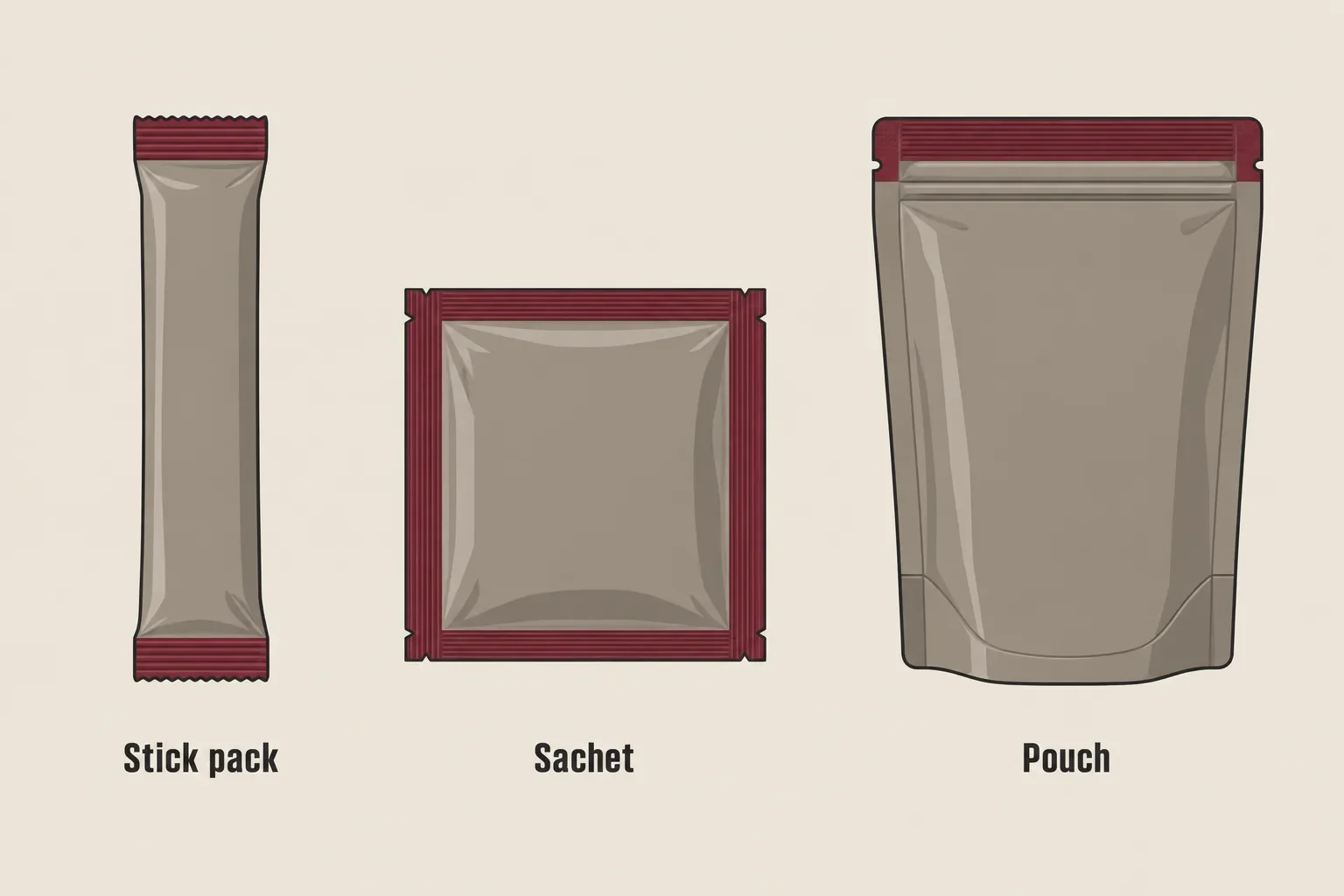
Armour Rose’s guide to stick pack vs sachet packaging covers the general comparison. This table keeps to what matters for supplements.
| Stick pack | Sachet | Multi-serve pouch or tub | |
|---|---|---|---|
| Best for | Single doses of electrolytes, collagen, greens, pre-workout | Larger or bulkier single servings | One flavor bought in volume |
| Customer use | Pours straight into a bottle; very portable | Tear and pour; less elegant into a bottle | Scoop per serving |
| Print area | Small and narrow | Larger front and back | Largest |
| Labeling | Tight; often relies on the carton | More room on each pack | Full label on the pack |
| Material per serving | Low | Higher than a stick for the same dose | Lowest |
| Sampling and variety | Excellent | Good | Poor |
| Typical sales channels | Retail cartons, subscriptions, e-commerce, gyms | Food service, larger servings, samples | Retail shelf, e-commerce bulk |
Many supplement brands run more than one format: a tub or pouch for the core product, and stick packs for trial packs, variety boxes and travel. Armour Rose sources stand-up pouches as well as stick pack film, so the two can be quoted as one program.
Easy-Open Features, Print Panels and Labeling
Opening features
- Tear notch. A small cut at the top so customers can tear the stick open cleanly. On a stick pack this is close to essential.
- Laser scoring. A line scored into the film so it tears straight across. Useful for structures that are tough to tear by hand.
- Easy-pour design. The tear position and the stick width decide whether powder pours neatly into a bottle or spills.
Print panels
A stick pack has a narrow front and back, plus a fin seal down the back. Artwork has to account for the seal areas, the cut-off position between sticks and the registration marks the machine reads to cut in the right place. Keep key brand and flavor information in the central, readable part of the front panel.
Labeling in a small space
Supplement labeling is regulated, and a stick leaves very little room. In the United States, the FDA’s Dietary Supplement Labeling Guide sets out requirements such as the Supplement Facts panel. In Canada, supplements are usually regulated as natural health products, and Health Canada’s guidance on labeling natural health products explains what has to appear on the label and the package.
Which text must go on each stick and which can go on the outer carton depends on how the product is sold and on the rules that apply to it. Confirm this with a regulatory specialist before the artwork is finalized. Packaging decisions follow from that answer, not the other way round.
Cartons and Display Boxes for Stick Packs
Most supplement sticks reach customers in a carton: a box of 10, 14, 20 or 30 servings, a mixed-flavor box, or a counter display at a gym, pharmacy or checkout.
Decisions to make:
- Count per box. Match it to how customers use the product: a week, two weeks, a month, or a variety assortment.
- Carton style and board. Folding cartons suit retail shelves; printed shippers or display trays suit counters. Armour Rose’s folding cartons page covers options.
- Label space. The carton often carries the full label when the stick has little room.
- Online and marketplace sales. Boxes sold online need to survive shipping and meet each marketplace’s packaging rules. See Armour Rose’s guide to Amazon packaging requirements for food products.
- Counter displays. Gyms, cafés and pharmacies often sell single sticks from a display box. Armour Rose’s PDQ and counter displays page covers those formats.
Specify the stick and the carton together. A stick that is a few millimeters longer than planned can mean a carton that no longer closes.
Working With a Stick Pack Co-Packer
Most supplement brands don’t own stick pack machines. They supply the formula and the printed film to a co-packer, a contract packaging company that fills and seals the sticks. The film arrives as rollstock: printed film on a roll, which the machine forms into sticks. Armour Rose’s roll stock film page covers how it’s supplied.
Before film is printed, send your co-packer’s requirements to your film supplier, and share your product details with the co-packer:
- Powder specification: bulk density, flow behavior, moisture sensitivity, particle size.
- Serving size and allowed fill tolerance.
- Machine details: stick width and length range, number of lanes, sealing method.
- Roll specification: web width, core size, roll diameter, unwind direction, splice rules.
- Film structure and sealing layer, so sealing settings can be set.
- Print registration: eye mark position and color, repeat length.
- Counts per carton and carton dimensions.
- Humidity controls on the filling floor for hygroscopic powders.
Ask for a trial run before the full order. If you have had problems with leaking or weak sticks, Armour Rose’s guide to pouch seal failure causes covers the usual suspects, including contaminated seals. For the trade-off between finished packs and film on a roll, see rollstock vs premade pouches.
Testing Before Launch: Seal, Fill and Shelf-Life Checks
A stick pack that looks right on the proof can still fail on the line or in a customer’s bag. Build these checks into the launch plan.
On the line
- Fill weight checks. Weigh sticks across the run, not just at the start, to confirm the dose stays within tolerance as the powder hopper empties and the line warms up.
- Seal checks. Inspect end seals and the back fin seal for wrinkles, channels and trapped powder. Simple squeeze tests and dye or vacuum leak tests catch weak seals before cartons are packed.
- Tear test. Open sticks the way customers will. A tear notch that rips at an angle or a film that stretches instead of tearing will draw complaints.
After packing
- Stability samples. Keep sealed sticks from the first run and check them over time for clumping, color change, odor and how well the powder dissolves. Store some in warmer and more humid conditions to see how the pack copes with summer shipping and bathroom cupboards.
- Transit test. Ship a few cartons through your normal courier route and check for split sticks, crushed cartons and powder leakage.
- Carton fit. Check that sticks sit neatly in the carton without bending at the seals, which can open micro-leaks.
Record what you test and the results. If a reorder changes the formula, the film or the co-packer, repeat the checks that the change affects.
Recyclable and Paper-Based Stick Packs
Many supplement brands want a lower-impact pack, and recyclable mono-material and paper-based stick pack films are available. Two cautions apply to supplements in particular.
First, moisture-sensitive powders put real pressure on the barrier. Structures designed for recyclability often give up some moisture or oxygen protection compared with foil laminates, so test them with your most sensitive formula before switching the whole range.
Second, stick packs run on demanding machines. A new film can need different sealing temperatures, pressures and dwell times, and some co-packers will want a trial before they accept it on a production line.
If you print a sustainability claim, make sure it matches the certified structure and the recycling programs your customers can actually use. Ask your packaging partner to quote a conventional and a recyclable structure side by side so you can compare barrier, cost and line performance.
Minimum Orders, Lead Times and Cost: What Drives Each
What drives the minimum order
- Print method. Digital printing suits short runs and many flavors because there are no plates or cylinders. Rotogravure and flexographic printing suit larger runs of fewer designs. Armour Rose’s guide to digital printing vs rotogravure packaging explains the trade-off.
- Number of flavors and designs. Each flavor usually means a separate design and a separate roll.
- Film structure. Standard structures are usually easier to source in smaller quantities than custom laminates.
What drives the lead time
- Artwork preparation, regulatory review and proof approval.
- Plates or cylinders, if needed.
- Material sourcing for the specific film structure.
- Printing, laminating, curing and slitting to roll width.
- Quality checks.
- Freight to the co-packer.
- The co-packer’s own filling schedule.
Reorders of approved designs are usually faster than first orders. For a full breakdown of each stage, read Armour Rose’s guide to how long custom packaging takes.
What drives the cost per serving
- Film structure (foil and specialty films cost more).
- Stick size and the number of lanes the machine runs.
- Print method, colors and number of designs.
- Co-packer filling charges and wastage during setup.
- Cartons, displays and shipping cases.
Compare quotes on the cost per filled, sealed, cartoned serving, not the film price alone.
When a Sachet, Pouch or Tub Is the Better Choice
Choose a sachet when:
- The serving is too large or bulky for a practical stick.
- You need more print area on each single-serve pack.
- The product goes mainly to food service or hospitality, where pouring into a bottle matters less.
Choose a multi-serve pouch or tub when:
- Most customers reorder one flavor in volume.
- Cost per serving is the main buying factor.
- The product is a large-serving protein or meal replacement.
Use both when:
- You want sticks for trial, travel and variety, and a pouch or tub for loyal customers. Many brands use sticks to get customers to try a product, then sell the bulk format.
A Supplement Brand's Pre-Order Spec Checklist
Product
- Product type and formula status (final or still changing)
- Serving size and fill tolerance
- Bulk density and flow behavior
- Moisture and light sensitivity
- Number of flavors and designs
Format
- Stick pack, sachet, pouch or a mix
- Stick dimensions confirmed by a fill trial
- Tear notch or laser scoring
Protection
- Shelf life target
- Film structure (foil, metallized, high-barrier clear, paper-based)
- Sealing layer suited to fine powder
Labeling
- Required text and where it goes (stick, carton or both)
- Regulatory review planned before artwork approval
Cartons and displays
- Count per carton
- Retail carton, counter display, shipper
- Marketplace requirements for online sales
Co-packer and ordering
- Co-packer machine specifications shared
- Roll specification confirmed
- Print method and artwork status
- Launch date and reorder frequency
- Delivery location for film and cartons
How Armour Rose Helps Supplement Brands
Armour Rose is a custom packaging partner that manages sourcing and production through a vetted manufacturing network. For supplement brands, that means the stick, the carton and the display can be planned as one program. Every project runs on the A-R-G Process: Ask First, Resolve Second, Grow Third.
- One partner across formats. Stick pack film, sachets, stand-up pouches, folding cartons, counter displays and shipping boxes, specified and quoted together.
- Specification support. Help matching film structures, sizes and opening features to your formula and your co-packer’s machines.
- Coordinated delivery. Film delivered to your co-packer and cartons to wherever they’re packed, planned around the same launch date.
Explore Armour Rose’s nutritional supplement packaging options, or keep reading for answers to common questions.
Related readingComprehensive Guide to Stick Pack Packaging, Sizes & FillingRead the guide →
Frequently asked questions
Are stick packs good for supplements?
Yes, for single doses of products like electrolytes, collagen, greens and pre-workout. They give exact dosing, are easy to carry, and work well for trial packs, variety boxes and subscriptions. Large servings and single-flavor bulk buyers are often better served by a sachet, pouch or tub.
What film is best for supplement stick packs?
It depends on how moisture-sensitive the formula is and how long the sticks need to last. Foil laminates give the highest barrier, metallized films give high barrier at lower cost, and clear films give less light protection. Ask for moisture barrier data as well as oxygen data.
How do I choose the right stick pack size for my supplement?
Start with the serving weight, then account for the powder’s bulk density, the headspace needed for a clean seal, and the formats your co-packer’s machine runs. Confirm the size with a fill trial on the actual machine with your actual formula.
Why are my supplement stick packs leaking?
The most common cause is powder dust in the seal area, which stops the layers bonding fully. Other causes include the wrong sealing settings, a sealing layer that doesn’t suit powder, or film that doesn’t match the machine. See the guide to pouch seal failure causes.
Why does my powder clump inside the stick pack?
Clumping or caking usually means the powder has absorbed moisture, from the filling environment, through a weak seal or through a film with too little moisture barrier. Check the film’s barrier, the seals and the humidity on the filling floor.
What's the difference between a stick pack and a sachet for supplements?
A stick pack is long and narrow, uses less material per serving and pours neatly into a bottle. A sachet is wider, holds larger servings and gives more print area. See the full stick pack vs sachet comparison.
What do I need to send a stick pack co-packer?
Your powder specification, serving size and tolerance, flavors and counts, and your film structure. The co-packer will give you their machine details and roll requirements, which your film supplier needs before printing.
Does all the labeling have to fit on the stick?
Not always. Which information must appear on each stick and which can go on the outer carton depends on how the product is sold and the rules that apply. Check the FDA or Health Canada requirements for your product with a regulatory specialist before finalizing artwork.
Can I sell supplement stick packs on Amazon?
Many brands do. Cartons and shipping packs need to meet the marketplace’s packaging and labeling rules and survive shipping. Start with the guide to Amazon packaging requirements for food products and check the current seller requirements.
Are recyclable stick packs available?
Some recyclable mono-material and paper-based stick pack films exist, but they generally offer less barrier than foil laminates, which matters for moisture-sensitive powders. Test any recyclable structure with your formula, and match any claim on the pack to the actual structure and local programs.
Should I start with stick packs or a tub?
Many brands start with the format their main customers want: a tub or pouch for regular users, and stick packs for trial, travel and variety. Launching both lets sticks bring in new customers and the bulk format keep them.
Get Your Stick Packs and Cartons Quoted Together
Send your powder specification, serving size, flavors, counts per box and co-packer details. Armour Rose will quote stick pack film and cartons together, with displays and shipping boxes alongside. Start with sachets and stick packs or contact Armour Rose to share your current specification.