



















Nuts are oily, dense and sharp. Dried fruit is sticky and pulls moisture from the air. Put either into a film chosen on price and the problems show up months later: nuts that taste stale inside their best-by date, shell fragments that puncture the pouch, and bottom seals that open on a pallet. Because these failures appear late, nut and dried fruit packaging is unusually easy to under-specify.
This guide covers what a nut, dried fruit or trail mix brand has to decide before quoting: which format suits which product and channel, how to protect oils from going rancid, how to stop punctures and seal failures, where a window helps or hurts, and when a side-gusset or flat-bottom bag beats a stand-up pouch. If you already want help with the whole program, start with Armour Rose’s dried fruit and nut packaging options.
Quick Answer: What Is the Best Packaging for Nuts and Dried Fruit?
For most retail nuts, dried fruit and trail mix, a resealable stand-up pouch with an oxygen, light and moisture barrier and a puncture-resistant laminate is the right starting point. Choose flat-bottom bags for heavier premium packs, side-gusset bags for bulk, and pillow bags or flow wrap for single-serve portions.
Why Nuts and Dried Fruit Are Hard on Packaging
Oil oxidation. Nuts are high in oil, and those oils oxidize when exposed to oxygen and light, which produces rancid, stale flavors. The Almond Board of California’s shelf-life summary notes that high storage temperatures, increased moisture, light and some metals can promote lipid oxidation in almonds. It also notes that processing makes almonds more susceptible: blanching and cutting increase the surface area exposed to oxygen, and roasting changes the nut’s structure so more oil is exposed. The same logic applies across most nuts. A roasted, chopped nut needs more protection than a whole raw one.
Odor pickup. The same summary notes that almonds can absorb the odors of other materials over time. A good barrier keeps outside smells out as well as keeping aroma in.
Punctures. Shell fragments, pits, sharp nut edges and hard dried fruit pieces damage thin film during filling and in transit. A single pinhole turns a barrier calculation into a leak.
Weight. A multi-serve nut pouch is heavy compared with a chip bag of the same size. Its bottom seal and gusset carry real load every time the pouch is dropped, stacked or squeezed.
Sticky, hygroscopic fruit. Dried fruit absorbs moisture from the air, which makes it sticky or encourages clumping. It also sticks to seal areas during filling, which weakens seals.
Settling and fines. Mixed products segregate in transit. Small pieces and dust collect at the bottom, which is what the customer sees through a window after shipping.
So the packaging decision for this category is really four decisions: barrier, puncture resistance, seal strength under load, and how the product presents after shipping.
Stand-Up vs Flat-Bottom vs Side-Gusset vs Pillow for Nuts and Dried Fruit
| Stand-up pouch | Flat-bottom pouch | Side-gusset bag | Pillow bag / flow wrap | |
|---|---|---|---|---|
| How it’s built | Front and back panels with a folded bottom gusset | Box-like flat base with side gussets | Gussets on both sides, folded or sealed bottom | Flat bag or wrapped portion, sealed on the edges |
| Shelf presence | Stands upright, wide front panel | Stands like a box; premium look | Stands when full; efficient | Lies flat; usually in a carton or display |
| Handling weight | Good for small and mid fills | Very stable at heavier fills | Efficient at bulk sizes | Small portions only |
| Resealing | Zipper standard | Zipper available | Zipper, slider or fold-and-clip | Usually single use |
| Typical fit | Retail nuts, dried fruit, trail mix | Premium and heavier retail packs | Bulk and club sizes | Single-serve, travel and multipack portions |
| Main trade-off | Bottom seal must be strong at heavier fills | Higher unit cost | Less premium shelf look | Needs a secondary pack for retail |
For a product-neutral comparison of the two upright formats, see flat-bottom bag vs stand-up pouch. Armour Rose sources stand-up pouches, flat-bottom pouches, side-gusset bags, pillow pouches and flow wrap film, as well as clear containers, so the format can follow the product and channel.
Barrier for Oils and Moisture: Choosing the Film
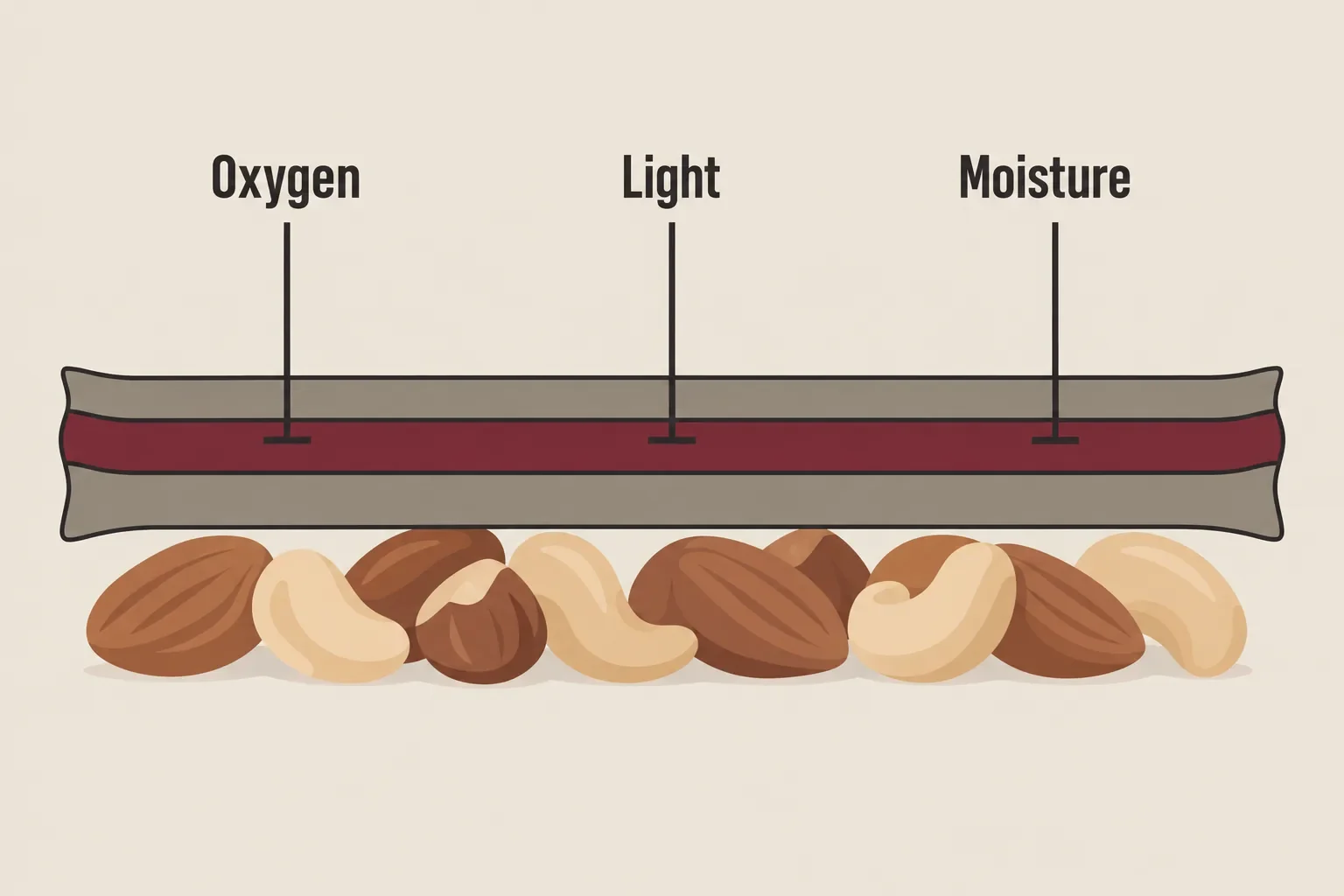
Nut and dried fruit pouches are laminates: several film layers bonded together, with the outer layer for print, middle layers for barrier and strength, and an inner sealant layer.
| What you need | Typical approach | Why it matters |
|---|---|---|
| Oxygen barrier | Metallized films, foil, or high-barrier coatings and layers | Slows rancidity in nut oils |
| Light protection | Opaque or metallized structures | Light speeds up oil oxidation |
| Moisture barrier | Films with low water vapor transmission | Keeps nuts crisp and dried fruit from going sticky |
| Odor barrier | High-barrier layers | Stops nuts picking up outside smells |
| Puncture resistance | Tougher layers and the right overall gauge | Stops shells and sharp pieces piercing the film |
| Sealant | A sealant layer matched to the line and the product | Strong seals even with oil or fruit residue nearby |
The Almond Board summary lists the package factors that affect almond shelf life: physical protection from film thickness, the moisture barrier, the oxygen barrier, and nitrogen flushing or vacuum packing. Those are the levers for most nuts.
- Nitrogen flushing replaces the air in the pack with nitrogen before sealing, which lowers the oxygen left with the product.
- Vacuum packing removes the air, which suits some bulk and foodservice packs but makes retail pouches rigid and less attractive.
- Oxygen absorbers are small packets placed inside the pack that take up remaining oxygen.
All three only work if the film and seals keep new oxygen from getting in. Set the barrier from your shelf-life target and oil content, not from a standard house film. For more on barrier measurement, read the explainer on oxygen transmission rate packaging.
Puncture Resistance: Specify for the Sharpest Product
A nut pouch should be specified for the sharpest thing that will ever go into it, not the average.
- Know the worst case. Shell fragments in shelled nuts, pits in dried fruit, sharp edges on chopped or slivered nuts, and hard pieces in trail mix are the usual culprits.
- Gauge and construction. Puncture resistance comes from the laminate construction and the overall gauge. A gauge reduction saves money per unit and can show up months later as leaking packs.
- Test in the real case. Run a drop and handling test with filled pouches in the actual shipping case, then inspect corners and the area around any window.
- Watch the fill point. Dense product falling onto the bottom of the pouch hits hard. Drop height on the line affects both punctures and seal damage.
Seal Strength Under Weight
A heavy pouch loads its bottom seal every time it is handled, and that is where many nut packs fail.
- Seal width and sealant. Wider seals and a sealant suited to the product give more margin under load.
- Gusset construction. The bottom gusset carries the weight. It has to be designed for your fill weight, not a lighter product.
- Seal contamination. Oil, salt, sugar and fruit residue in the seal area weaken the bond. Keep product away from the jaws and check the seal area on the line.
- Stack height. Pouches at the bottom of a stacked case or pallet carry more load. Validate seals against your actual stack height.
Seal dwell time and line speed also compete on a vertical form-fill-seal line with dense product. Push the line faster and the bottom seal is often the first thing to give. For diagnosis of failing seals, see Armour Rose’s guide to pouch seal failure causes.
Windows: Showing the Product Without Losing Protection
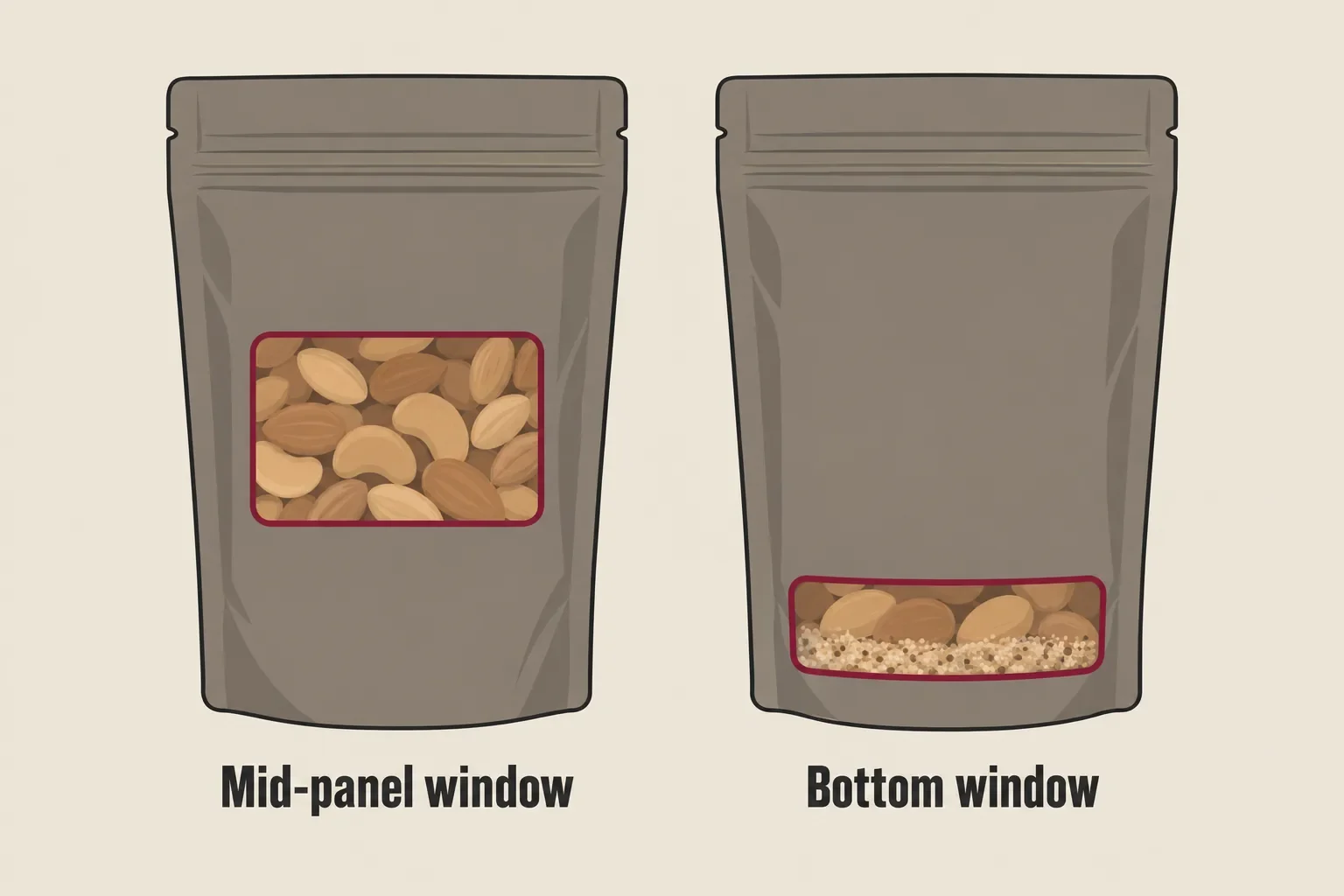
A clear window is one of the most requested features for nuts and dried fruit, because premium product sells on looks.
What a window costs you
- Light protection. The clear area lets light reach the oils, which speeds oxidation. High-oil and roasted nuts are the most sensitive.
- Barrier continuity. The window area is usually a clear film with a different barrier from the metallized or opaque body.
- Puncture weak point. Window areas can be weaker against sharp pieces.
Where to place it
- Mid-panel, not the bottom. After shipping, fines and small pieces settle at the bottom. A window at the bottom shows dust; a window higher on the panel shows whole product.
- Away from seals and the zipper. Keep the window clear of seal areas so it does not weaken them.
- Shape and size. A smaller window limits light exposure while still showing quality.
If your shelf life is long or your nuts are roasted and oily, consider a fully opaque pouch with strong photography instead of a window.
Trail Mix: Segregation, Fines and Moisture Migration
Trail mix combines products that behave very differently in one pack.
- Segregation. Small and dense pieces sink, large and light pieces rise. What looked balanced at filling looks uneven on the shelf.
- Fines and dust. Nut skins, salt and broken pieces collect at the bottom.
- Moisture migration. Dried fruit often carries more moisture than nuts. In a sealed pack, moisture can move from the fruit to the nuts, softening nuts and hardening fruit. Check this in shelf-life testing for each recipe.
- Mixed sharpness. Trail mix often includes the hardest pieces in the range, so puncture testing matters.
Format and window choice should reflect how the mix settles. A flat-bottom pouch with a mid-panel window often presents a mix better than a tall stand-up pouch with a bottom window.
Sizes and Fill Weights: Single-Serve to Club Packs
Nut and dried fruit ranges usually span very different pack sizes, and each pulls the specification in a different direction.
| Pack type | Typical format | Key considerations |
|---|---|---|
| Single-serve and travel packs | Pillow bag or flow wrap | Fast filling, reliable seals, often sold in a carton or display |
| Retail multi-serve | Stand-up pouch with zipper | Barrier, reclosure, window placement |
| Premium and gift | Flat-bottom pouch or a rigid gift box | Presentation, print area, stable footprint |
| Club and bulk | Side-gusset or large flat-bottom bag | Seal strength, gusset load, case and pallet fit |
| Foodservice | Bulk bags or vacuum packs | Barrier and handling over presentation |
Density varies a lot across the category. Dense nuts and sticky dried fruit take far less space than puffed or freeze-dried products for the same weight. Confirm sizes with a fill test using your actual product at target weight, and check the result against your shelf, case and pallet.
Clear Containers, Tubs and Multipacks
Not every nut or dried fruit product belongs in a pouch. Rigid clear containers and tubs are common in bulk, deli, bakery-adjacent and club channels, where shoppers want to see a large quantity of product and reuse the container.
When a clear container makes sense
- Visibility sells. Premium mixed nuts, candied or chocolate-coated nuts and colorful dried fruit often sell better when the whole product is visible.
- Club and bulk formats. Large tubs stack well on club pallets and feel like value.
- Reuse and reclosure. A screw or snap lid survives far more openings than a zipper.
The trade-offs
- Light exposure. A fully clear container gives no light protection, so it suits products with shorter shelf lives or fast turnover, or needs a sleeve or label that covers part of the surface.
- Weight and freight. Rigid containers weigh more and ship more empty space than pouches.
- Barrier and seal. Many tubs rely on an induction or peelable seal under the lid for freshness, which has to be specified with the container.
Dressing the container
Labels and printed sleeves carry the brand on a clear container. Armour Rose sources carton sleeves and wraps for trays, tubs and multipacks, and Armour Rose’s guide to shrink sleeves vs pressure-sensitive labels explains the label options. For rigid clear formats, see clear containers.
Multipacks
Single-serve pillow packs and flow-wrapped portions are usually sold in a folding carton multipack or a counter display. Planning the portion film and the carton together keeps counts, dimensions and artwork consistent.
Resealable Zippers for Multi-Serve Packs
Nuts and trail mix are multi-serve products, so the zipper is used many times.
- Choose a zipper rated for repeat use and a film gauge that supports it at your pack weight. Zippers that fail after a few openings are a common complaint.
- Keep salt, oil and crumbs out of the zipper track at filling, or it will not close properly.
- Add a tear notch above the zipper so customers do not cut through it.
Armour Rose’s resealable zipper pouches page covers closure options.
Filling Lines and Co-Packers
Dense product is unforgiving on a filling line. More drop energy at the fill point means the seal has to bond fully before the next cycle pulls on it, which competes with line speed.
If you fill on a vertical form-fill-seal line from rollstock, printed film on a roll formed into bags on the machine, the film has to match the machine:
- Web width for the forming tube.
- Core diameter and unwind direction.
- Film stiffness that tracks well at a heavy fill weight.
- Sealant and seal settings matched to your speed and dwell time.
If you fill premade pouches, the pouch dimensions, zipper position and seal areas have to suit your filler or co-packer. Share your line speed and fill weight before ordering, and run a sample on the actual machine. Armour Rose sources roll stock film and premade pouches, and works from your co-manufacturer’s equipment requirements where the fill happens elsewhere. For the trade-off between the two, read rollstock vs premade pouches.
Storage and Distribution: What the Pack Cannot Fix
Good packaging slows deterioration, but storage conditions still matter. The Almond Board of California’s updated storage recommendations for almonds are to store them under cool and dry conditions, below 15°C (59°F) and below 60% relative humidity, to keep almond moisture between 3% and 5.5% for optimal stability, and to use packages with good barrier properties against water and air.
For nut and dried fruit brands, that means:
- Ask where the product will sit. Warm warehouses, trailers and sunny retail displays shorten shelf life even with a good barrier.
- Match the barrier to the route. Export and long distribution chains need more protection than local DTC sales.
- Keep odors away. Nuts can pick up odors from nearby goods in storage.
Club, Bulk and Gift Channels
Nut and dried fruit brands sell heavily through club, bulk and gift channels, and those buyers often start with the case, pallet and display, not the pouch.
- Club stores. Case count, pallet pattern and display footprint come first. See Armour Rose’s guide to Costco packaging requirements for suppliers.
- Floor and pallet displays. Displays for heavy product must carry weight without slumping. See floor and pallet displays.
- Counter displays. Smaller packs sell from PDQ and counter displays at checkout and on shelves.
- Shelf-ready trays. Trays speed up stocking and protect packs in transit; see shelf-ready packaging and trays.
- Gifts and online orders. Holiday assortments and gift sets often use rigid and mailer boxes.
- Shippers. Dense product needs strong corrugated shipping boxes with good stacking performance.
A common and avoidable problem is a display order that does not match the case the pouches ship in. Planning the pouch, shipper and display in one program reconciles counts and dimensions before any tooling.
Sustainable Options and Claims
Nut and dried fruit packaging needs strong barrier and puncture resistance, which traditionally means mixed-material laminates that are hard to recycle. Options to discuss:
- Mono-material pouches. Pouches made from a single polymer family, usually polyethylene, can be accepted where that material is collected. Test barrier and puncture performance carefully, because nuts are demanding on both.
- Down-gauging. Less material can reduce impact, but test against punctures and seal strength first.
- Paper-based cartons and trays for multipacks and displays.
Before you print a claim, confirm what the specific structure supports, whether programs in your customers’ regions accept it, and that the wording on the pack matches exactly.
Minimum Orders, Lead Times and Cost
What drives minimums
- Print method. Digital printing suits short runs and many SKUs; rotogravure suits large runs of fewer designs. See digital printing vs rotogravure packaging.
- Number of SKUs and sizes. Each product and size can be another design.
- Structure. High-barrier and puncture-resistant structures can need more setup than standard films.
What drives lead time
- Artwork and proof approval.
- Plates or cylinders, if needed.
- Film and component sourcing.
- Printing, laminating and converting.
- Quality checks.
- Freight, customs and delivery.
Reorders of approved designs are usually faster than first runs. For the stage-by-stage view, read how long custom packaging takes.
Seasonal demand. Nut and dried fruit sales often peak around holidays. Where available for your product, make-and-hold arrangements, in which an efficient quantity is produced and released as you need it, can suit that pattern. For certain products, with some manufacturing partners, Armour Rose can hold a safety stock position.
Compare quotes on the delivered cost per sellable pack. A cheaper film that leads to rancid returns or leaking pallets costs more than it saves.
When to Choose a Side-Gusset or Flat-Bottom Bag Instead
Choose a side-gusset bag when:
- You sell bulk or club sizes where packing density and cost matter most.
- Heavy fills need flexible capacity and efficient filling.
Choose a flat-bottom pouch when:
- You sell heavier premium packs that should stand like a box.
- You need more print area for origin, nutrition and brand story.
- A stand-up pouch would slump as it empties.
Choose pillow bags, flow wrap or cartons when:
- You sell single-serve or travel portions, often in a multipack carton or counter display.
Many brands use a mix: stand-up pouches for core retail, flat-bottom bags for premium lines, side-gusset bags for bulk, and portion packs for convenience channels.
A Nut and Dried Fruit Brand's Pre-Order Spec Checklist
Product
- Product types: whole, chopped, roasted, raw, dried fruit, trail mix
- Oil content and roast level
- Sharpest or hardest product in the range
- Fill weight per size and number of SKUs
Protection
- Shelf-life target and distribution route
- Oxygen, light and moisture barrier set from oil content and shelf life
- Nitrogen flushing, vacuum or oxygen absorbers
- Puncture test plan with the worst-case product
Format and presentation
- Stand-up, flat-bottom, side-gusset, pillow or a mix
- Window: yes or no, size and placement
- Zipper rated for repeat use, tear notch
Seals and line
- Seal width, sealant and gusset for your fill weight and stack height
- Rollstock or premade pouches
- Line or co-packer specifications shared
Channel
- Case count, pallet pattern and display requirements
- Gift, club or online formats
Ordering
- Print method and artwork status
- Seasonal peaks and interest in a make-and-hold program
- Delivery location and reorder frequency
How Armour Rose Helps Nut and Dried Fruit Brands
Armour Rose is a custom packaging partner that manages sourcing and production through a vetted manufacturing network, so nothing in its model rewards steering you toward one format.
- Specification led. The work starts from oil content, fill weight and shelf-life target, then chooses the process.
- Film and corrugated together. The pouch, the shipper and the display or tray come from one program, so counts and dimensions reconcile before tooling.
- Alternate manufacturers. Armour Rose can qualify an alternate manufacturer for a format, with your final approval as a checkpoint, so a booked press does not have to delay your run.
- Safety stock on select products. For certain products, with some manufacturing partners, stock can be held for seasonal and bulk demand.
- The A-R-G Process (Ask First, Resolve Second, Grow Third). A packaging and usage review of your current formats, fill weights, delivery points and equipment; a specification with options and the trade-offs between cost and performance; then production, delivery and customs brokerage across Canada and the United States.
Explore Armour Rose’s dried fruit and nut packaging options, or read on for common questions.
Related readingOxygen Transmission Rate Packaging: OTR and Shelf LifeRead the guide →
Frequently asked questions
What is the best packaging for nuts?
For most retail nuts, a resealable stand-up pouch with an oxygen, light and moisture barrier and a puncture-resistant laminate. Heavier premium packs suit flat-bottom pouches, and bulk sizes suit side-gusset bags.
How do I stop nuts from going rancid in the package?
Use a film with a real oxygen and light barrier, consider nitrogen flushing or oxygen absorbers, keep seals strong, and avoid large windows on oily or roasted nuts. Storage matters too: cool, dry conditions slow oxidation.
Do roasted nuts need more protection than raw nuts?
Usually yes. Roasting changes the nut’s structure so more oil is exposed to oxygen, and chopping or blanching increases the exposed surface area, so roasted and cut nuts generally need a stronger barrier.
Why do my nut pouches split at the bottom?
Usually the bottom seal or gusset is not specified for the fill weight and stack height, or oil and salt are contaminating the seal. Check seal width, sealant, gusset construction and line speed. See pouch seal failure causes.
Should nut packaging have a window?
It can help sales, but it reduces light protection and shows settled fines. Keep windows small, place them mid-panel, and consider an opaque pouch for high-oil or roasted nuts with a long shelf life.
What packaging is best for dried fruit?
A moisture-barrier stand-up pouch with a reliable zipper suits most dried fruit. Keep sticky fruit out of the seal area during filling, and match the barrier to how much moisture the fruit carries.
How do I package trail mix so it does not separate?
Some settling is unavoidable. Choose a format and window placement that presents the mix well after shipping, keep headspace low, and test for moisture moving between fruit and nuts.
Are nut pouches recyclable?
Some are. Mono-material polyethylene pouches can be accepted where that material is collected, but they must still meet barrier and puncture requirements. Confirm any claim against the specific structure and local programs.
Can I get the pouch, shipper and display from one supplier?
Normally these come from different converters. Armour Rose sources film, corrugated and displays through one program, so counts and dimensions are reconciled once.
Is nitrogen flushing worth it for nuts?
For oily and roasted nuts with a long shelf life, often yes. Nitrogen flushing lowers the oxygen left in the pack, but it only works with a film and seals that keep new oxygen out.
Get Your Nut and Dried Fruit Packaging Specified
Send your product types, oil content, fill weights, shelf-life target, line or co-packer details and channels. Armour Rose will specify the pouch, shipper and display options side by side in one program. Start with dried fruit and nut packaging or contact Armour Rose to share your current packaging.