



















Custom jerky bags carry more risk than most snack packaging. A bag of chips that goes stale is a quality complaint. A shelf-stable meat product that loses its barrier is a far more serious problem, and the margin for error is much smaller.
Oxygen turns the fat rancid and shifts the color of the surface. Moisture moving in or out pushes the product outside the range it was made to hold. And the place most packs actually fail is the seal, where fat, salt and spice from the product end up between the film layers.
This guide walks through the decisions a jerky, meat stick or meat bite brand has to make before asking for quotes: the format, the high-barrier film, how oxygen absorbers and the film work together, how to keep seals clean, how to handle hang holes and displays, and when flow wrap, a carton multipack or a gift box is the better choice.
If you already want help with the whole program, start with Armour Rose’s custom jerky and meat snack packaging options.
Quick Answer: What Is the Best Bag for Jerky?
For most multi-serve jerky, the right starting point is a resealable high-barrier stand-up pouch, specified together with the oxygen absorber or flushing method you use. Choose flow wrap for single sticks and bites, a flat-bottom pouch for premium shelves, and a counter display or clip strip for checkout sales.
Why Jerky and Meat Snacks Are Hard to Package
Oxygen and rancidity. Jerky and meat snacks contain fat, and fat oxidizes when it meets oxygen. That produces rancid, stale flavors and can change the color of the meat surface. The more fat in the recipe, the faster that happens and the stronger the barrier needs to be, which is why oxygen transmission rate is the first number to ask a supplier for.
Water activity. Water activity is a measure of how much free water is available in a food for microbes and chemical reactions. Shelf-stable meat snacks are dried to sit inside a specific range.
If the pack lets moisture in, the product can move out of that range. If the pack lets moisture out, the product dries, hardens and loses texture. Either way, the film has to control moisture in both directions, which is a tighter requirement than a dry snack faces.
Fat, salt and spice at the seal. During filling, small amounts of fat, marinade, salt and seasoning reach the seal area. Once they are trapped between the two film layers, the bond weakens. The seal can look perfect and still leak.
Sharp and irregular pieces. Dried meat has hard edges and corners that can stress or pierce thin films, especially in heavier packs and in the shipping case.
Heavy packs on hooks. Multi-serve jerky bags are often heavy for their size. A hang hole in a film that is too thin tears on the hook at retail.
Impulse placement. A large share of meat snack volume sells at the checkout, on clip strips and from counter displays. A pack built for a shelf can fail at the till.
This combination is why jerky specifications sit several steps above a standard snack film. The rest of this guide covers each decision.
Formats Compared for Jerky, Sticks and Meat Bites
Format follows serving size and placement. A single stick at a till and a family pouch in a grocery aisle are two different engineering problems. For a full, product-neutral comparison of the two upright formats, see the guide to flat-bottom bags vs stand-up pouches.
| Stand-up pouch | Flat-bottom pouch | Resealable zipper pouch | Flow wrap | |
|---|---|---|---|---|
| How it’s built | Front and back panels with a folded bottom gusset | Box-like flat base with side panels | Any pouch format with a press-to-close zipper | Film wrapped around a single stick or bite with a long seal and two end seals |
| Best fit | Multi-serve jerky and meat bites | Premium jerky, larger packs, gift-style bags | Jerky eaten over several sittings | Single sticks, snack-size bites, multipack inners |
| Shelf presence | Stands upright, wide front panel | Strongest: stands like a box, more print panels | Depends on the base format | Sold loose in a display, a caddy or a carton |
| Barrier | High-barrier laminates available | High-barrier laminates available | Zipper adds a closure path to manage | High-barrier films available |
| Filling | Hand fill or premade-pouch machines | Hand fill or premade-pouch machines | As for the base format | Horizontal flow wrappers fed by roll stock |
| Main cost drivers | Usually the most economical upright format | More material and converting steps | Zipper adds cost | Film only, but needs a wrapper |
Roll stock is printed film supplied on a roll for automated lines. It feeds flow wrappers for sticks and bites and form-fill-seal lines for bags. Armour Rose sources stand-up pouches, flat-bottom pouches, resealable zipper pouches, flow wrap film and roll stock film for meat snack lines.
Matching the format to the product
- Multi-serve jerky: a resealable high-barrier stand-up pouch is the usual default.
- Premium or larger packs: a flat-bottom pouch stands squarely and adds panel space for the brand story and required information.
- Meat sticks: individually flow-wrapped, then sold from a counter display, a caddy or a carton multipack.
- Meat bites and snack packs: small pouches or flow-wrapped portions, often grouped in a display tray.
- Club packs: larger pouches or multipacks inside a shipper designed around the club store’s requirements.
High-Barrier Film Structures for Meat Snacks
Most jerky bags are laminates: several film layers bonded together. The outer layer carries the print, middle layers provide the barrier, and the inner sealant layer bonds the pack closed.
| What the pack needs | How it is usually achieved | Why it matters for meat snacks |
|---|---|---|
| Oxygen barrier | Metallized films, foil, or high-barrier coatings and layers | Slows rancidity and color change |
| Moisture barrier | Films with low water vapor transmission | Keeps the product inside its water activity range |
| Light protection | Opaque or metallized layers | Protects fat and surface color |
| Toughness | Stronger layers in the laminate and the right overall gauge | Resists sharp pieces, handling and heavy packs on hooks |
| Seal through contamination | A sealant chosen for fat, salt and spice in the seal area | Prevents channel leaks |
The barrier target should come from the shelf life you need to state and the fat content of the product, not from a supplier’s standard structure. Ask for barrier data, not just “high barrier”. The key measure for oxygen is oxygen transmission rate (OTR), explained in Armour Rose’s guide to oxygen transmission rate packaging.
Oxygen Absorbers and the Film: One System
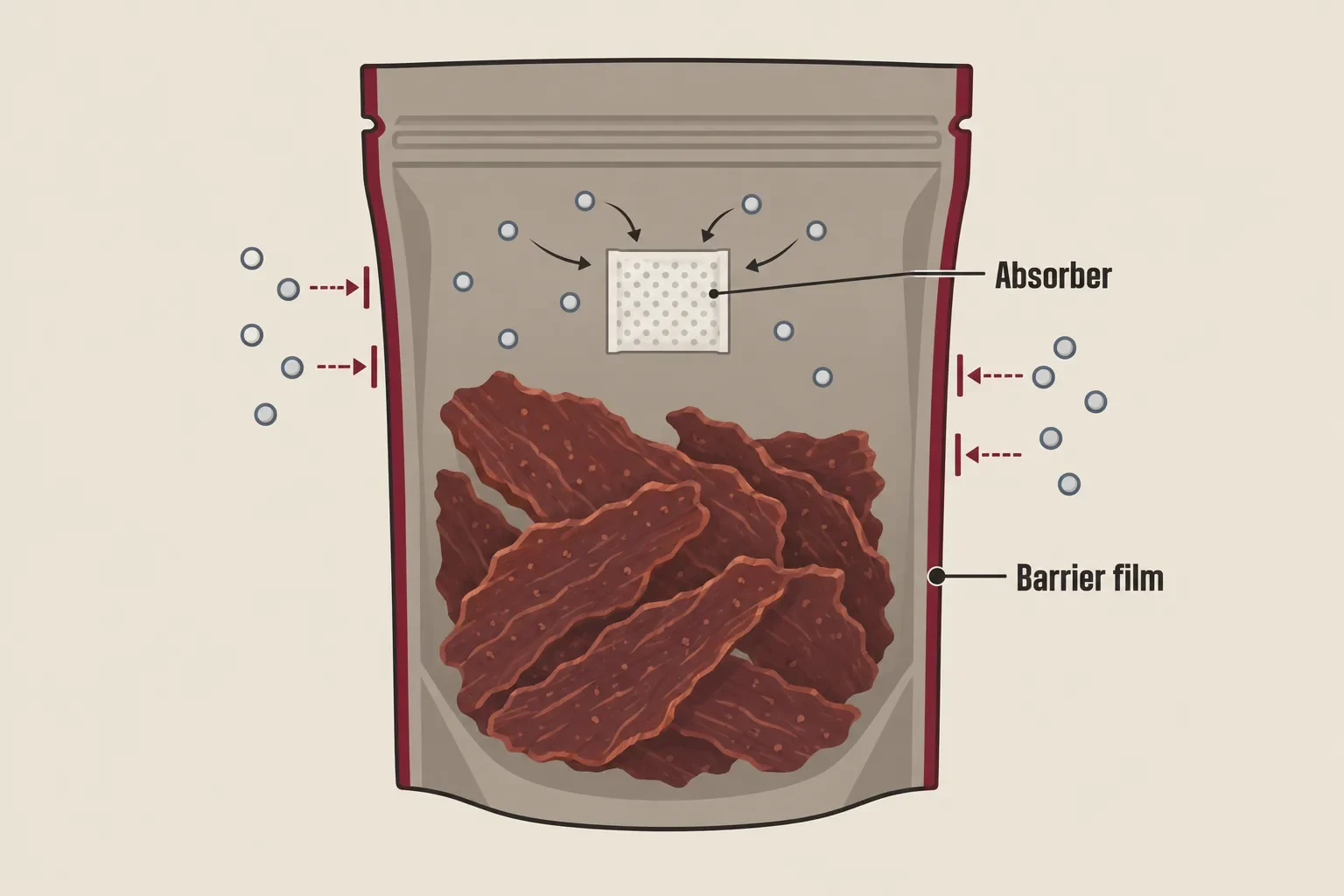
Most jerky brands put a small oxygen absorber in each pack: a sachet containing a material that reacts with and removes oxygen left in the bag after sealing. This is the “little bag” customers ask about when they open a pouch of jerky, and it is why many jerky bags look partly empty: the pack is sized for the product, the absorber and the headspace, not packed tight.
What brands often miss is that the absorber and the film are one system:
- An absorber can only remove a limited amount of oxygen. If the film or the seals let oxygen in (see the common pouch seal failure causes), the absorber is used up quickly and the product is no longer protected.
- Absorber size depends on the pack. The pack volume, headspace and the film’s barrier all affect how much absorbing capacity you need. Size the absorber with the final pouch dimensions, not a generic chart.
- Placement and labeling matter. The absorber has to sit where it does not interfere with the seal, and packs usually carry a “do not eat” marking on the sachet itself.
- Alternatives exist. Some brands use vacuum packaging or nitrogen flushing (filling the pack with nitrogen before sealing) instead of, or alongside, an absorber. Each changes how the pack looks, how it fills and what the film has to do.
Shelf stability is ultimately a food-safety question for your process, not only a packaging one. In the US, the USDA Food Safety and Inspection Service publishes a compliance guideline for meat and poultry jerky produced by small and very small establishments that covers how drying, water activity and packaging fit into a safe process. Confirm your targets with your process authority or food-safety adviser, then specify the packaging around them.
Seal Integrity: Fat, Salt and Spice at the Jaws

Barrier gets most of the attention, but the seal causes most of the failures in this category. Fat, salt and spice residue reach the seal area during filling and create narrow channel leaks: tiny paths through the seal that look sealed and fail a shelf-life test weeks later, long after the run has shipped.
A film that seals cleanly on a dry product can fail on a fatty one at the same settings. The variables you can control are:
- The sealant layer. It has to seal through a contaminated area, not a clean one.
- Jaw temperature and pressure. Set for the film and the contamination, not a lab sample.
- Dwell time. The time the jaws stay closed. It is the first thing that shrinks when a line runs faster, and it is often the hidden cause of leaks.
- Product handling. How pieces drop into the pack, whether marinade or oil drips onto the seal area, and how clean the filling equipment stays.
What to send for machine fit
Before a plant quotes, share:
- The machine the product runs on, or your co-manufacturer’s equipment requirements.
- Target line speed and the fat content of the product.
- Web width, core diameter, unwind direction and cut-off length for roll stock.
- Pouch dimensions, zipper position and absorber placement for premade pouches.
If a target speed and a reliable seal are not compatible at the chosen film gauge, that is far cheaper to find out before plates are cut. Armour Rose’s guide to pouch seal failure causes walks through diagnosis when seals are already failing.
Windows, Zippers, Tear Notches and Hang Holes
Features that protect the product
- Press-to-close zipper. Expected on multi-serve jerky, which is eaten over several sittings. Keep fat and seasoning away from the zipper track during filling, or it will not close properly.
- Tear notch. Lets customers open the pack cleanly above the zipper.
- Seal width. Wider, well-placed seals give more margin when the seal area is contaminated.
Features that help the sale
- Reinforced hang hole. A heavy multi-serve pouch on a hook or clip strip needs a reinforced hang hole and a gauge rated to the actual pack weight, or it tears at retail. This is a film decision, not an afterthought.
- Window. A clear window shows the product, which helps sell premium jerky. It also reduces light and sometimes oxygen protection, so weigh it against your shelf-life claim and limit its size if the barrier is tight.
- Finishes. Matte, soft-touch and spot gloss shape the brand. They do not change protection.
Sizes and Pack Formats by Channel
Pack size often follows placement rather than the other way round. A buyer works from a footprint and a case count, and the pack has to fit behind those numbers.
| Channel | Typical pack | What drives the spec |
|---|---|---|
| Checkout and convenience | Single sticks, small pouches | Display footprint, units per caddy, price point |
| Clip strips and pegs | Small to mid pouches with hang holes | Hang hole strength, pack weight |
| Grocery shelf | Multi-serve stand-up or flat-bottom pouches | Shelf presence, facings, resealing |
| Club stores | Large pouches and multipacks | Club case and pallet requirements |
| Online and gifting | Pouches inside a mailer or gift box | Transit protection, presentation |
Whatever the channel, confirm the final size with a fill test: fill sample pouches with the actual product at the target weight, add the absorber, seal them on your equipment and check the fill line, the headspace and the seal area.
Displays, Clip Strips, Shelf-Ready Trays and Case Counts
Because so much meat snack volume sells on impulse, the display is part of the specification.
- Counter and PDQ displays. For single sticks and small packs at the till. See PDQ and counter displays.
- Floor and pallet displays. For larger promotions and seasonal events.
- Shelf-ready trays. Cases that open into a tray for faster stocking. See shelf-ready packaging and trays.
- Club stores. Expect detailed case, pallet and display requirements. Armour Rose’s guide to Costco packaging requirements for suppliers shows how specific those can be.
High unit value also makes theft (shrink) a concern at retail, which affects how a display presents the product and how many facings it exposes.
The most common problem is a counter display or tray that does not match the case the pouches ship in, because the film supplier and the corrugated supplier never spoke. Agree the case count once and build every format to it.
Labels and Panel Space
Meat snack packs carry a lot of required information: the product name, net weight, ingredients and allergens, nutrition information, inspection and establishment marks where they apply, handling statements and the brand’s details. In the US, meat product labels fall under USDA FSIS rules; brands selling into Canada also need to plan for Canadian requirements, including bilingual labeling.
For the pack, that means:
- Plan the panels before the artwork. Flat-bottom pouches offer more panel space than stand-up pouches. Single sticks have almost none, so required information often sits on the caddy, carton or case.
- Keep required text off seals, gussets and zipper tracks, where it becomes hard to read.
- Leave space for date coding where your process needs it.
This is packaging guidance, not regulatory advice. Confirm label content with your regulatory adviser.
Sustainability: Why High Barrier and Recycled Content Pull Against Each Other
This is the category where honesty matters most. High barrier performance and recycled content pull against each other. Post-consumer recycled (PCR) options that work on a lower-barrier snack film are often not feasible where a shelf-stable meat claim is at stake.
What can realistically be done:
- Film. Where a percentage of PCR content can be used without compromising the barrier, it can be specified. In many meat snack structures, it cannot.
- Cartons, corrugated and displays. The position is much stronger here, with recycled content and FSC-certified board available for multipack cartons, shippers and displays.
- Right-sizing. Matching pouch and case sizes to the product reduces material and freight without touching the barrier.
Print only the claims you can document for a buyer or a quality team.
Minimum Orders, Lead Times and Cost: What Drives Each
What drives the minimum order
- Print method. Digital print carries lower minimums and no plate cost, which suits many flavors and smaller runs. Conventional print costs more to set up and rewards volume. The guide to digital printing vs rotogravure packaging explains the trade-off.
- Number of designs. Each flavor and size counts as a design.
- Structure. High-barrier and specialty sealant structures may need more setup than standard snack films.
What drives the lead time
Plan further ahead than for a standard snack film, and the reason is capacity rather than complexity: high-barrier structures run on fewer presses. The stages are:
- Artwork preparation and proof approval.
- Plates or cylinders, if the print method needs them.
- Material sourcing for the barrier film, zipper and any window.
- Printing, laminating, curing and converting.
- Display and corrugated production on their own schedules.
- Quality checks.
- Freight, customs brokerage and delivery.
Sequencing film, cartons and displays backwards from your production date, so they arrive together, matters more than any single lead time. See the guide to how long custom packaging takes for a stage-by-stage breakdown.
What drives the unit cost
- Barrier structure and gauge.
- Pouch size, zipper, reinforced hang hole and window.
- Print method, colors and number of designs.
- Order quantity, freight and duties.
Compare quotes on the delivered cost per sellable pack. A cheaper film that loses barrier or leaks at the seal costs far more in returns and retailer trust.
When to Choose Flow Wrap, a Carton Multipack or a Gift Box Instead
Choose flow wrap when:
- You sell single meat sticks or snack-size bites.
- The product sells from a counter display, caddy or carton rather than as a standalone bag.
Choose a folding carton multipack when:
- You sell several flow-wrapped sticks or small pouches together.
- You need more print space for a retail box or a club pack.
Choose a rigid or mailer box when:
- You sell jerky gift boxes, sampler packs or online orders that need branded presentation and a right-sized box that protects sealed packs in transit. See rigid and mailer boxes.
Many meat snack brands combine formats: high-barrier stand-up pouches for multi-serve jerky, flow-wrapped sticks in counter displays, and gift boxes for seasonal sales. That works best when the whole range is specified together.
A Meat Snack Brand's Pre-Order Spec Checklist
Product
- Product types: whole-muscle jerky, chopped and formed, sticks, bites
- Fat content per recipe
- Shelf-life claim and water activity target confirmed with your process authority
- Pack weights and number of SKUs
Protection
- Oxygen and moisture barrier from the shelf-life claim
- Oxygen absorber, vacuum or nitrogen flush, sized to the final pack
- Sealant suited to fat, salt and spice in the seal area
- Window: yes or no, and size
Format and features
- Stand-up, flat-bottom, flow wrap or a mix
- Zipper, tear notch, reinforced hang hole
- Dimensions confirmed by a fill test with the absorber in place
Line and filling
- Equipment type or co-manufacturer requirements
- Target line speed and dwell time
- Web width, core diameter, unwind direction and cut-off for roll stock
Retail
- Channels: checkout, clip strip, grocery shelf, club, online
- Displays, caddies and shelf-ready trays
- Case count agreed across pouch, display and shipper
Planning
- Print method and artwork status
- Label content and panel space for each market
- Launch date, reorder frequency and delivery locations
How Armour Rose Helps Meat Snack Brands
Armour Rose is a custom packaging partner that manages sourcing and production through a vetted manufacturing network, so a high-barrier recommendation is driven by your shelf-life claim rather than by what one plant can run this month.
- Barrier-led specification. The starting point is fat content, water activity and the shelf-life claim, then the process is chosen to match.
- Film and absorber as one system. Barrier, sealant for a contaminated seal area and absorber compatibility specified together.
- Every format from one source. High-barrier stand-up, flat-bottom and resealable zipper pouches, roll stock and flow wrap film, folding carton multipacks, corrugated shipping boxes, rigid and mailer boxes, PDQ and counter displays, floor and pallet displays, shelf-ready trays and labels.
- Reinforced hang holes and gauge rated to the actual pack weight.
- Counts reconciled. Pouch, carton, display and shipper sourced together, so case counts and footprints match before tooling is committed.
- Alternate manufacturers. Armour Rose can qualify an alternate manufacturer for high-barrier structures, which run on a narrower set of presses, with your final approval as a checkpoint.
- Cross-border supply. Delivery and customs brokerage across Canada and the United States, and for certain products, with some manufacturing partners, stock can be held for release against your schedule.
The A-R-G Process (Ask First, Resolve Second, Grow Third) runs in three steps: a current state review of formats, fat content, shelf-life claims and equipment, specification and options quoted through vetted manufacturers with the trade-offs laid out, and production and supply managed through to delivery. Explore Armour Rose’s jerky and meat snack packaging options.
Related readingOxygen Transmission Rate Packaging: OTR and Shelf LifeRead the guide →
Frequently asked questions
What is the best packaging for beef jerky?
For most multi-serve beef jerky, a resealable high-barrier stand-up pouch with an oxygen absorber or flushing method specified alongside the film is the best starting point. Premium packs often move to flat-bottom pouches, and single sticks to flow wrap.
What are the little bags inside beef jerky packs?
They are usually oxygen absorbers: small sachets that remove oxygen left in the pack after sealing, which helps slow rancidity and color change. They are not meant to be eaten and only work properly inside a film and seal that hold.
Why are beef jerky bags so empty?
The pack is sized for the product, the oxygen absorber and the headspace needed for a clean seal and zipper, not packed tight. Dried meat is also irregular and does not settle like a powder or a chip.
Do jerky bags need to be vacuum sealed?
Not necessarily. Many brands use oxygen absorbers or nitrogen flushing instead of vacuum packaging. The right method depends on your product, process and shelf-life targets, which should be confirmed with your process authority.
Why do our jerky seals keep failing shelf-life testing?
In this category it is usually contamination rather than barrier. Fat, salt and spice in the seal area create channel leaks that look sealed. Review the sealant, jaw pressure and dwell time at your actual line speed.
Can jerky bags have a window?
Yes, and it helps sell premium jerky. A window reduces light and sometimes oxygen protection, so check it against your shelf-life claim and keep it small if the barrier needs to be tight.
How do I stop hang holes tearing on heavy jerky bags?
Use a reinforced hang hole and a film gauge rated to the actual pack weight. Specify it with the film, not as an afterthought, and test filled packs on the hooks or clip strips you will use.
What packaging do meat sticks need?
Single meat sticks are usually flow-wrapped in high-barrier film, then sold from counter displays, caddies or carton multipacks. The film still needs a sealant suited to fat and seasoning.
Is recyclable jerky packaging possible?
It is difficult. High barrier and recycled content pull against each other, so PCR film is often not feasible for shelf-stable meat. Cartons, corrugated shippers and displays offer stronger options, including recycled content and FSC-certified board.
How far ahead should we plan a jerky packaging order?
Further ahead than a standard snack film, because high-barrier structures run on fewer presses. Plan backwards from your production date so film, cartons and displays arrive together.
Get Your Jerky Packaging Specified as One System
Send your product types, fat content, shelf-life claim, absorber or flush method, line or co-manufacturer details and retail channels. Armour Rose will specify the film, pouch, display and shipper as one system. Start with custom jerky and meat snack packaging or contact Armour Rose to share your current specification.