



















Two numbers show up on almost every corrugated quote: an ECT rating like 32 ECT or a burst rating like 200 lb test. Buyers often treat them as interchangeable grades of “strong.” They are not. They measure different failure modes, they use different units, and picking the wrong one is how a pallet of protein bars arrives at a distribution center with the bottom two layers crushed.
Here is what each test measures, when each one matters, and how to choose a spec that matches the way your product travels.
ECT vs Burst Strength at a Glance
- ECT (Edge Crush Test) measures stacking strength: how much force the edge of a board sample takes before it crushes. Reported in pounds per inch of board width.
- Burst strength (the Mullen test) measures puncture and rupture resistance: how much pressure it takes to break through the board. Reported in pounds per square inch.
- ECT measures edgewise compression resistance of corrugated board and is related to stacking performance. Burst measures the board’s resistance to rupture under pressure; it does not directly predict a finished box’s drop or impact performance.
- Neither number describes the finished box on its own. Flute profile, box dimensions, moisture, die-cuts, and pallet pattern all move the real-world result.
- For food and beverage shipments, start with the load, pallet pattern, storage conditions, and handling route. ECT may be relevant to stacking; burst is a board rupture measure, not a shortcut for assessing rough handling.
What the Edge Crush Test Measures
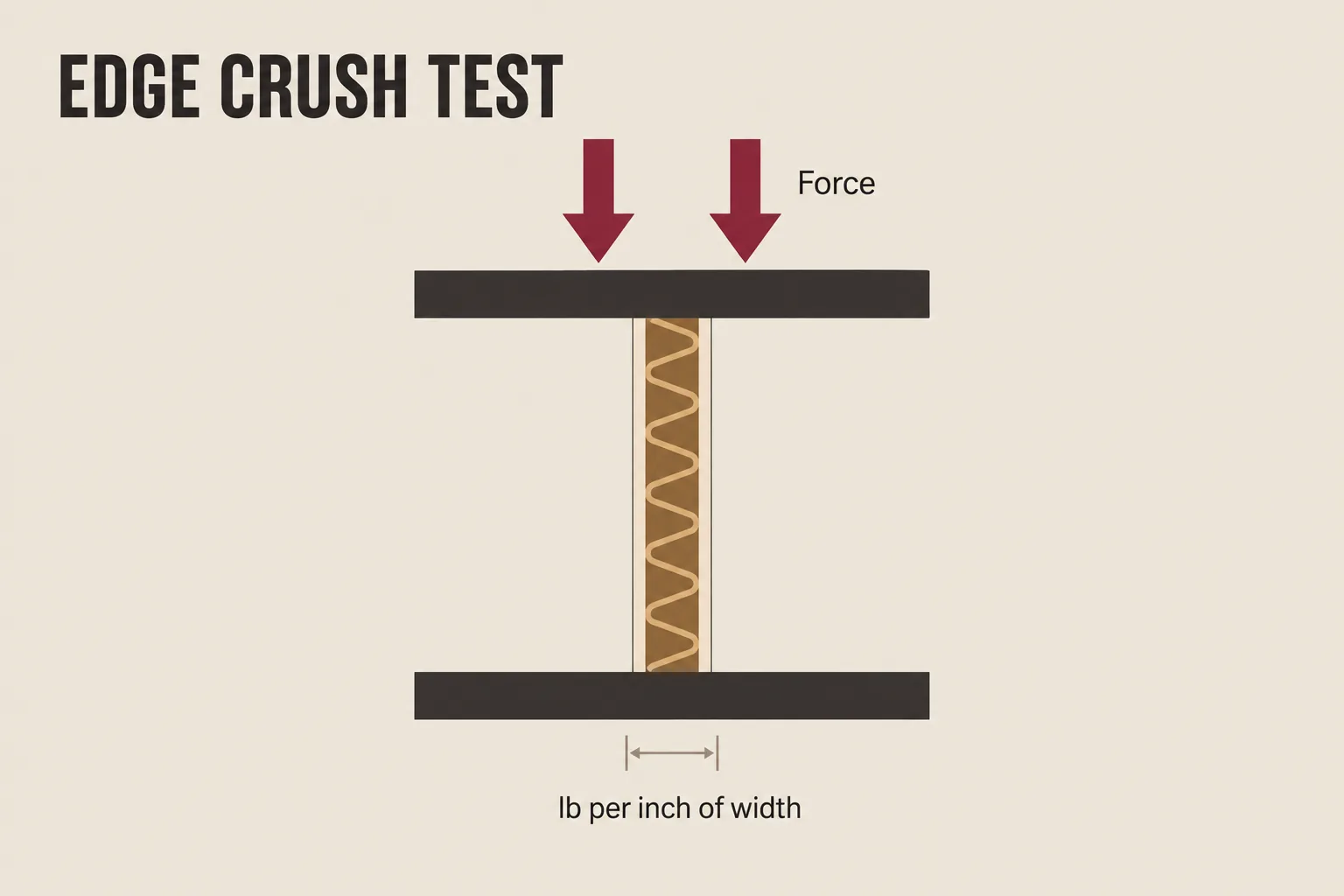
The test is simple. A small piece of combined board is cut, stood on its edge, and compressed between two plates until it fails. The force at failure, divided by the width of the sample, is the ECT value. TAPPI T 811 describes a method for measuring edgewise compressive strength of corrugated board.
That is why a spec reads “32 ECT” rather than “32 pounds.” The number is force per inch of board width, which lets it scale to boxes of different sizes.
ECT is one input used to estimate a box’s compression performance. Box dimensions, construction, closures, contents, storage conditions, and pallet pattern also affect the result, so the board rating alone cannot establish a safe stacking height.
When pallet stacking is a concern, ECT is relevant because it measures edgewise board compression. To assess the finished package, consider its construction and load conditions and, where appropriate, test the completed box.
What the Mullen Burst Test Measures
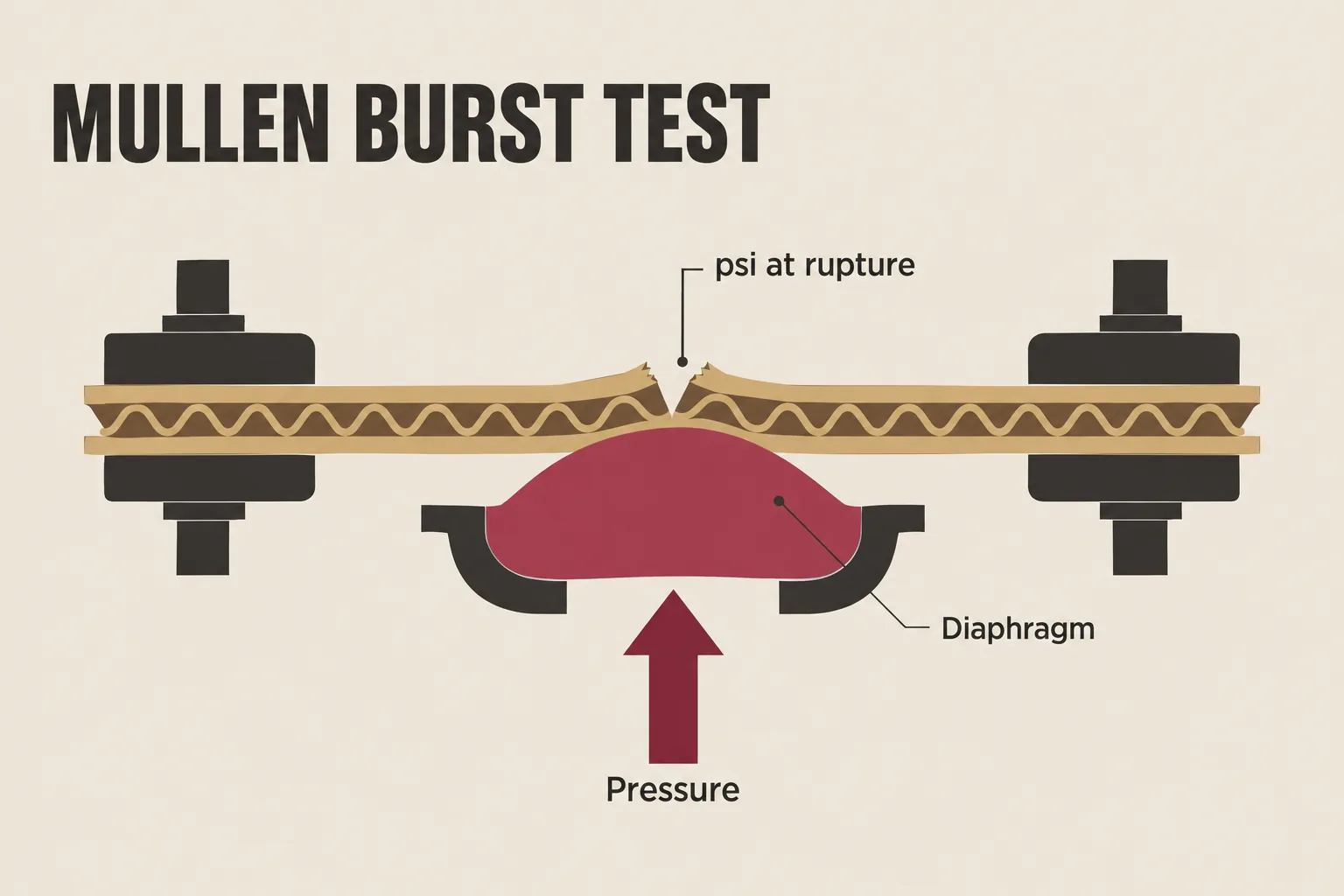
In the burst test, a sample of board is clamped over an opening and a rubber diaphragm is pushed against it with increasing hydraulic pressure until the board ruptures. The pressure at the moment of failure is the rating, expressed in pounds per square inch. A “200 lb test” rating refers to that value. TAPPI T 810 describes the bursting-strength test for corrugated board.
Burst strength measures the board’s resistance to rupture under pressure. It should not be presented as a direct measure of a complete box’s resistance to drops, impacts, or other distribution hazards.
A legacy specification may still use a burst rating. Before changing it, check the current customer, retailer, carrier, and packaging requirements, then validate any proposed change for the actual box and distribution conditions.
Where burst still earns its place: dense or heavy contents, less-than-truckload freight where cases are handled individually, and any lane with a lot of manual loading and unloading.
ECT vs Burst vs Box Compression (BCT)
What each measures. ECT measures edgewise compression resistance of corrugated board. Burst measures the board’s resistance to rupture under pressure. Neither directly measures every aspect of a finished box’s performance in distribution.
Units. Pounds per inch versus pounds per square inch. Two different physical properties, which is why there is no clean formula to convert one into the other.
Board construction. Burst ratings reward heavier liners, because heavier liners resist rupture. ECT rewards a stiffer, better-matched combination of liner and medium. Two boards can carry the same burst rating and behave very differently in a stack.
Cost and weight. A different board construction may change material use and shipping weight, but savings depend on the finished design, supplier quote, and freight arrangement. Compare the total cost only after the new package has been validated.
Using equivalency charts. Equivalency charts can help start a specification discussion, but they do not guarantee equivalent performance in a finished box. Review the full box construction and validate a proposed change under relevant conditions. ASTM D5639/D5639M covers selection of corrugated board materials and box construction based on performance requirements.
How ECT, Burst, and BCT Differ
ECT and burst are tests of corrugated board. Box compression testing (BCT) evaluates the compression resistance of a completed shipping box under specified test conditions. A compression result does not replace distribution testing for hazards such as drops, vibration, or impacts. Ask the packaging supplier which test reflects the risk you need to evaluate.
| Measure | What is tested | Useful context |
|---|---|---|
| ECT | Edgewise compression resistance of corrugated board | A board property related to box stacking performance |
| Burst strength | Resistance of corrugated board to rupture under pressure | A board property; not a drop-test result |
| BCT | Compression resistance of a completed box | Useful when evaluating the box under compressive loading |
ASTM D5639/D5639M addresses material and box-construction selection based on performance requirements.
Reading the Box Maker’s Certificate
Look at the bottom flap of many shipping cases for a box maker’s certificate (BMC). The exact information shown can vary; use the stamp and the supplier’s specification together to confirm the rating and limits for that box.
Depending on the box and applicable specification, the certificate may show an ECT or burst rating and limits related to box size and packed weight. Confirm what the specific stamp means with the box maker or supplier rather than assuming every certificate contains identical details.
Two practical uses:
1. Reverse-engineering a spec you already run. If you inherited a case and nobody can find the original specification, the stamp is your starting point.
2. Checking the stated limits. Confirm the packed case stays within the size and gross-weight limits shown on its certificate and any current customer or carrier requirements. If it does not, ask the supplier to review the specification before shipping.
Armour Rose’s A-R-G Process (Ask First, Resolve Second, Grow Third) starts with a review that can consider corrugated packaging alongside other packaging needs. Ask what specifications and supporting documents are available for the proposed solution. Explore Armour Rose’s corrugated shipping box solutions.
Check Current Carrier and Customer Requirements
Customer, retailer, carrier, and co-packer requirements may call for a specific rating, construction, or test. Check the current requirement that applies to your shipment before changing a legacy specification.
Then review the actual shipping route and handling conditions. A board rating alone does not demonstrate that the finished package will withstand every hazard on that route.
Two exceptions override everything else. If a retailer contract or a customer specification dictates a particular rating, that spec wins. And if you ship into a program with its own case requirements (club channel, retail-ready displays, certain distributors), confirm the current requirement before you change anything. Do not assume the version you were handed two years ago is still live.
How Flute Profile Changes the Answer
The flute is the wavy layer between the liners, and its profile changes how a board behaves at the same rating.
- C flute: a common shipping-case profile; suitability depends on the box design, product, and distribution requirements.
- B flute: a lower-profile option that may suit some retail-ready cases; confirm the needed strength, print, and converting characteristics with the packaging supplier.
- E and F flute: fine profiles used in some retail and display packaging. The right choice depends on the structure and its use.
- BC and EB double wall: two-flute constructions that may be considered when a design needs additional structure. Confirm the finished-box performance required for the load.
Flute choice and ECT interact. The same ECT number can produce different finished-box results across flute profiles and box dimensions. Discuss the board rating alongside box style, dimensions, load pattern, and storage conditions instead of treating the rating as the whole specification.
The Variables Neither Test Captures
ECT and burst test board samples under specified test conditions. Real shipments encounter conditions that can affect package performance, so review the distribution environment as part of the specification.
Moisture. Humidity and moisture can affect corrugated performance. If cases will be refrigerated, exposed to condensation, or stored in humid conditions, include those conditions in the packaging review and validation plan.
Time under load. A box may remain stacked for an extended period. Include expected storage duration and stacking conditions when assessing compression needs; a brief test result alone may not represent every storage scenario.
Pallet pattern. How cases are arranged can change how loads are carried through a pallet. Include the actual pallet pattern in the review and any test plan.
Cut-outs. Hand holes, vent holes, score lines, and tear strips remove material from the load-bearing walls and reduce effective stacking strength.
Display die-cuts. Corrugated trays and PDQ displays may include perforations or cut-outs that change the structure. Assess the finished display in its intended configuration. See Armour Rose’s shelf-ready packaging and trays for related packaging options.
Choosing a Spec for Food and Beverage Shipments
Snack, bar, and better-for-you brands. Review case weight, pallet height, stacking pattern, storage, and route. These details help determine whether board compression, finished-box compression, or another test needs to be considered.
Canned and bottled beverage. Packed weight and pallet configuration are important inputs. Do not assume that a heavier product automatically requires a particular ECT, burst rating, or wall construction; confirm the complete specification for the shipment.
Corrugated trays and PDQ displays. Because the finished display may include openings or perforations, assess the completed structure in its intended loaded configuration rather than relying on the flat-board rating alone.
Co-packer and equipment fit. Confirm proposed board and box changes with the co-packer. Check that the case remains compatible with the line’s documented requirements before a full production run.
The reality check. A full pallet shipment and a shipment with repeated individual-case handling may present different risks. Let the product, load, route, and customer requirements guide the specification.
Overspec and Underspec: The Real Cost Math
Underspec is the visible failure. Crushed cases, retailer chargebacks, rejected loads, replacement product, and a brand that looks damaged at the exact moment a shopper sees it.
A specification that exceeds the actual requirement may add material or freight cost, while an inadequate package may contribute to damage or rework. Compare costs only after confirming the package still meets customer requirements and performs in the intended distribution conditions.
Consider total cost, including board price, freight, damage, rework, and replacement shipments. The relative impact of each item depends on the product and shipping program, so use the brand’s own cost and damage data rather than assuming one factor will dominate.
A structured review works in a predictable order: current specification, actual load profile and pallet configuration, damage history by lane, then a right-sized recommendation. That sequence matters. A recommendation made without the damage history is a guess.
Armour Rose works across packaging categories, including corrugated, folding cartons, printed films, and pouches. Its sourcing model can bring those requirements into one packaging discussion, while the final board specification should be confirmed against the product, shipment, and manufacturing partner’s capabilities. Learn more about Armour Rose’s custom packaging solutions.
How to Validate a Spec Change Before You Commit
1. Start with what you have. Pull the box maker’s certificate from a current case and document the real pallet configuration: pattern, tiers, total load weight, and how long a pallet typically sits.
2. Test the finished box, not just the board. A board sample passing a lab test tells you about the material. A box compression test evaluates the container’s resistance to compression under stated conditions. ASTM D642 covers compression testing of shipping containers; select the test and setup with the supplier or qualified packaging professional.
3. Ship a trial through the real lane. Same route, same carrier, same handling, same destination. Inspect at the destination, not at your own dock.
4. Document the result. Write down the board grade, flute, ECT or burst rating, dimensions, and the pallet pattern that passed.
5. Keep the winning spec on file. A documented spec is what makes reorder number twelve identical to reorder number one, instead of a fresh negotiation every time.
Related readingSBS vs CUK vs CRB Paperboard: How to ChooseRead the guide →Frequently asked questions
Is a higher ECT always a stronger box?
Can I convert a 200 lb test rating to an ECT number?
Which rating matters more for stacking on a pallet?
Which rating matters more for rough handling and heavy contents?
Does single wall versus double wall matter more than the rating?
Do retail-ready cases and PDQ displays need a different spec?
Where do I find my current rating?
Get the Spec Right the First Time
ECT measures edgewise compression resistance of board; burst measures board rupture resistance. Neither alone predicts all finished-box or distribution performance. The box design, load, pallet pattern, and route help determine what specification and validation are appropriate.
Armour Rose’s packaging review can consider your current packaging, load profile, co-packer requirements, and related packaging needs before you discuss a corrugated solution.
If you are reviewing a legacy specification or investigating package damage, contact Armour Rose to discuss your current case and packaging requirements.