



















Rollstock vs premade pouches comes down first to where the package is formed. Rollstock is formed, filled, and sealed on compatible form-fill-seal equipment; premade pouches arrive converted and are filled on pouch-filling equipment. The right choice depends on your product, volume per SKU, co-packer line, and total operating cost.
Two ways exist to get a snack, a bar, a granola blend, or a specialty beverage into a flexible pack: buy printed film on a roll and form the bag at the moment you fill it, or buy finished bags and fill them. Cost per unit, shelf life, line speed, and time to launch all sit downstream of that one choice.
Brands get it wrong in predictable ways. Some buy rollstock before they have the volume or the equipment to justify it. Others stay on premade pouches for years after the volume would have paid for the switch several times over. Both mistakes are expensive, and an hour of honest math prevents either one.
Rollstock vs Premade Pouches at a Glance
Rollstock is printed laminated film wound on a core. The bag is formed, filled, and sealed in one continuous pass, on your line or your co-packer’s.
Premade pouches arrive as finished bags. Side seals, bottom gusset, zipper, tear notch, and hang hole are applied before the pouch ships to you. You open, fill, and seal.
At stable, higher volume, rollstock may have a lower packaging unit price because the supplier does not convert each bag. Premade pouches can suit launches, smaller runs, frequent SKU changes, or formats with features the filling line cannot form. Compare both options against your equipment and actual cost per saleable filled pack.
Compare total delivered cost per saleable filled pack: packaging price, tooling and setup, filling labor, startup waste, changeovers, equipment and maintenance, freight, storage, and any obsolete inventory.
A lower unit quote can still produce a higher total cost once the full production and supply picture is included.
| Decision factor | Printed rollstock film | Premade pouches |
|---|---|---|
| What arrives | Printed film on a roll | Finished pouches ready to fill |
| Filling setup | Compatible form-fill-seal line | Manual or machine designed for premade pouches |
| Cost drivers | Film, line capacity, labor, setup, waste and downtime | Finished pouch price, filling labor, freight and storage |
| Common advantage | Continuous production on a compatible line | More format and feature options with less converting at the filling site |
| Often worth comparing when | Volume is stable and concentrated in a few SKUs | Demand is new or variable, or SKU count is high |
| Key check | Confirm roll and print specs with the actual line | Confirm pouch dimensions, features, and filler compatibility |
These are tendencies, not fixed rules. Compare the product, installed equipment, order quantities, and run length for each SKU before choosing.
What Rollstock Actually Is
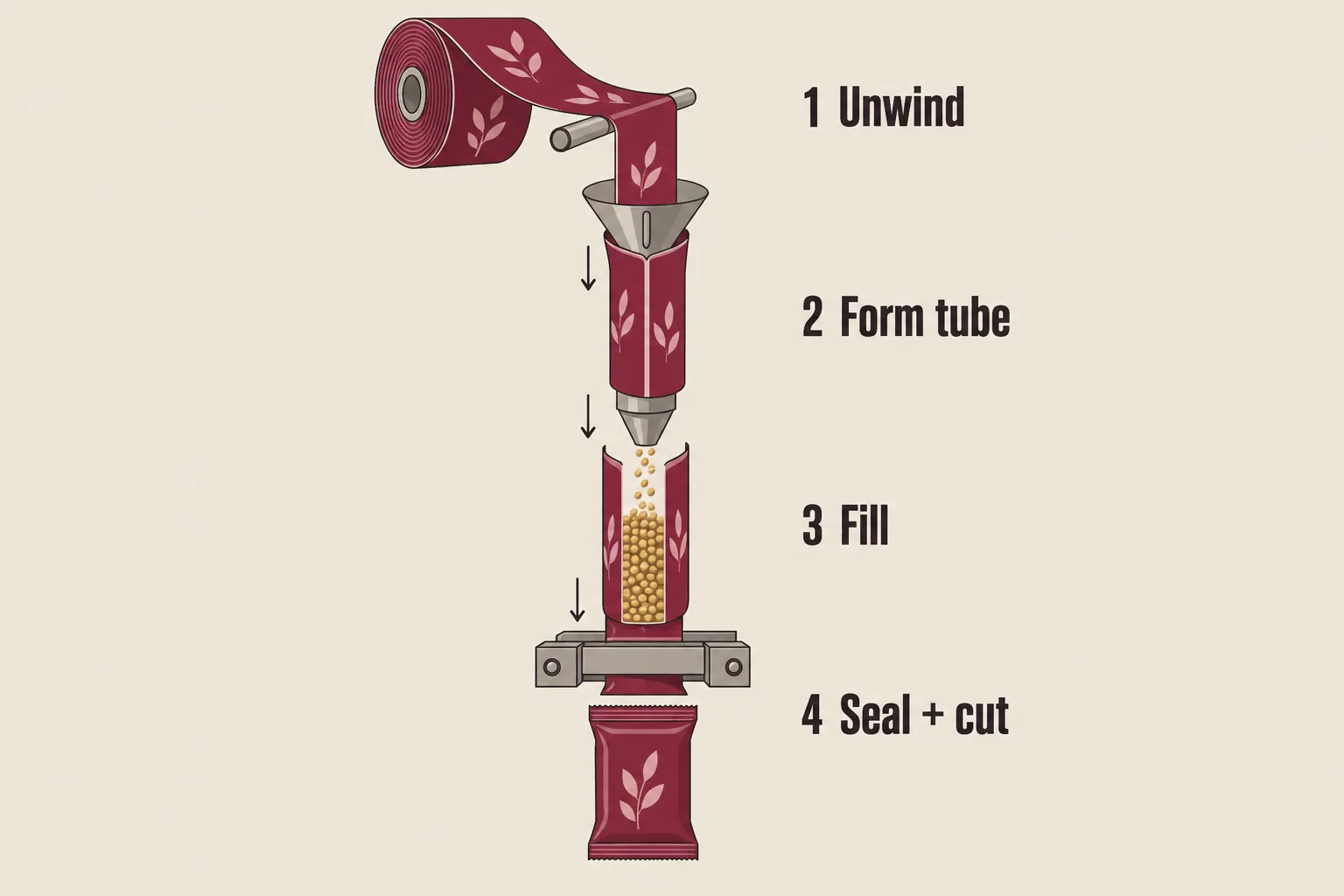
Rollstock arrives as a roll of printed film, cut to a specific width and wound to a specific length for one machine. The bag does not exist until the machine makes it. Film feeds over a forming collar, wraps into a tube, takes a back seal and a bottom seal, receives the product, then takes a top seal that also becomes the bottom of the next bag.
Many snack, popcorn, and chip products run on vertical form-fill-seal (VFFS) lines, while bars and similar products often use horizontal form-fill-seal (HFFS) flow wrapping. Confirm the line and product requirements with the co-packer; configurations vary.
Depending on the equipment and tooling, rollstock can form formats such as pillow bags, some gusseted bags and flow wraps. A flat pillow format may suit products that do not need to stand on the shelf. Compare lay-flat pillow pouches against the product, line and total cost rather than assuming one format is always cheapest.
Before ordering, match the film width, maximum roll diameter, core size, unwind direction, repeat length and eye-mark requirements to the actual machine. A mismatch can make a roll unusable, so get the current line specifications in writing. See Armour Rose’s roll stock film specifications for the machine details to confirm.
Rollstock can suit high-volume production when the line, SKU run length, changeovers, and material yield support it. Compare actual line output and total cost rather than assuming it is always the cheapest or fastest route.
What Premade Pouches Actually Are
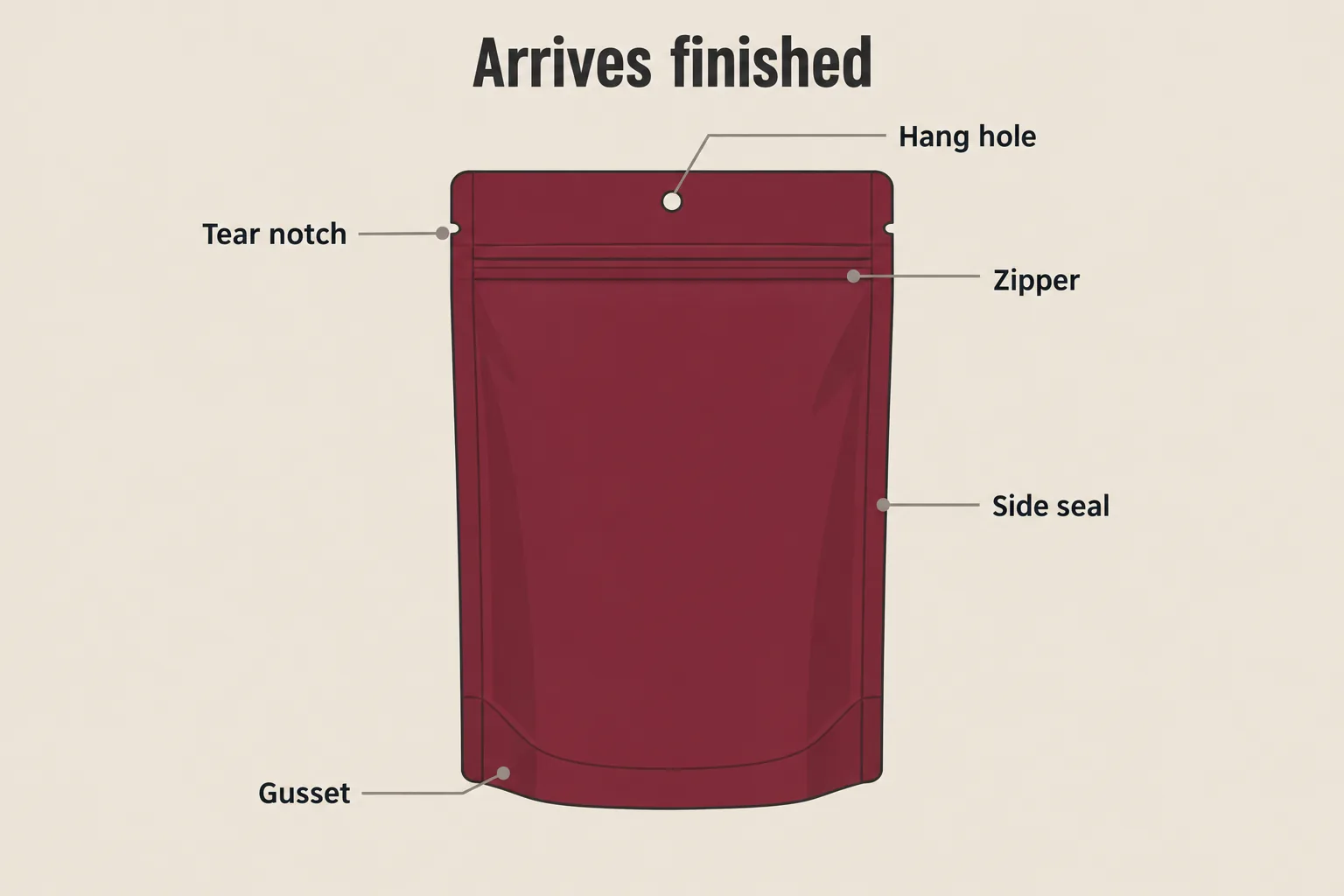
A premade pouch is film already converted into a bag. The converter runs the film, makes the seals, applies the zipper, punches the notch, and ships finished units in cartons.
Premade pouches offer a range of formats and features, including zippers, spouts, shaped designs and flat-bottom styles. Some rollstock systems can form stand-up pouches with the right equipment and tooling, so confirm the format with the filling-line supplier. See premade stand-up pouch options as one example of a finished-pouch format.
Filling scales with volume. A launch brand can hand fill and heat seal on a tabletop unit. A growing brand moves to semi-automatic filling. Established volume moves to a rotary pouch filler that picks up, opens, fills, and seals each pouch in sequence.
The trade-off sits inside the unit price. You are paying for the converter’s labor, tooling, scrap, and margin on the bag-making step. That is not a criticism of the format; it is the reason the format works: someone else absorbed the complexity.
Premade pouches can help a launch avoid buying a form-fill-seal line, although the brand or co-packer still needs a suitable way to fill and seal the pouch. Order minimums depend on the printer, structure, and run.
Cost: Unit Price Is Only One Line on the Invoice
The structural argument for rollstock is simple. Remove the bag-making step and the same laminate costs less per finished bag. What changes is everything around it.
On the rollstock side, add capital cost or rental of form-fill-seal equipment, film scrap at every startup and every changeover, operator skill (a good operator materially reduces waste), and maintenance on seal bars, forming collars, and film tracking.
On the premade side, add the finished-pouch unit price and account for the freight and warehouse space required by the actual pouch shape and pack-out.
Printing tooling applies to both. Plates or cylinders are a one-time charge per design, spread across the run.
Build the comparison yourself, one line per format:
(Packaging price + print/tooling + freight and storage + expected waste or obsolete stock) per saleable pack + (filling labor + allocated equipment, setup, maintenance and downtime) per saleable pack = total cost per filled, saleable pack.
Run it for your real volume, not your hoped-for volume. Much of the movement in that number can come from procurement structure, consolidated freight where shipments can be combined, and line efficiency rather than from grinding another fraction of a cent off the unit price. Lowering total cost and lowering unit cost are different projects, and the first often moves the needle further.
Speed and Throughput
Forming from rollstock is generally faster at scale, for mechanical reasons. Making the bag and filling it happen in the same motion, in one continuous web, with no separate handling step.
A premade pouch filler has to pick a pouch from a magazine, open it, hold it, fill it, then seal it. Each is a discrete action, and discrete actions cap cycle rate. That is a real constraint on a high-volume product and irrelevant on one doing modest weekly numbers.
Hand filling premade pouches works perfectly well for small runs and becomes a bottleneck faster than most founders expect. The moment a second shift exists purely to keep up with filling, the math on automation has already changed.
Changeover behaves differently too. Switching SKUs on a rollstock line means a roll swap and, if the bag size changes, a forming collar change. Switching on a pouch line often means loading a different magazine, which is faster.
Rollstock also carries downtime risks that premade pouches do not: film tracking off center, seal bar temperature drift, print drifting out of position. None are exotic. All need an operator who knows the machine.
Order Minimums and Lead Times
Rollstock is quoted by weight or by length, so the minimum is tied to what a printing press economically runs. Even a small rollstock order carries a press minimum, and that minimum can translate into far more finished bags than a young brand sells in a year.
Premade pouches are quoted per unit, which makes test markets, limited runs, and low volume per SKU much easier to buy in a quantity that matches real demand.
Multi-SKU brands can ask whether a shared material structure works across products. Artwork, print setup, and minimums may still apply separately by design, so confirm how the supplier calculates each run before spreading volume across the portfolio.
Lead times depend on the supplier’s schedule, print method, structure, artwork approval, and converting steps. Premade pouches may need an additional converting stage, but confirm the current dates for both formats rather than assuming one will always arrive sooner.
Digital printing is the practical route to lower minimums for launches, seasonal editions, and test SKUs. It removes the tooling charge and shortens the runway, at a higher cost per unit once volume grows. That is exactly why brands use it to launch and move to conventional printing when demand proves out.
Schedule a format trial around your co-packer’s production calendar, current inventory, and retail deadlines. Do not assume a particular season is quiet across the food and beverage industry.
Shelf Presence and Format Flexibility
On a retail shelf, the question is what the shopper actually sees.
A stand-up pouch can present a broad front panel and stand on the shelf when its structure and fill support that use. A pillow bag has a different shelf profile. Evaluate the filled pack in the intended retail setting before treating appearance as a deciding factor.
Reclosure splits the same way. A zipper or slider is straightforward on a premade pouch because the converter applied it. On a form-fill-seal line, it requires a zipper applicator, which is a capital and maintenance decision rather than a specification change.
Decorative effects are available in both: matte and gloss zones, soft-touch finishes, clear windows, registered metallic effects. Their cost depends on print method and run length, not on the format.
The product and line help narrow the options. Bars often use flow wrap; some snack products run in pillow or gusseted formats. Granola, trail mix and nut blends may fit either route, depending on the filling equipment, pack features and required barrier.
Check the pack-out before committing. Bag dimensions set case count, and case count sets pallet configuration, club-store pack requirements, and shipping cost per unit in e-commerce. A format decision made in isolation from the case pack tends to get revisited.
Material Structure, Barrier and Shelf Life
Both formats can use similar laminate families, but shelf life is not determined by format alone. Product characteristics, material structure, seal integrity, filling conditions and storage all matter.
Oily snacks, roasted nuts and coffee need oxygen and moisture protection, which usually means a metallized or barrier layer in the laminate. A dry, low-fat product with quick turns often needs far less. Specifying more barrier than the product requires is one of the most common sources of avoidable packaging cost.
The seal-making steps differ. Premade pouches arrive with converted seals and features, but the final top seal is made during filling; rollstock packages are formed and sealed on the filling line. Evaluate the finished seal under actual production conditions for either route, especially when seal performance affects product protection.
Nitrogen flushing and one-way degassing valves work in both formats with different mechanics. On a form-fill-seal line, the flush happens during forming; on premade pouches, it happens at the filler.
Some recyclable-design or mono-material structures are available for flexible packaging, but material claims depend on the complete package and the market where it is sold. A structure may also run differently on a filling line, so confirm the supplier’s specification and trial it before approval.
Sustainability and Compliance
Do not assume rollstock uses less material than an equivalent premade pouch. Compare the actual pack weights and full structures before making a material-use claim. Environmental rules and producer-responsibility programs vary by market, so confirm the requirements for the provinces and states where the product will be sold.
Before describing a package as recyclable or making another environmental claim, check the evidence and qualify the statement for the relevant market. Review the FTC Green Guides for U.S. environmental marketing and the Canadian Competition Bureau’s guidance on environmental claims for Canada.
Ask the manufacturer or relevant supplier for current food-contact documentation and written specifications for the intended market and use. The FDA explains how to check the regulatory status of components in food-contact materials. Confirm who supplies and reviews each document before the first production run; do not treat a general statement as approval for every product or use. In Canada, Health Canada oversees the safety of food packaging materials.
The Co-Packer Question
Most small and mid-size food brands do not own the filling line. That single fact usually settles the format before cost enters the conversation, because the co-packer’s installed equipment is what it is.
Settle these before quoting anything:
- Machine make and model on the line that will run your product
- Maximum film width the machine accepts
- Maximum roll diameter and required core size
- Whether they run premade pouch fillers at all, and at what pouch sizes
- Scrap and startup waste allowance, and who pays for it
- Whether they accept customer-supplied film, and under what specification
Sending a roll the machine cannot physically accept is a common and genuinely expensive error. The roll is unusable, the production slot is lost, and the reorder restarts the lead time.
Trials de-risk this. A test roll or a short sample pouch run, timed and measured, shows real output and real scrap before a full production order is committed. Armour Rose’s co-manufacturer partnerships can help align packaging specifications with production requirements.
Brands running product at more than one co-packer have an extra reason to standardize specifications across sites. One specification that runs everywhere is worth more than a marginally better specification at each location.
A Decision Framework You Can Apply This Week
Choose premade pouches when:
- Demand is still uncertain, or volume per SKU does not support a long, stable run on compatible equipment
- You have less than a year of stable demand history
- SKU count is high, and volume per SKU is low
- The format is non-negotiable for the brand: spouted, flat-bottom, or a shaped die cut
- You need to be on shelf quickly and cannot wait on equipment
Model the rollstock switch when:
- Volume is stable and growing on a small number of SKUs
- You or your co-packer already have form-fill-seal capacity
- Warehouse space is constrained (rolls occupy far less space than cartoned pouches)
- Unit cost has become a board-level conversation
Consider the hybrid: one shared rollstock structure for core SKUs, premade pouches retained for small, seasonal or promotional items. Plenty of brands run both permanently, by design.
Before requesting a quote in either format, gather annual volume by SKU, fill weight and product bulk density, required shelf life, retail channel, co-packer equipment details, available storage space, and your current landed unit cost. A quote built on those inputs is a decision tool. A quote built on a bag size and a guess is a number.
Migrating From Premade Pouches to Rollstock Without Disrupting Supply
Most comparisons stop at the comparison. The transition is the harder part, and where supply gaps happen.
A sequence that works:
- Validate volume. Twelve months of actual shipments, not forecast.
- Confirm line capability. Machine specifications in writing, from the co-packer or your own maintenance team.
- Match the structure. The rollstock laminate should deliver the same barrier and shelf life as the pouch it replaces. Do not change two variables at once.
- Order a trial roll. Short length, correct specification, real artwork.
- Run a timed trial. Measure actual output per hour and actual scrap, including startup. Estimates run optimistic.
- Phase the changeover. Move one SKU, stabilize it, then move the rest.
Run down pouch inventory in parallel rather than stranding it in the warehouse. Writing off good pouches erases a meaningful share of the savings the switch was meant to deliver. Include inventory and delivery planning in the changeover discussion.
Artwork does not transfer one-to-one. Panel layout changes, the print repeat has to match the bag length, and register marks have to be added. Design intent carries over; the production file does not.
Keep a premade pouch specification qualified as a fallback. It covers promotional packs, small SKUs, and the week the form-fill-seal machine is down for repair. A second qualified route is continuity planning, not indecision.
That is also the right way to think about single sourcing. The value is single-source accountability: one specification owner, one quality standard, one point of escalation when something goes wrong. It is not single-plant dependency, and a well-built program keeps qualified alternatives in place.
Where the Rest of the Pack Fits
Flexible film is rarely the whole package. A multipack needs a folding carton. A retail-ready presentation needs a corrugated tray or a PDQ display. Variant management often needs labels.
The rollstock or pouch decision has knock-on effects on all of them. Bag dimensions drive carton dimensions, carton dimensions drive case pack, and case pack drives tray and display design. Change the bag and leave the carton specification alone, and the fit problem gets discovered on the assembly line.
Consolidating film, cartons, trays, and displays under one specification owner reduces version drift, keeps artwork aligned across components, and lets shipments arrive together rather than from four vendors on four days.
Many brands buy film from one partner and manage cartons, trays, and displays across several others, usually because that is how it started rather than because anyone chose it. What that fragmentation costs in coordination time and freight is worth a look. Armour Rose also supplies shelf-ready packaging and trays as part of its broader packaging range.
How Armour Rose Approaches the Choice
The format recommendation comes last, not first.
The A-R-G Process (Ask First, Resolve Second, Grow Third) starts with discovery: what you package today, what your co-packer’s equipment can actually run, how often you order, in what quantities, and where it all ships. A gap analysis then identifies where supply or specification is weak, followed by options with pricing estimates and specification alternatives. You review, we adjust, and the order follows a decision you can defend.
Armour Rose is a custom packaging partner that manages sourcing and production through a vetted manufacturing network. That structure matters here for one reason: the recommendation is not constrained by one plant’s product line. A supplier who only makes premade pouches will recommend premade pouches. Armour Rose’s end-to-end sourcing and production management service supports the broader, multi-line sourcing model described here.
With 25+ years serving food and beverage brands across Canada and the United States from Toronto, the working model is a single source for flexibles, folding cartons, corrugated trays, displays and labels. Armour Rose can help coordinate packaging options across these categories through its manufacturing partner network. Confirm the scope, documentation and service commitments for each project before placing an order.
Related readingTypes of Flexible Packaging: Formats, Materials & UsesRead the guide →FAQs About Rollstock vs Premade Pouches
Can premade pouches run on a VFFS machine?
Can rollstock make a stand-up pouch?
Does the format determine a pouch’s shelf life?
Is rollstock cheaper than premade pouches?
Can I use the same artwork for both formats?
What volume justifies switching to rollstock?
Can premade pouches use a recyclable-design structure?
Do I need my own machine to use rollstock?
How long do custom printed rolls and pouches take to produce?
Can one supplier handle film, cartons, and displays together?
Next Step
Bring three things to a discovery conversation: annual volume by SKU, your co-packer’s equipment details, and your current landed unit costs. That is enough to build a side-by-side rollstock and premade pouch estimate for the same product, with total delivered cost shown rather than price per bag alone.
Schedule a call or request a packaging quote to compare the two formats using your product, co-packer line, and current landed costs.