


















The wrong packaging supplier rarely announces itself upfront. It shows up later: a failed shelf-life test, a compliance gap flagged by a retailer, a batch that seals inconsistently and forces a recall. Choosing well is a sourcing decision with real stakes. This guide gives you a framework to vet suppliers and match packaging to your product, so you can shortlist with confidence before you request a single quote.
What a food and beverage packaging supplier actually does
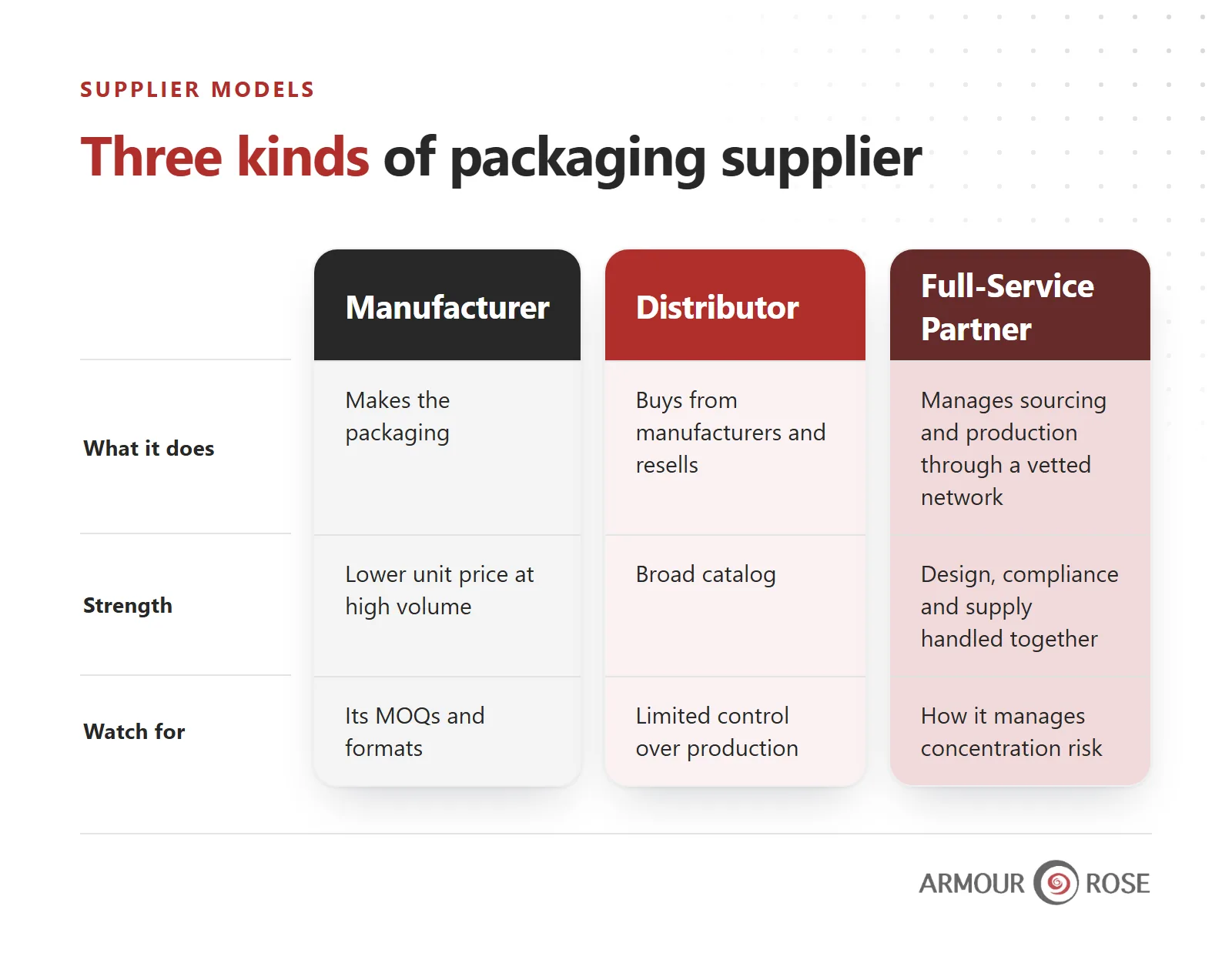
Not every supplier does the same job, and the labels blur. A manufacturer makes the packaging. A distributor buys from manufacturers and resells, often carrying a broad catalog but limited control over production. A full-service packaging partner, such as Armour Rose, manages structural design and pre-press artwork processing (you supply print-ready graphic files), materials sourcing, production, and logistics through a vetted network of manufacturers. It does not make the packaging itself, and it is accountable for the result.
The distinction drives lead times, minimum order quantities, and how many vendors you manage. Buying direct from a manufacturer can lower the price per unit at high volume, but it ties you to their MOQs and formats, and the saving can disappear once you add freight, storage, and the overhead of managing another vendor. A distributor gives you range without deep customization. A full-service partner offering custom packaging solutions for food and beverage brands can simplify sourcing when you need design, compliance, and supply reliability handled together. Know which model fits before you compare names.
Count the total cost, not the unit price
The cheapest quote per thousand units is the easiest number to compare and the most misleading one to decide on. What you actually pay is the total landed cost of getting the right packaging onto your line, on time, for as long as you need it.
Four costs sit outside the unit price and can outweigh it:
- Freight. Sourcing closer to your plant, or consolidating shipments across formats, can cut a line item that a lower unit price rarely offsets.
- Storage and working capital. A large minimum order that wins you a better rate becomes warehouse rent and cash tied up in film you have not run yet.
- Administration. Every extra vendor is another set of POs, invoices, quality documents, and phone calls when something is late.
- Obsolescence. A label or carton redesign turns unused inventory into waste, and the more you bought to hit a price break, the more you write off.
Ask any supplier to price a realistic year, not a single run: your actual order pattern, your seasonality, your likely artwork changes. The supplier who talks in those terms is the one who understands your business.
One source or many
Most brands do not buy one kind of packaging. A single product line can need flexible film, a paperboard carton, a corrugated shipper, and a label, and each of those can come from a different manufacturer with its own MOQ, lead time, and quality documentation.
Managing that yourself means four vendor relationships and four sets of problems, and when a component runs late, coordinating the fix is your job. Consolidating those through one partner with a broad manufacturing network moves that coordination off your desk. It can also make the total cost above easier to control, because one partner can trade off freight, volume, and timing across the whole basket rather than optimizing one line at a time.
The trade-off is real and worth naming: a single source concentrates your supply relationship. Ask how a candidate manages that risk, what happens when their preferred manufacturer for a format cannot deliver, and whether they can pivot to an alternative without restarting your qualification process. Armour Rose’s model is single-source accountability across a network of vetted manufacturers, so your program does not depend on one plant. We can qualify an alternate manufacturer for a format, and you would typically give final approval as a checkpoint.
If you work with a co-manufacturer
Brands that use a co-manufacturer (co-packer) have a coordination problem the checklist above does not solve on its own. Your packaging has to arrive at someone else’s plant, run on someone else’s line, and meet their specifications for roll width, core size, case count, and pallet pattern.
Confirm early who owns packaging procurement in that relationship, who holds the inventory, and whose specifications win when they conflict. A supplier who has worked alongside co-manufacturers will ask these questions before you do. See how we approach co-manufacturer partnerships.
Start with your product, not the supplier
You cannot choose a supplier until you know what you need packaged. Nail your requirements first.
Match packaging to your product type
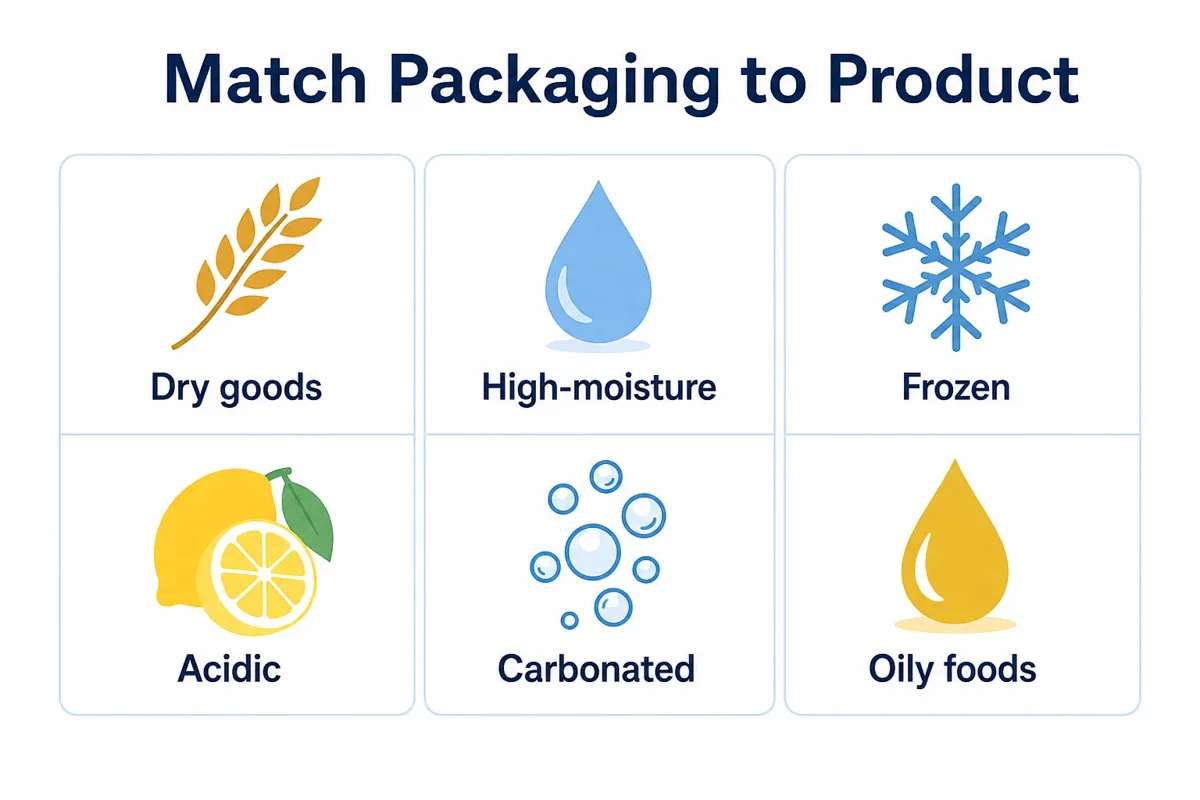
Dry goods, wet or high-moisture foods, acidic products, carbonated beverages, and oily foods each place different demands on materials. Acidic and oily products can degrade certain films and coatings, and research on chemical migration finds that acidic or fatty foods are more likely to interact with packaging materials and facilitate migration into the food. Carbonated drinks need pressure resistance. Because packaging sits in direct contact with what people consume, food-contact safety and material migration are non-negotiable, and regulators in your selling market set clear expectations for materials that touch food.
Shelf life, barrier properties, and freshness
Define how long the product must stay fresh, then work backward to the barrier you need against oxygen, moisture, and light. A high-barrier structure protects a sensitive product but costs more and can be harder to recycle. Under-specify and you shorten shelf life; over-specify and you pay for protection you do not need.
Right-size your packaging
Oversized packaging wastes material, raises shipping costs, and invites damage from product movement. Undersized packaging risks crushing and leaks. Right-sizing balances protection, waste, and freight, and it is one of the easiest places to save money without compromising quality.
The core criteria for vetting a supplier

Once your requirements are clear, run every candidate through the same checklist.
Food-grade compliance and certifications. Confirm the supplier works with food-contact-approved materials and can document it. Ask about food-safety management systems, traceability, and how they handle audits. If you sell in the United States, materials that touch food must be authorized under the Food and Drug Administration’s food-contact rules. If you sell in Canada, Health Canada controls the safety of food packaging materials under the Food and Drugs Act. A credible supplier should speak to the regulator for your market fluently. Do not accept vague reassurance here.
Quality control and testing capability. Ask how they sample production runs and what they test for: seal integrity, drop resistance, closure performance, and material migration. Consistent output batch to batch separates a dependable partner from a gamble.
Industry experience and references. Suppliers who have worked in food and beverage understand the failure modes newcomers miss. Ask for references from brands with products similar to yours, and actually call them.
Material range and customization. A supplier with a wider range of flexible packaging materials and formats can match structure to product instead of forcing your product into stock options. Ask whether they can prototype and adjust specs as you scale.
Capacity, MOQs, and lead-time reliability. This is where many buyers get burned. Can the supplier meet your volume today and your volume in a year? What are realistic lead times, and how do they perform against them? Ask about capacity headroom for seasonal spikes, and about what happens when you outgrow your current format.
Customer service and communication. Responsiveness during the sales process usually predicts responsiveness when something goes wrong. Note how quickly they answer, how clearly they explain trade-offs, and whether they push solutions or just take orders.
Sustainability without the greenwashing
Recyclable, compostable, and recycled-content materials matter to buyers and regulators, but they have to be weighed against barrier performance and cost. A compostable film that fails your shelf-life target is not a win.
Ask for evidence, not adjectives. Request specifics: what standard a “recyclable” claim meets, what percentage of recycled content a material contains, and what testing backs a “compostable” label. A supplier who can substantiate claims is a safer long-term partner than one who leans on green language without proof.
The frameworks buyers ask about

A few shorthand models come up often. Treat them as thinking tools, not rigid rules, since definitions vary by source.
- The types of packaging: primary (touches the product), secondary (groups primary units, like a carton), and tertiary (bulk transit, like corrugated trays and shippers). Some frameworks add a fourth level for unit loads and pallets.
- The 4 C’s of packaging: Contain, Communicate, Convenience, and proteCt.
- The 5 P’s of packaging: Product, Protection, Price, Presentation, and Placement.
Use these to pressure-test whether your packaging is doing every job it should, from protecting the product to selling it.
Red flags and questions to ask before you commit
Bring a short list to every supplier call:
- Can you provide food-contact compliance documentation for my market?
- What is your realistic lead time, and how often do you hit it?
- How much capacity headroom do you have for growth or seasonal spikes?
- What happens if a batch fails quality checks?
- Can you quote my full packaging basket, not just one format?
- Can I order a paid sample or trial run first?
Watch for the warning signs: no documentation, vague answers on food-grade status, no references, or reluctance to provide samples. A supplier offering a genuine breadth of packaging services and formats should welcome these questions, not dodge them.
Making the final decision
Weigh each candidate against your own priorities rather than a generic scorecard. If shelf life is your make-or-break factor, weight barrier and testing capability heavily. If you are scaling fast, weight capacity and lead-time reliability. If procurement consistency is the pain, weight vendor network breadth and the ability to hold pricing across a year. Before a large commitment, run a paid sample or short trial to see quality and communication in practice.
Armour Rose has spent more than 25 years sourcing custom packaging for food and beverage brands across North America, from start-ups placing a first order to national brands running multiple formats. Clients rate us 4.9 out of 5, and we offer paid samples, trial runs, and prototyping, with minimums that depend on the product and spec. Our A-R-G Process starts with a straight conversation: we Ask First about what your product actually needs and what it will cost you across a year rather than a single run, we Resolve Second with a solution and transparent pricing, and we help you Grow Third. Get a quote or schedule a call.
Related readingSingle Source Packaging Supplier: One Partner for F&BRead the guide →
Frequently asked questions
Manufacturer or distributor: which is better for a small food brand?
For smaller or fast-changing brands, a full-service partner or distributor usually offers more flexibility and design support. Distributors can offer lower minimums on stock items, but custom printed packaging carries minimums set by the manufacturer, so ask about them up front. Buying direct from a manufacturer tends to pay off once your volumes are high and your formats are stable, though the lower price per unit is only a saving if it survives the freight, storage, and administration that come with it.
How do I verify a supplier's packaging is food-safe?
Food-contact compliance documentation should show that materials meet the standards of the regulator in your selling market, the Food and Drug Administration in the United States or Health Canada in Canada. You should not have to chase it. Armour Rose manages this documentation for you from the manufacturers in our vetted network, which currently hold SQF certification. We can walk you through how migration and seal integrity are tested. We can supply SQF certificates for the manufacturers behind your primary, secondary and tertiary packaging.
Should I use one packaging supplier or several?
Several specialists can win on price for an individual format. One partner covering the whole basket often wins on total cost, because freight, minimum orders, and administration are traded off across every format at once rather than optimized one line at a time. Ask a single-source candidate how they handle a manufacturer failing on one component.
What are the types of packaging?
Primary, secondary, and tertiary, with some frameworks adding a fourth level for unit loads and pallets.
What are the 4 C's and 5 P's of packaging?
The 4 C’s are Contain, Communicate, Convenience, and proteCt. The 5 P’s are Product, Protection, Price, Presentation, and Placement.