









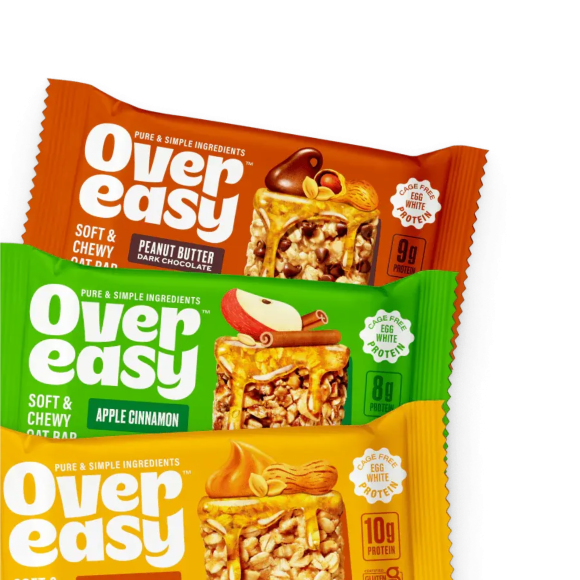














Stick packs and sachets do the same job: hold one serving, protect it on the shelf, and open cleanly. They differ in shape, seal count, film use, and the filling line each one requires.
Pick the wrong format and the mismatch surfaces at the co-packer after the print plates are cut.
Here is how the two formats actually differ, and how food and beverage brands should work through the decision.
Stick Pack vs Sachet Pack: The Short Answer
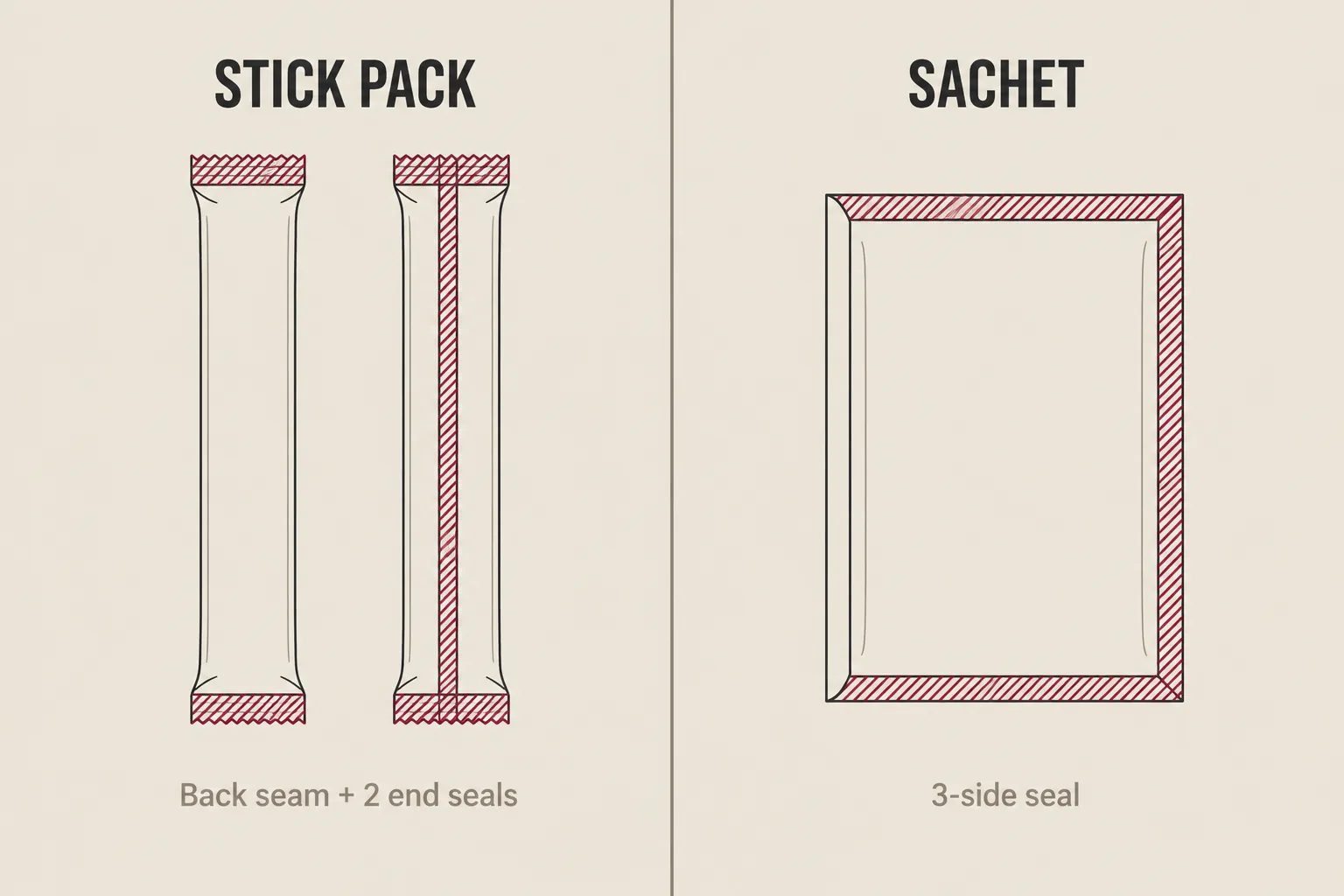
A stick pack is a narrow, tube-shaped single-serve pack, usually made from rollstock with a longitudinal back seam and seals across the top and bottom. A sachet is a flatter pack made with a three-side, four-side, or other edge-seal construction. These are useful starting definitions, not product rules: both formats can be engineered for more than one type of fill when the film, seals, dosing system, and machine are suitable.
At a glance:
Related readingSachets and Stick Packs Specified To Your FillerRead the guide →| Factor | Stick pack | Sachet |
|---|---|---|
| Shape | Narrow and elongated | Flat, rectangular, square, or custom-shaped |
| Seal pattern | Usually one longitudinal seam plus two end seals | Usually three or four sealed edges, depending on construction |
| Typical starting point | Free-flowing powders, granules, and measured drink mixes | Liquids, gels, creams, sauces, and portioned powders |
| Opening and use | Narrow opening that can support controlled pouring | Wider tear or squeeze opening, depending on the fill and tear design |
| Print area | Tall, narrow branding panel | Broader flat panel in many configurations |
| Equipment | Often a multilane form-fill-seal setup | Vertical or horizontal form-fill-seal, or preformed-sachet equipment, depending on the program |
| Main cost variables | Film area, laminate, print setup, lane count, speed, scrap, and freight | Film area, seal construction, laminate, print setup, speed, scrap, and freight |
The decision should begin with the product’s flow or viscosity, dose, opening experience, equipment, volume, and distribution requirements. There is no universal ranking of those factors; the right order depends on the product and the line. Armour Rose’s flexible film and pouch packaging services can be considered alongside the carton, tray, display, and shipping requirements around the single-serve pack.
What Is a Stick Pack?
A stick pack is typically formed from one roll of flexible film. The web is shaped into a narrow tube, joined with a longitudinal seam, filled, and sealed across the top and bottom. The exact seam, seal, and film construction depend on the equipment and the product’s barrier and seal requirements.
Many stick-pack programs use multilane form-fill-seal equipment, allowing several narrow packs to be formed and filled in parallel. Lane count, dose accuracy, film width, machine speed, and the co-packer’s tooling all affect the final specification.
For the consumer, the narrow format can make measured powders and granules easy to pour into a bottle, mug, or other opening. That benefit depends on the tear notch, opening size, product flow, and how completely the pack empties, so it should be checked in a product trial.
Best-Fit Products for Stick Packs
Stick packs are often considered for free-flowing powders and small granules such as coffee, sugar, creamer, electrolyte mixes, greens, protein blends, collagen, and drink flavourings. For food and beverage brands, a stick can make a single serving easy to count, pack into a carton, and distribute through retail, foodservice, sampling, or subscription channels.
A stick pack may also be possible for selected liquid or semi-liquid products, but viscous, sticky, chunky, or fibrous fills can require a different dosing and sealing setup. Treat those products as a validation question rather than ruling them in or out from shape alone.
What Is a Sachet Pack?
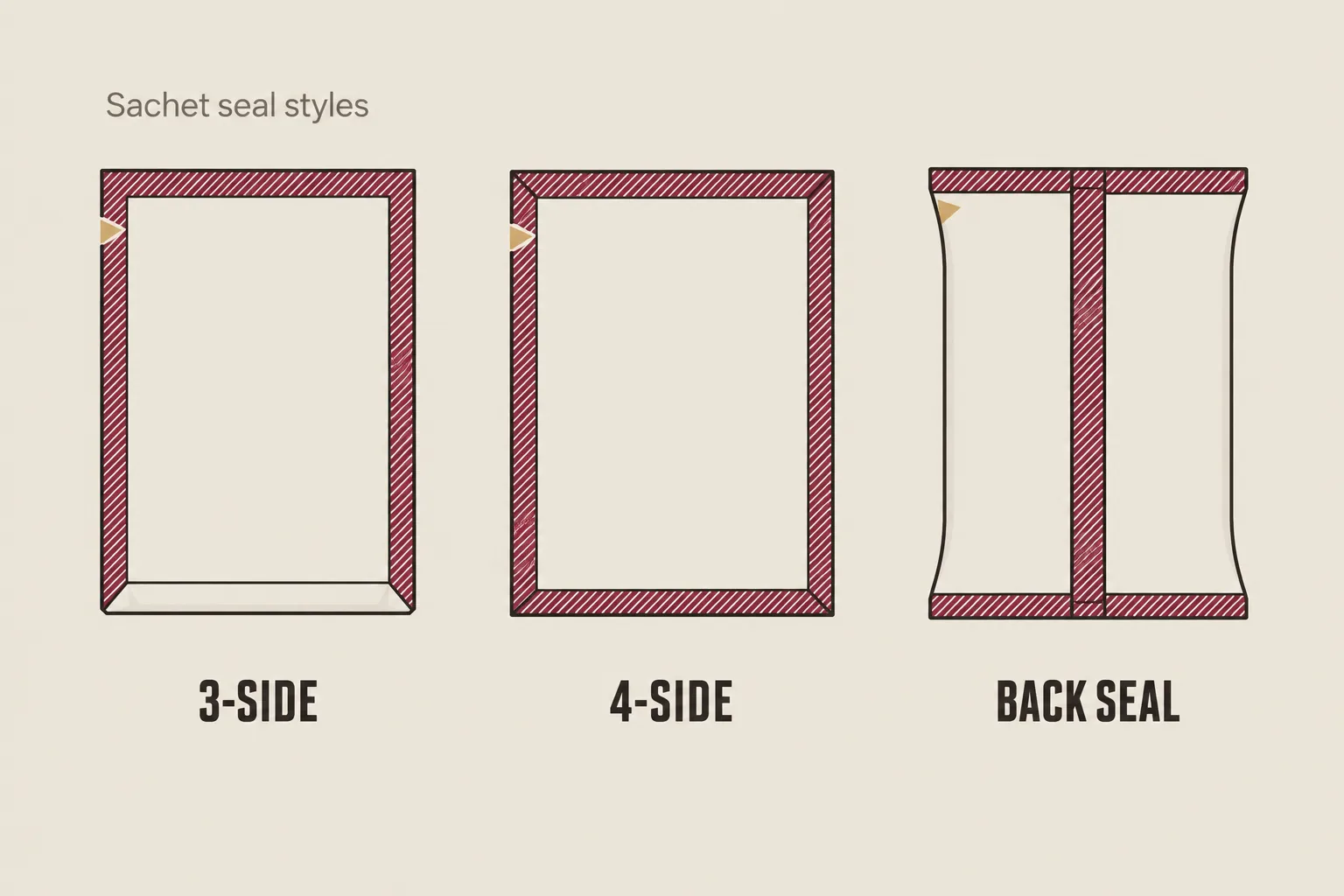
A sachet is a flat flexible pack sealed around its edges. Common constructions include three-side seals, four-side seals, back-seal formats, spouted versions, and custom or contour-cut shapes. The construction is selected according to the product, fill volume, opening method, equipment, and desired presentation.
Some sachets are made from rollstock on a form-fill-seal line; others are supplied as preformed packs for a different filling process. Confirm the format and equipment together because the same word, “sachet”, can describe more than one production setup.
Best-Fit Products for Sachets
Sachets are often selected for portioned liquids, gels, creams, sauces, dressings, oils, honey, and other fills that consumers squeeze or spread. Their wider cavity can also suit some powders and granules when the dose, opening, and emptying behaviour work better in a flat pack.
A sachet can provide a broad printable face for a small sample, condiment, meal-kit portion, or foodservice pack. It may be less convenient than a stick when a fine powder needs to be poured through a narrow bottle opening, but that depends on the tear design and the product’s flow characteristics.
Seals, Film Use and What Drives Unit Cost
A cost comparison between stick packs and sachets should account for film area and seal construction, not seal count alone. A stick pack may use less film for an equivalent fill geometry, while a sachet may be more efficient for a different dose or shape. The finished dimensions and the amount of headspace matter.
Film structure is often a major cost driver: the number of layers, total gauge, barrier materials, sealant, and required protection from moisture, oxygen, light, heat, or grease all affect the specification. A right-sized structure is more useful than assuming one format is always cheaper.
Printing also changes the comparison. Plate or cylinder charges, colour count, repeat length, artwork versions, minimum run quantities, and the number of flavours determine how setup costs are spread across units.
Total landed cost should include machine speed, changeover time, startup scrap, rejected packs, tooling, freight, warehousing, and excess or obsolete film created by forecast or SKU changes. Logistics and fulfillment requirements should be included when comparing order cadence, delivery locations, inventory programs, and case-pack quantities.
Filling Equipment and Co-Packer Fit
The equipment available to the co-packer is a major constraint, but it is not the only possible answer. Stick packs commonly run on multilane form-fill-seal equipment. Sachets may run on vertical or horizontal form-fill-seal equipment, or may be supplied preformed for a compatible filling operation. Machine availability, speed, lane count, sealing jaws, dosing method, and changeover requirements all need to be checked.
If you are evaluating a new co-packer or a different filling setup, Armour Rose’s co-manufacturer partnerships service is a relevant internal resource. The equipment conversation should happen before artwork, tooling, or a final film order is approved.
The film specification must match the line that will run it. Confirm web width, roll diameter, core size, unwind direction, registration marks, sealant compatibility, lane layout, dose-weight tolerance, tear-notch position, and the required roll direction. Some of these details change the roll or artwork specification rather than the carton die line, so ask the converting and filling teams to review the complete package.
Shelf Presence: Print Area and the Pack Around the Pack
A sachet often offers a broader uninterrupted panel, while a stick pack creates a tall, narrow branding area. The usable print area depends on the finished dimensions, seals, tear notch, registration requirements, copy, and any space reserved for a barcode or variable information.
Single-serve formats rarely stand alone in a retail program. The units may sit inside a folding carton, corrugated tray, or PDQ display, and the outer pack may do most of the shelf-facing work. Coordinate colour targets, coatings, copy, barcode placement, case pack, and carton count across the film and paperboard specifications.
Club, grocery, foodservice, and direct-to-consumer channels can require different counts and pack configurations. Those choices affect the outer carton or tray size, shipping strength, pallet utilization, and the number of units the consumer sees at once.
Sustainability and Material Trade-Offs
Using less film can reduce material per serving, but only when the finished pack still protects the product for its required shelf life. A lighter structure is not an improvement if it increases leaks, spoilage, damaged product, or waste. Compare the actual finished specifications rather than treating stick packs or sachets as automatically more sustainable.
Barrier, seal integrity, filling temperature, and local end-of-life options all matter. Multi-layer films, metallized layers, foil, coatings, and recycled-content claims can affect how a package performs and how it is handled after use. Confirm any recyclability, recycled-content, or environmental claim against the finished specification and the destination market. The Flexible Packaging Association is a useful industry resource for broader flexible-packaging context.
Before You Choose: Validate the Product and the Line
A short product and line trial can resolve questions that a comparison chart cannot. Before buying tooling or committing to a long film run, ask the filling team to review:
- fill flow, viscosity, particle size, clumping, and dose range;
- opening force, tear direction, pouring, squeezing, and how completely the pack empties;
- seal integrity, leaks, product trapped in the seal area, and performance after handling;
- machine speed, lane count, changeover time, startup scrap, and roll changes;
- barrier and shelf-life requirements, including fill temperature where relevant;
- secondary packaging, case packing, distribution handling, and the intended sales channel.
For Canadian food products, review the final label and packaging information against CFIA food-labelling guidance for industry. For U.S. food-contact materials, consult the relevant FDA food-contact-substances guidance. These references support the review; product-specific compliance decisions remain with the brand and its qualified advisors.
How to Choose: A Practical Decision Path
1. Classify the fill. Start with free-flowing powder, granule, liquid, gel, cream, or semi-solid, then note any clumping, stickiness, fibres, or particles. 2. Define the dose and the moment of use. Decide whether the consumer will pour into a bottle, stir into a drink, squeeze onto food, or use the full portion another way. 3. Confirm the co-packer’s lines. Check available equipment, lane counts, dosing method, sealing format, roll requirements, and changeover constraints before design work begins. 4. Set the shelf life target. Use the product’s sensitivity to moisture, oxygen, light, heat, or grease to guide the film structure. 5. Model the full program. Compare minimum run quantities, print setup, tooling, machine labour, scrap, freight, warehousing, and the cost of changing over flavours or SKUs. 6. Decide the secondary pack with the single-serve pack. Confirm carton, tray, display, case-pack, barcode, and pallet requirements before artwork is finalized.
As an initial screen, a free-flowing powder headed into a narrow opening often points toward a stick pack, while a liquid, gel, cream, or squeeze-use portion often points toward a sachet. That is only a starting point. Borderline products, such as clumping powders, coarse blends, or viscous fills, should be tested on the intended line before the format is finalized.
Coordinating the Format With Your Packaging Program
Armour Rose Group is a Toronto-based custom-packaging sourcing and brokerage partner for food and beverage brands across Canada and the United States. Through third-party manufacturing partners, it coordinates flexible films, pouches, folding cartons, corrugated packaging, labels, displays, and related packaging requirements. Its consultative process starts with current packaging, co-packer or equipment needs, purchase frequency, quantities, and delivery locations, then develops specification options and pricing estimates for customer review.
Armour Rose’s sourcing and brokering role can give a brand one coordination point across multiple packaging product lines while production remains with the selected manufacturing partners. The buyer should still confirm food-contact, labelling, sustainability, and other applicable compliance requirements for the finished package with the relevant suppliers and advisors.
When a brand is comparing stick packs and sachets, the review can cover the film, filling requirements, secondary packaging, delivery plan, and expected purchasing pattern together. That creates a more useful comparison than a film-only unit quote.
Comparing stick packs and sachets for a new product or reformulation? Request a packaging review with the product type, dose, co-packer line details, target volumes, and delivery locations.